
TL;DR

Get business pricing on tools and workshop supplies
- Business-only prices and quantity discounts
- Tax-exempt purchasing
- Multiple users, one account, clear invoices
Hunker describes using a razor scraper to remove paint from French door glass after painting, rather than masking every pane with painter’s tape. The method depends on scraping carefully with a sharp blade and removing the paint before it has dried for too long; the report says glass and blade condition affect the task.
Hunker has outlined a razor-scraper method for cleaning paint from French door glass: paint the muntins and frames, let stray paint dry, then scrape it from the panes rather than applying painter’s tape around each pane. The home-improvement report presents the approach as a potentially quicker alternative to masking, while warning that a dull blade or careless scraping can make the work harder and risk damaging the glass.
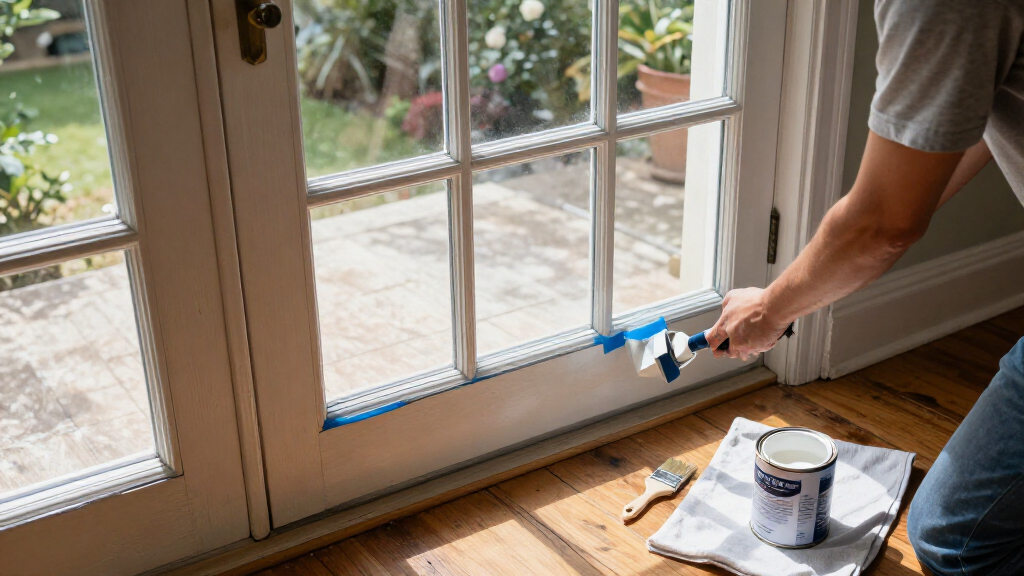
French doors often have narrow muntin bars dividing the glass into smaller panes. Painting those bars neatly can be difficult, and Hunker says brushwork alone may leave paint on the glass. Painter’s tape is a familiar way to protect the panes, but applying it takes time, and paint can seep underneath. The alternative in the report is to remove the excess after painting rather than mask every glass edge beforehand.
Hunker advises waiting until the paint has dried but not leaving it too long. The report says removal is usually easier within 24 hours, because paint becomes harder to scrape as it dries further. Its explanation is that many house paints and primers do not adhere strongly to smooth glass. The report does not specify a particular paint formula or drying conditions, so the timing may vary by product and environment.
For the scraping, Hunker recommends a sharp razor scraper held at about a 45-degree angle or shallower. The blade should be pressed against the paint, not driven into the glass. The report advises lifting an edge and pushing the blade carefully toward the point where the glass meets the muntin, then trimming away the loosened paint. Afterward, the glass can be cleaned to remove any remaining haze.
Less Masking, Careful Cleanup
The method could reduce the time spent applying and removing tape, particularly on doors with many small panes. It may also offer a simpler cleanup option for painters who find it difficult to cut in neatly around each muntin. Hunker describes it as a potentially faster and cheaper alternative to masking approaches, but provides no timed comparison or cost test. Readers should treat those advantages as the report’s assessment, not measured results.
The trade-off is that scraping shifts some of the precision work to the cleanup stage. A sharp blade and light pressure matter: Hunker cautions that a dull blade makes removal more difficult and can raise the risk of injury or glass damage. The technique is therefore not risk-free, and it may not suit every glass surface, paint, or user. Following the paint maker’s instructions and handling blades carefully remain important.
Popular right now

Ninja Crispi Glass Air Fryer (Stone) – 4‑in‑1

Hisense 85 U7 Mini-LED ULED 4K UHD Smart Google TV (85U7SG, 2026)

Dyson Ball Animal 3 Upright Vacuum
As an affiliate, we earn on qualifying purchases.
Why French Door Panes Need Cleanup
The report focuses on a common feature of French doors: multiple glass panes separated by wood or other framing. Painting the muntins can freshen the doors or change their color, but the narrow edges create many places where a brush can leave paint on the glass. Masking each edge protects the pane in advance, while the scraper approach removes marks afterward.
Hunker also mentions liquid masking products, which are applied to glass before painting and peeled or scraped away later. It says those products may damage a wood frame and notes that they still require a blade for removal. The report does not identify a specific instance of damage or compare products under controlled conditions, so this is a caution rather than a demonstrated outcome for every liquid masking product.
““Most types of house paints and primers don’t adhere well to smooth glass.””
— Hunker
Limits of the Scraper Advice
The source does not provide a controlled comparison showing how much time or money the scraper method saves over painter’s tape. It also does not test the method across different paints, glass coatings, door materials, or drying conditions. Its suggested 24-hour window is presented as general guidance, not a guaranteed deadline for every product.
Hunker does not describe whether the technique is appropriate for specialty, treated, or antique glass, or for paint that has bonded unusually strongly. Nor does it give a separate safety procedure for every door finish. Readers should check product directions and use care around both sharp blades and glass; the report’s advice should not be read as a promise that scraping will leave every pane or frame undamaged.
Check Paint Before Scraping
Anyone trying the approach should first check the paint label for drying and cleanup directions, then assess a small area before scraping a whole door. Hunker’s method calls for a sharp scraper held at a shallow angle, gentle pressure, and removal before the paint becomes too difficult to lift. After scraping, the glass can be cleaned to clear residual haze; the report cautions against cleaning windows in direct sun.
The source offers no follow-up test or product-specific update. Whether the method works well will depend on the paint, glass, and timing, so readers may need to adapt the process to their doors rather than assume the same results in every case.
Key Questions
Can I use a razor scraper instead of painter’s tape on French doors?
Hunker describes scraping stray paint from the glass after painting as an alternative to taping each pane. The report does not claim the method is suitable for every type of glass or paint.
When should I scrape the paint off?
The report advises scraping after the paint has dried but says it is usually easier within 24 hours. Actual drying time can vary, so follow the paint manufacturer’s directions.
How should the blade be held?
Hunker recommends a sharp blade at a 45-degree angle or shallower, using gentle pressure against the paint. It warns not to push the blade into the glass.
Can scraping scratch or crack the glass?
Hunker warns that careless scraping can damage glass and that a dull blade can make the task harder. The report does not establish that damage can always be avoided; use caution and check whether the method suits the glass.
Source: hunker.com