TL;DR

Get business pricing on tools and workshop supplies
- Business-only prices and quantity discounts
- Tax-exempt purchasing
- Multiple users, one account, clear invoices
Choosing hardwood is less about finding a single “best” species and more about matching the wood’s hardness, stability, appearance, workability and cost to your project’s intended use. White oak (Janka 1,360 lbf) is the strongest all-purpose pick; hard maple and cherry suit fine furniture; poplar suits painted work; teak, ipe and black locust resist rot outdoors. Test your finish on an offcut before committing the whole piece.
I once built a beautiful red oak outdoor bench. Beautiful for about eleven months. Then the open grain drank rain all winter, the finish peeled in sheets, and the leg joints swelled and checked until the thing wobbled like a bar stool with a missing foot. That bench taught me the lesson every woodworker learns eventually: the wrong species fails no matter how good the joinery.
Here’s the truth most beginners miss. Choosing hardwood is less about finding the “best” species and more about matching the wood to the project’s intended use. Hickory is a terrible cutting board and a fantastic floor. Poplar is gorgeous under paint and forgettable under clear coat. There is no universal winner — there’s only the right answer for what you’re building this weekend.
In this guide, you’ll get real Janka numbers, a species-by-project matching table, shop-tested workability notes, and the finishing traps that ruin otherwise solid work. Everything here applies to a real garage shop, not a production facility with a 10-inch slider and a 5-horsepower dust collector.
Match species to location first: indoor work (maple, cherry, walnut, white oak, poplar) versus outdoor work (white oak, teak, ipe, black locust) — red oak fail…
Use Janka hardness only where wear matters: hard maple (1,450 lbf) for floors and cutting boards, cherry (950 lbf) is fine for dining tables under normal care…
Buy 15–30% extra lumber, acclimate it until the moisture content stabilizes (typically 6–10% for indoor furniture), and never rigidly fasten wide solid panels…
Blotchy species (maple, cherry, birch) need conditioner or gel stain; walnut is best finished clear; always test the full finishing schedule on an offcut from…
Cut costs with secondary species (poplar for painted and hidden parts) and veneer over stable substrates rather than buying rare solid stock nobody will see.
How to Choose the Right Hardwood for Your Next Project
There is no universal winner. Hickory is a terrible cutting board and a fantastic floor. Poplar is gorgeous under paint and forgettable under clear coat. Choosing hardwood is about matching hardness, stability, appearance, workability and cost to what you’re actually building.
Real Janka numbers, a species-by-project matching table, shop-tested workability notes, and the finishing traps that ruin otherwise solid work — for a real garage shop.
The Janka Numbers That Matter
Janka hardness = the force (lbf) needed to embed a steel ball halfway into the wood. It matters enormously for floors, work surfaces and heavily used furniture — and almost not at all for a wall-hung cabinet door. Notice: cherry, one of America’s most prized furniture woods, is softer than both oaks.
Don’t buy hardness you don’t need. Janka does not measure stiffness, structural strength, weather resistance or stability. Very hard wood is heavier, harder on tooling, and pilot holes become mandatory or you’ll snap screws and split boards.
Indoors or Out? Answer This First
White oak and red oak can look nearly identical, but white oak’s plugged vessels (tyloses) make it substantially water-resistant — red oak’s open pores wick water so fast it rotted my outdoor bench in eleven months. Exterior durability is half design, half species: slope surfaces for drainage, ventilate undersides, and seal end grain.
| Project | Strong Candidates | Indoor | Outdoor | Main Consideration |
|---|---|---|---|---|
| Dining table | White oak, walnut, cherry, hard maple | ✓ | ✗ | Stability, dent resistance, repairability |
| Cutting board | Hard maple, walnut (closed grain) | ✓ | ✗ | Food-safe, tight grain, hardness |
| Flooring | Hickory, hard maple, white oak | ✓ | ~ | High Janka wear resistance |
| Fine furniture | Cherry, walnut, hard maple | ✓ | ✗ | Color, figure, workability |
| Painted work | Poplar | ✓ | ✗ | Economy; forgettable under clear coat |
| Outdoor furniture | White oak, teak, ipe, black locust, cedar | ✗ | ✓ | Natural decay resistance |
| Tool handles | Hickory, ash | ✓ | ✓ | Impact strength (moves with humidity) |
| Red oak anything-outside | — | ✓ | ✗ | Open pores drink water like a sponge |
Workability in the Real Garage
How a species responds to cutting, routing, sanding and fastening often decides the project’s mood more than its color does.
Cherry & Walnut
Generally pleasant to machine and glue. Cherry darkens beautifully with age and sunlight — a color payoff worth its 950 lbf softness on a well-cared-for table.
Hard Maple
Burns when routed or sawn with dull tooling. Needs pre-stain conditioner or gel stain — it blotches badly under standard oil stains.
White Oak & Hickory
White oak is hard on cutting edges; hickory is tough and demanding to machine. Dense woods need pilot holes or you’ll snap screws and split boards.
Figured Grain
Highly figured boards may tear out when planing or routing. Take lighter passes and sharpen more often — figure costs time as well as money.
Oily Tropicals
Teak and ipe need special surface preparation (solvent wipe-back) before glue or finish will hold. Don’t skip this step.
Poplar & Veneer
Cut costs with secondary species for painted and hidden parts, and veneer over stable substrates rather than buying rare solid stock nobody will see.
Why Your Boards Move — and How to Pick Wood That Moves Less
Wood is a sponge that never stops working. It expands across the grain as humidity rises and shrinks as it falls, every season, for the life of the piece. Your defense is a process, not just a species choice:
Buy Dry Lumber
Kiln-dried to roughly 6–10% moisture content for indoor furniture, depending on climate.
Acclimate
Sticker the boards in the destination space for a week or two — done when moisture stops drifting, not after X days.
Measure
Use a pin or pinless moisture meter. A $40 meter prevents $400 of cracked panels.
Design for Movement
Elongated screw slots, floating tenons, breadboard ends pinned on one side only.
Never Rigid-Fasten
Never rigidly fasten a wide solid panel across the grain — the classic self-destructing design.
“I once screwed a flatsawn cherry tabletop flat to a rigid apron. Two winters later, a crack ran clean through the middle like a fault line. The wood wasn’t defective — my design was.”
Lesson Learned · Quartersawn lumber moves ~half as much as flatsawnThe Finishing Traps That Ruin Solid Work
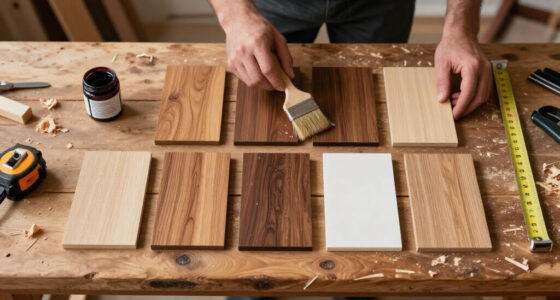
Different hardwoods absorb stains and finishes very differently. Always test the complete finishing schedule on an offcut from the actual project stock before committing the whole piece.
Blotchy Species
Maple, cherry and birch need conditioner or gel stain — standard oil stains absorb unevenly and ruin the surface.
Walnut: Finish Clear
Walnut’s rich brown is best preserved with a clear finish. Staining it hides exactly what you paid a premium for.
Oak: Stain-Friendly
Oak accepts many stains well thanks to its open grain — but open pores may need grain filler for a glass-smooth finish.
Pale Woods Yellow
Maple and ash can yellow under oil-based finishes. Choose waterborne products if you want to keep the pale look.
Sunlight Shifts Color
Sunlight darkens cherry while fading or warming other species. Rotate samples before deciding on a final schedule.
Test on an Offcut
The single most repeated rule in finishing: never commit the whole piece to an untested schedule. Offcut first, always.
Start Here: Where Will the Project Live, Indoors or Out?
Before you think about grain or color, answer one question: does the wood stay inside or face the weather? That single answer eliminates half your species list immediately. Indoor furniture and cabinetry can use maple, cherry, walnut, white oak and poplar without a second thought. Outdoor projects demand natural decay resistance or serious treatment — and few domestic species deliver it.
For outdoor work, your strong candidates are white oak, teak, ipe, black locust, genuine mahogany and cedar (yes, cedar is technically a softwood, but it earns its place). White oak works because its vessels are plugged with structures called tyloses, which block water movement through the grain. Red oak lacks that plugging — its open pores drink water like a sponge, which is why my bench rotted its way into the firewood pile.
Here’s the part people skip: exterior durability is half design, half species. Teak left with trapped water in a joint will still degrade. Slope your surfaces for drainage, ventilate the undersides, seal or shelter end grain (where wood absorbs moisture fastest), and never let a screw pocket hold a puddle. I’ve seen untreated white oak benches survive fifteen years because the builder understood water flow, and teak fail in five because he didn’t.
One more consideration: if a project straddles both worlds — a covered porch table, an entryway bench in a snowy climate — treat it as outdoor. Covered is not protected. Humidity and temperature swings will still hammer the wood.
As an affiliate, we earn on qualifying purchases.
The Janka Numbers That Actually Matter (And the Ones That Don’t)
Janka hardness measures a wood’s resistance to denting and wear, expressed in pounds-force (lbf) — the force needed to embed a steel ball halfway into the wood. It matters enormously for flooring, work surfaces and heavily used furniture, and almost not at all for a wall-hung cabinet door. Here are the numbers worth memorizing:
| Species | Janka Hardness (lbf) |
|---|---|
| Poplar | 540 |
| Cherry | 950 |
| Black walnut | 1,010 |
| Red oak | 1,290 |
| White oak | 1,360 |
| Hard maple | 1,450 |
| Hickory | 1,820 |
| Ipe | 3,510 |
Notice anything? Cherry — one of the most prized furniture woods in America — is softer than both oaks. Softer isn’t worse. Cherry dents if you drop a cast-iron skillet on it, but for a dining table treated with ordinary care, 950 lbf is plenty, and the color payoff is enormous. Meanwhile, ipe at 3,510 lbf will shrug off decades of deck traffic and simultaneously dull every blade you own.
Hardness has real costs on the shop side. Very hard wood is heavier, harder on tooling, tougher to fasten (pilot holes become mandatory or you’ll snap screws and split boards), and harder to repair when damaged. Janka does not measure stiffness, structural strength, weather resistance or stability — a common and expensive confusion. Hickory handles impacts (that’s why it’s tool handles and baseball bats) but moves a lot with humidity. Don’t buy hardness you don’t need.
As an affiliate, we earn on qualifying purchases.
Why Your Boards Move — and How to Pick Wood That Moves Less
Wood is a sponge that never stops working. It expands across the grain as humidity rises and shrinks as it falls, every season, for the life of the piece. Dimensional stability — how much a species moves and whether it tends to cup, twist or bow — separates furniture that survives a decade from furniture that cracks its first winter. Species differ meaningfully: mahogany and quartersawn white oak are notably stable, while hickory and flatsawn beech can fight you.
Your defense is a process, not just a species choice:
- Buy properly dried lumber — kiln-dried to roughly 6–10% moisture content for indoor furniture, depending on your climate.
- Acclimate it in the destination space for a week or two, stickered for airflow. Acclimation is done when the moisture content stops drifting, not after an arbitrary number of days.
- Measure moisture content with a pin or pinless meter when practical. A $40 meter prevents $400 of cracked panels.
- Design for movement: elongated screw slots, floating tenons, breadboard ends pinned only on one side.
- Never rigidly fasten a wide solid-wood panel across the grain. That’s the classic self-destructing design.
Grain orientation matters as much as species. Quartersawn lumber moves roughly half as much across its width as flatsawn and shows straighter, tighter grain — which is why quartersawn white oak defined Arts and Crafts furniture and why it costs more. Kiln-dried also doesn’t mean “done moving.” The wood’s moisture content keeps adjusting to whatever room it lands in forever; finish only slows the exchange. I learned this the hard way with a flatsawn cherry tabletop screwed flat to a rigid apron. Two winters later, a crack ran clean through the middle like a fault line. The wood wasn’t defective — my design was.
As an affiliate, we earn on qualifying purchases.
Match the Species to the Build: A Project-by-Project Cheat Sheet
How to choose hardwood for a specific build comes down to a short checklist: expected wear, movement, appearance, food contact or not, and budget. This table pairs common projects with species that consistently perform — and tells you what tradeoff each choice carries.
| Project | Strong Candidates | Main Considerations |
|---|---|---|
| Dining table | White oak, walnut, cherry, hard maple | Stability, dent resistance, repairability |
| Kitchen cabinets | Maple, cherry, white oak, walnut | Finish consistency, appearance, cost |
| Painted cabinets | Poplar, soft maple | Smooth surface, economical price |
| Flooring | White oak, red oak, maple, hickory | Hardness, movement, refinishing depth |
| Cutting board | Hard maple, cherry, walnut | Closed grain, food-safe glues and finishes |
| Outdoor furniture | Teak, white oak, ipe, black locust | Decay resistance, movement, maintenance |
| Carving | Basswood, butternut, mahogany | Fine grain, low hardness, predictable cutting |
| Turning | Maple, cherry, walnut | Grain, moisture, tool response |
| Children’s furniture | Maple, beech, white oak | Strength, rounded edges, safe finish |
| Shelving | Oak, maple, walnut | Stiffness, span, load, board thickness |
Read the table with a critical eye. A cutting board needs closed grain — hard maple at 1,450 lbf with tight pores won’t harbor bacteria the way open-grained red oak will. Never use pressure-treated lumber, toxic species, or unidentified reclaimed wood near food. Shelving is a stiffness problem, not a hardness problem: a 3/4-inch oak shelf spanning 36 inches will sag under books. Either drop to a 30-inch span, go to 8/4 stock, or add a lipped edge.
And for painted projects, stop buying pretty wood. Poplar at a fraction of the cost of cherry, with a fine surface that takes paint beautifully, is the smart play. Spending premium money on lumber nobody will ever see is the classic beginner tax. Save the walnut budget for pieces where the wood is the whole point.
As an affiliate, we earn on qualifying purchases.
How Each Species Behaves at the Saw and Under Finish
Workability and finishing response can make or break your project experience — and they vary wildly between species that look similar on the rack. Cherry and walnut machine beautifully: clean cuts, predictable routing, easy sanding. They’re the woods I hand beginners who want results without a fight. Hard maple, though, burns if you route or rip it with dull tooling — a fresh, sharp blade is non-negotiable, and even then feed steadily.
White oak is genuinely hard on cutting edges; plan on more sharpening cycles. Hickory is just plain demanding. Highly figured grain — curly maple, for instance — will tear out unless you take light passes with sharp, high-angle or spiral cutterhead tooling. Oily tropical woods like teak often need a wipe with acetone before gluing or the joint fails. And dense species need pilot holes for every screw, or you’ll snap fasteners and split workpieces.
Finishing is where the traps multiply. Maple, cherry and birch blotch badly when stained because their grain absorbs stain unevenly — use a pre-stain conditioner or a gel stain, or skip stain entirely. Oak takes almost any stain well thanks to that open grain, though open-pored woods need grain filler if you want a glass-smooth surface. Walnut is usually finished clear, because stain just mutes the color you paid a premium for.
Two more gotchas: pale woods like maple yellow noticeably under oil-based finishes, so test waterborne options if you want to keep it bright. And cherry darkens dramatically with age and light exposure — that fresh-milled pale pink board will be deep reddish-brown in two years. Always test your entire finishing schedule on an offcut from the actual project stock, not on a scrap of something else. Species, board, and even board-to-board color variation will surprise you.
Buying Smart: Board Feet, Grades, Budget and Sustainability
Lumber pricing is volume-based: board feet = thickness in inches × width in inches × length in feet ÷ 12. A 4/4 board 6 inches wide and 8 feet long is 4 board feet. Once you can run that math in your head, the lumberyard stops being intimidating. Remember that dimensions are nominal — a “4/4” board typically surfaces down to 13/16 inch or less, so order 5/4 when your finished part needs a full 3/4 inch plus planing room.
Budget with a waste allowance. Buy 15–30% more than your cut list calls for — more if the project has curved parts, defects to work around, or grain matching across panels. Figured wood and wide, long, clear, quartersawn boards all carry premiums; that’s normal market behavior, not a dealer gouging you.
Two honest budget strategies from a garage-shop perspective. First, use cheaper secondary species for hidden parts: poplar drawer sides and pine cabinet backs are what pro furniture makers do, not a compromise. Second, veneer over a stable substrate gives you the look of rare crotch walnut without the cost, weight or movement of thick solid stock. Neither solid nor veneer is “better” — solid wood offers depth and repairability; veneer offers efficiency and stability.
On sourcing: look for FSC or PEFC chain-of-custody certification, documented legal origin, reclaimed material, or locally cut lumber. Be skeptical of vaguely labeled tropical hardwoods — “mahogany” can cover several unrelated species. Ask for the scientific name and country of origin. And at the yard, physically inspect boards for moisture content, twist, cup, checks, knots, sapwood and color consistency. Photos in an online inventory help, but boards within a species vary enormously. Reclaimed wood is a fantastic resource — if you metal-detect it first. A buried nail meeting a planer blade is a $90 lesson.
Finally, safety: wood dust irritates lungs, skin and eyes, and some species trigger real allergic reactions. Run real dust extraction (even a shop-vac-based cyclone beats nothing), wear a respirator and eye protection, and look up species-specific risks before sanding anything exotic you haven’t worked before.
Frequently Asked Questions
What is the best all-purpose hardwood?
White oak is the strongest all-purpose choice — 1,360 lbf Janka, naturally decay-resistant thanks to tyloses, attractive, and widely available. It works for furniture, cabinetry, flooring and even sheltered outdoor use. Hard maple is the better pick when you want a pale, smooth, modern surface instead of prominent grain.
Which hardwood is easiest for beginners?
Poplar, cherry and walnut. Poplar is cheap, forgiving, and perfect for painted projects where mistakes hide under color. Cherry and walnut machine cleanly with ordinary tooling and finish beautifully, though they cost more. Avoid hard maple and hickory until your blades are sharp and your technique is dialed in — maple burns and hickory fights back.
Is harder wood always better?
No. Extremely hard wood resists wear but is heavier, harder on blades, tougher to screw and sand, and harder to repair. A 3,510 lbf ipe dining table is overkill that will dull your tooling; a 950 lbf cherry table serves a careful family for generations. Choose hardness based on expected wear, not bragging rights.
How dry should hardwood be, and how long should it acclimate?
Indoor furniture lumber is typically used at 6–10% moisture content depending on local climate; exterior wood equilibrates higher. Acclimation has no fixed day count — it’s finished when the moisture content stabilizes at a level appropriate for the destination environment. A moisture meter turns guesswork into measurement; even a cheap one pays for itself on the first avoided crack.
What do 4/4, 5/4 and 8/4 mean, and how much extra should I buy?
Those are rough thickness designations in quarters of an inch: 4/4 is about one inch thick before surfacing, 8/4 about two inches. After drying and planing, a 4/4 board usually finishes around 13/16 inch or less. Buy 15–30% more than your cut list requires — more for curved parts, defects, grain matching or figured material.
Should I stain my hardwood?
Staining is optional and sometimes harmful. It can unify mismatched lumber or shift color, but it can also obscure natural character or blotch badly on maple, cherry and birch. Many premium hardwoods — walnut especially — look best under a clear finish that lets the wood’s own color do the work. If you do stain, test the complete schedule on an offcut first.
Can I mix different hardwood species in one project?
Yes, if the contrast is deliberate. Pairing walnut with pale maple reads as a design choice; two nearly-matching species that differ slightly in color and grain usually look accidental. Account for differences in movement rates, hardness and finishing response — and finish test both species together, because they may amber at different rates under the same oil.
Conclusion
Here’s the whole thing in one sentence: stop asking “what’s the best hardwood?” and start asking “what does this specific project need to survive?” Hardness for wear, stability for panels, closed grain for food contact, decay resistance for weather, workability for your tooling, and a budget that doesn’t blow out on wood nobody sees. Match those six answers to a species and the choice makes itself.
Before you buy a single board, sketch the project, write down where it lives and how it gets used, and pull up the Janka and movement numbers. Then go to the yard, put your hands on the actual lumber, and pick the boards — not the species name on the label. The wood tells you more in ten seconds of inspection than any catalog ever will. Your future self, sitting at a crack-free table twenty winters from now, will thank you.
Fall Picks
fall essentials
As an affiliate, we earn on qualifying purchases.