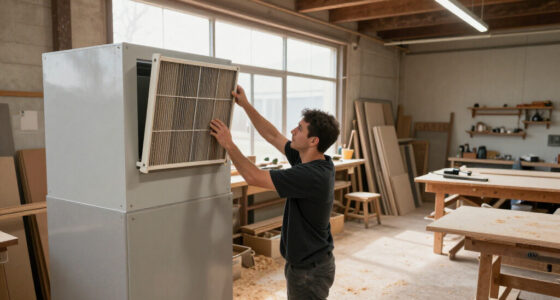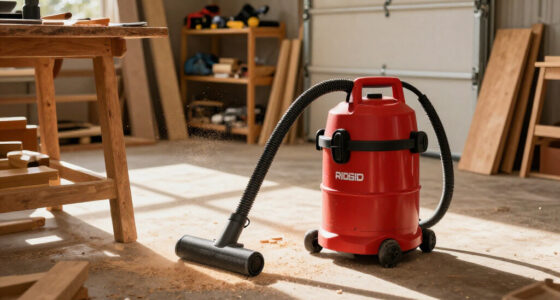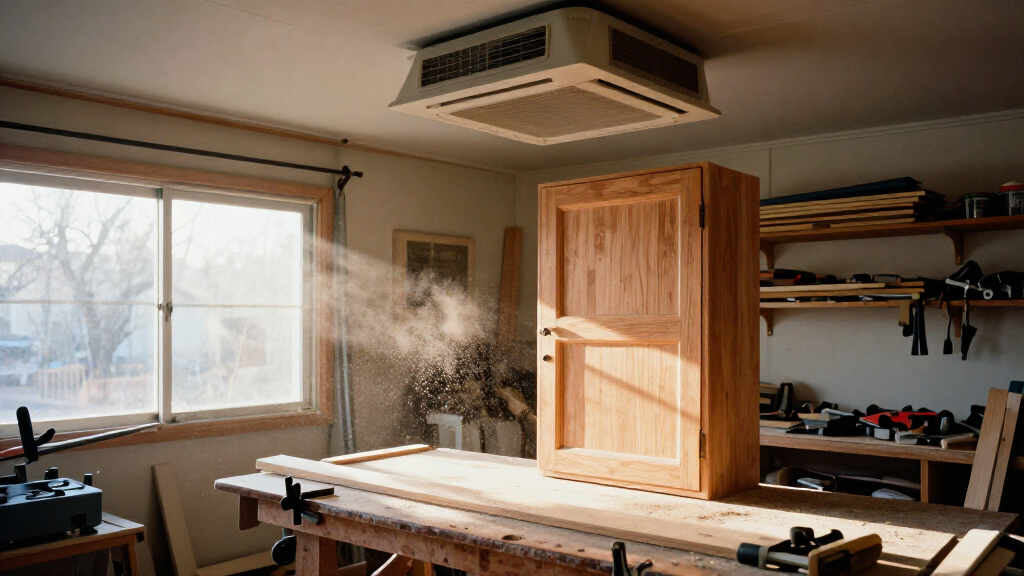

Choose, install, and check a shop air filtration system so it captures airborne particles produced by woodworking, sanding, or similar shop tasks. This guide is for shop owners and DIYers with basic measuring and tool skills. Plan on 2–4 hours for a straightforward ceiling-mounted unit; ducted systems or new electrical work take longer. A room air cleaner helps control suspended dust, but it does not replace source capture at a machine or suitable respiratory protection.

Get business pricing on tools and workshop supplies
- Business-only prices and quantity discounts
- Tax-exempt purchasing
- Multiple users, one account, clear invoices

WEN 3417 3-Speed Remote-Controlled Industrial-Strength Air Filtration System (556/702/1044 CFM)
- ✔ Airflow: 556 / 702 / 1,044 CFM
- ✔ Stated room coverage: Up to 1,000 sq ft
- ✔ Filtration: 5-micron pre-filter and 1-micron inner filter

DEWALT Air Filtration System Dust Collector for Woodworking DWXAF101
- ✔ Filtration: Static cotton pre-filter and H11 HEPA filter
- ✔ Particle capture claim: Over 95% of 0.3-micron particles
- ✔ Modes: HI, MID, LO, and AUTO
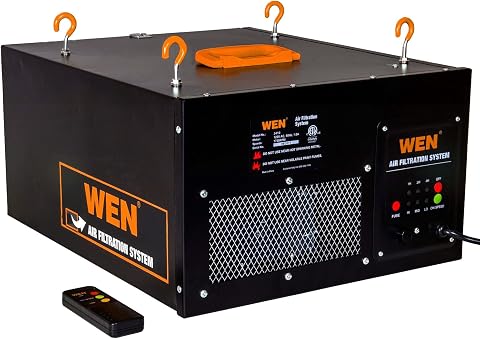
WEN 3410 3-Speed Remote-Controlled Air Filtration System (300/350/400 CFM)
- ✔ Airflow: 300 / 350 / 400 CFM
- ✔ Stated room coverage: Up to 400 sq ft
- ✔ Filtration: 5-micron pre-filter and 1-micron inner filter
Difficulty: Intermediate | Time: 2–4 hours for planning and installation; allow extra time for electrical work or ducting
What You’ll Need
Tools & Materials:
- Tape measure
- Pencil and paper or a phone for recording room dimensions
- Stud finder
- Ladder rated for the installation height
- Drill and fasteners specified by the unit manufacturer
- Eye protection and a dust mask or respirator for dusty work
Knowledge:
- Basic room measurement
- Ability to locate ceiling joists or other structural supports
- Ability to follow the unit’s electrical and mounting instructions
Read the system manual before buying or mounting it. Check the unit’s weight, required clearances, voltage, filter replacement details, and mounting method. If the unit needs a new circuit, hardwiring, or duct changes, have a qualified professional handle that work.
WEN 3417 3-Speed Remote-Controlled Industrial-Strength Air Filtration System (556/702/1044 CFM)
For a larger woodworking area, the WEN 3417’s 1,044 CFM top setting is the clearest reason to put it first. Its three speeds—556, 702, and 1,044 CFM—give us some flexibility: run a lower setting for routine circulation or step up when the shop has more airborne dust to clear. WEN lists coverage up to 1,000 square feet, well beyond the 400-square-foot rating of the smaller WEN 3410.Both WEN models use a 5-micron pre-filter and 1-micron inner filter, with replacements available. The 3417’s advantage is capacity, not a more refined filter specification. Buyers focused on finer-particle filtration may prefer the DEWALT, whose supplied specifications identify an H11 HEPA filter and capture claim for 0.3-micron particles. We do not have a stated airflow figure for the DEWALT, so we cannot make a direct capacity comparison.The larger WEN also asks for more room and tolerance for noise: it weighs 55 pounds, measures 30.3 by 24 by 12.2 inches, and is rated at 63–68 dB. That is a meaningful step up from the 31-pound WEN 3410, rated at 50–60 dB. The 3417 includes chains and eyebolts, an RF remote rated to work from up to 26 feet, and a programmable shutoff timer. It makes most sense when room coverage and airflow take priority; for a smaller shop or quieter operating environment, the 3410 is the more proportionate choice.
Pros:
- Three airflow settings up to 1,044 CFM
- Rated for rooms up to 1,000 square feet
- Remote control and programmable shutoff timer
- Replaceable 5-micron pre-filter and 1-micron inner filter
Cons:
- Larger and heavier than the other listed options at 55 pounds
- Stated noise range of 63–68 dB is higher than the WEN 3410’s
- Does not have the supplied HEPA filtration specification listed for the DEWALT
Best for: Woodworkers with a larger shop who want the highest stated airflow and room coverage among these three systems.
Not ideal for: Buyers with a compact workspace, a strong preference for lower stated noise, or a priority for a specified HEPA filtration level.
Bottom line: We rank the WEN 3417 first for larger shops because its 1,044 CFM top setting and 1,000-square-foot coverage lead this lineup.
“We rank the WEN 3417 first for larger shops because its 1,044 CFM top setting and 1,000-square-foot coverage lead this lineup.”
DEWALT Air Filtration System Dust Collector for Woodworking DWXAF101
The DEWALT DWXAF101 is the distinct choice when the filter specification is the main comparison point. It combines a static cotton pre-filter with an H11 HEPA filter, and the product information claims capture of over 95% of 0.3-micron particles. Neither WEN model in this lineup is described with that same HEPA specification. That gives us a clearer filtration claim to compare, although it does not make the unit a substitute for dust collection at the tool or establish performance beyond the stated claim.Convenience is another point of difference. DEWALT lists HI, MID, LO, and AUTO modes; the automatic mode senses air quality and adjusts speed, according to the supplied description. It also has 1-, 2-, 4-, and 8-hour timer settings, a filter replacement indicator, and a washable pre-filter. Compared with the WEN systems, which offer three manual speed settings and replaceable pre-filters, these features may make routine operation and upkeep easier for buyers who want more feedback from the unit.There is a notable information gap for capacity: the supplied DEWALT details do not state CFM or room coverage. Its 20.9-pound weight and 10.2 by 15.9 by 20-inch dimensions make it the lightest listed system, and it hangs with included hooks and chains. The stated noise level is 64 dB, while both WEN models provide ranges. We would choose this unit for its documented HEPA filtration and automatic controls, but choose the WEN 3417 when a clear, high airflow figure and large stated coverage matter more.
Pros:
- H11 HEPA filter with stated capture of over 95% of 0.3-micron particles
- Four modes, including automatic air-quality sensing
- Washable pre-filter and filter replacement indicator
- Lightest listed unit at 20.9 pounds, with hooks and chains for hanging
Cons:
- Supplied product details do not state airflow or room coverage
- Stated noise level is 64 dB, with no range provided
- The supplied details do not describe its airflow capacity against either WEN model
Best for: Woodworkers who prioritize a specified H11 HEPA filter, automatic speed mode, and a washable pre-filter.
Not ideal for: Buyers who need a stated CFM rating or room-coverage figure to size a system for their shop.
Bottom line: We recommend the DWXAF101 when its stated HEPA filtration and automatic mode matter more than having a published CFM and coverage rating.
“We recommend the DWXAF101 when its stated HEPA filtration and automatic mode matter more than having a published CFM and coverage rating.”
WEN 3410 3-Speed Remote-Controlled Air Filtration System (300/350/400 CFM)
In a smaller workshop, the WEN 3410’s modest scale can be a better match than the 3417’s much higher capacity. It offers 300, 350, and 400 CFM settings and is rated for rooms up to 400 square feet. That makes it a fit for a compact garage or dedicated work area where a 1,000-square-foot rating may be unnecessary. Its 31-pound weight is also 24 pounds less than the larger WEN, which can make installation and repositioning more manageable.Its filtration approach is familiar from the 3417: a 5-micron outer pre-filter and a 1-micron inner filter. Buyers who want the lineup’s stated H11 HEPA filtration should look instead at the DEWALT, which also has automatic mode and a filter indicator. The 3410 keeps the controls simpler: three fan speeds, an RF remote that works from up to 26 feet, and a programmable timer. Those basics are useful for overhead placement, where reaching the unit to switch it off would be inconvenient.The tradeoff is straightforward: less airflow and smaller stated coverage than the 3417, without DEWALT’s HEPA filtration claim or automatic sensing. In return, the WEN 3410 has the lowest stated noise range here at 50–60 dB and a smaller 17 by 20.5 by 10-inch body. It is the most balanced fit for a buyer who needs straightforward ceiling-mounted circulation in a smaller shop. We would skip it for a large open workshop where its 400 CFM maximum may not suit the coverage need.
Pros:
- Three airflow settings for up to 400 CFM
- Rated for rooms up to 400 square feet
- Lowest stated noise range in this lineup at 50–60 dB
- RF remote and programmable shutoff timer
Cons:
- Much lower maximum airflow and coverage than the WEN 3417
- Uses a 1-micron inner filter rather than the DEWALT’s specified H11 HEPA filter
- Does not list automatic air-quality sensing or a filter replacement indicator
Best for: Woodworkers with a smaller shop, up to the stated 400-square-foot coverage, who want remote operation and a timer.
Not ideal for: Owners of large shops seeking the highest airflow, or buyers who specifically want the DEWALT’s H11 HEPA filtration claim and automatic mode.
Bottom line: We choose the WEN 3410 for smaller shops where its 400 CFM ceiling, lighter build, and lower stated noise range suit the space.
“We choose the WEN 3410 for smaller shops where its 400 CFM ceiling, lighter build, and lower stated noise range suit the space.”
As an Amazon Associate we earn from qualifying purchases.
Before You Start
List the tasks that create dust and identify where they happen. Use machine-level dust collection or local exhaust to capture dust at the source; a room filtration unit is supplemental cleanup for particles that remain airborne. Do not rely on a filter rating alone to judge performance: airflow, room layout, filter condition, and the type of dust all matter. Keep the unit away from sparks, hot work, and locations where its intake could draw in flammable vapors. Follow the manufacturer’s safety and clearance requirements.
Step-by-Step Instructions
Step 1: Measure the shop
Measure the room’s length, width, and ceiling height. Multiply the measurements to estimate room volume in cubic feet. Note partitions, tall storage, machinery, and areas where dust-producing tasks take place; these can disrupt airflow and create poorly served zones.
Tip:For an irregular room, calculate each rectangular section separately and add the volumes.
Check: You have a room-volume estimate and a simple sketch showing major obstructions and work areas.
Step 2: Set an airflow target
Use the manufacturer’s guidance to select an airflow rate for your room volume and intended use. Compare the unit’s published airflow at the filter condition you expect to use, not just a maximum figure that may apply without filters or restrictions. If the maker provides air changes per hour, calculate the target airflow by multiplying room volume by the recommended air changes per hour, then divide by 60 to get cubic feet per minute.
Tip:For example, a 2,400-cubic-foot room at 6 air changes per hour calls for 240 cubic feet per minute. Treat this as a planning estimate; room shape and placement affect actual circulation.
Check: You have a target airflow in cubic feet per minute and a unit whose documented filtered airflow meets that target or the manufacturer’s recommendation.
Step 3: Choose the system and filters
Pick a unit rated for your shop size and the particles you need to control. Check the filter stages, replacement part availability, and the manufacturer’s stated particle performance. Confirm that the system is intended for the dust or fumes in your shop. Standard particulate filters do not remove every gas, vapor, or hazardous contaminant; use task-specific extraction and controls for those exposures.
Tip:Compare filter replacement cost and availability as well as the initial price. A system is less useful if its filters are difficult to source or routinely left overdue.
Check: The unit’s instructions describe suitable applications, airflow, filter types, and a clear replacement process for your needs.
Step 4: Choose a safe location
Place the unit where its intake can draw air from the dusty work area and its outlet can circulate air across the room. Avoid placing it directly above a machine if the manufacturer prohibits that position or if the airflow could spread dust toward people or clean areas. Keep required clearance around the intake, outlet, filters, lights, doors, and sprinkler heads. Plan access for filter changes and cleaning.
Tip:In a long shop, a central location may circulate air more evenly. If walls or equipment divide the room, one unit may not serve every zone well.
Check: Your sketch shows the planned location, airflow path, clearances, and room to reach the filters.
Step 5: Inspect the mounting surface
Use a stud finder and careful inspection to locate the ceiling joists or other structural supports. Compare their position with the unit’s mounting points and the manual’s load requirements. Do not fasten a heavy unit to drywall alone. If the supplied brackets do not line up with supports, use a mounting method approved by the manufacturer and appropriate for the structure.
Tip:Ceiling-mounted equipment can fall if attached to an inadequate surface. Ask a qualified installer to assess uncertain framing or unusually heavy equipment.
Check: You have marked structural support locations that align with an approved mounting plan.
Step 6: Mount the unit
Disconnect power before handling the unit. With another person helping if needed, install the brackets or hangers using the specified hardware and support points. Tighten fasteners as directed, then check that the unit is level, stable, and clear of nearby objects. Do not improvise chains, hooks, or fasteners that are not rated for the load.
Tip:Follow the manual’s orientation instructions. Some models require a specific direction for the intake, outlet, or filter access.
Check: The unit is firmly supported, does not wobble when gently checked, and meets the listed clearances.
Step 7: Install the filters and connect power
Fit each filter in the direction shown by its airflow arrows or labels. Close filter doors and latches fully, then connect the unit to a suitable outlet or completed circuit as specified in the manual. Keep cords clear of walkways and moving equipment. Do not use an extension cord unless the manufacturer explicitly permits one and provides the required rating.
Tip:Check that protective packaging has been removed from every filter before closing the unit.
Check: Filters sit flat in their frames, access panels are closed, and the power connection matches the unit’s specifications.
Step 8: Run and check airflow
Start the unit and select the manufacturer-recommended setting for normal operation. Listen for unusual rattling, feel for airflow at the outlet without reaching into the unit, and check that the intake and outlet are not blocked. If the unit has a timer or remote control, test it while standing in a safe position. Reposition the unit only after switching it off and disconnecting power.
Tip:A piece of lightweight tissue held near the intake can show whether air is being drawn in. Keep it outside the grille and do not let it enter the unit.
Check: The unit runs steadily, air moves through the outlet, no panels or filters leak dust visibly, and there is no abnormal noise or smell.
Step 9: Set a routine for use and maintenance
Use the filtration system during dust-producing work and for the additional run time recommended by the manufacturer. Record the installation date and filter changes. Inspect filters and grilles at the intervals in the manual, or sooner if airflow drops or a filter indicator signals replacement. Switch off and disconnect power before opening the housing; handle used filters according to their labels and local disposal guidance.
Tip:Do not clean or reuse a disposable filter unless its maker says it is washable or serviceable.
Check: You know when the unit should run, how to check filter condition, and which replacement filters it takes.
Common Mistakes to Avoid
- Buying a unit based only on room floor area or its advertised maximum airflow. — Calculate room volume and compare it with filtered airflow and the manufacturer’s recommendations.
- Treating room filtration as a substitute for dust collection at a machine. — Capture dust at the source and use room filtration to reduce particles left in the air.
- Mounting the unit to drywall or unverified supports. — Fasten it to suitable structural supports using the approved mounting method and hardware.
- Blocking the intake or outlet with shelves, walls, or equipment. — Preserve the listed clearances and check the air path after the shop layout is in place.
Troubleshooting
Problem: Airflow seems weak after installation.
Solution: Switch off and disconnect the unit. Check that filters are installed in the correct direction, packaging is removed, access panels are shut, and grilles are clear. Replace a loaded filter if the manual calls for it. If airflow remains weak, check the model’s setup guidance or contact the manufacturer.
Problem: The unit vibrates or rattles.
Solution: Turn it off and disconnect power. Check that mounting fasteners and panels are secure and that filters are seated correctly. Do not keep operating a loose or unstable ceiling-mounted unit; correct the mounting problem before restarting.
Problem: Dust still settles on surfaces.
Solution: Check that source collection is operating, filters are in good condition, and the unit circulates air through the work zone. Move obstructions or adjust placement only within manufacturer limits. Fine dust can remain airborne or settle despite room filtration, so continue cleaning with methods suited to the dust and avoid dry sweeping.
What Success Looks Like
The finished installation is securely mounted to suitable supports, has clear intake and outlet paths, and runs steadily at the selected setting. The filter stages match the unit instructions, the air movement reaches the shop’s work area, and a maintenance schedule is in place. During work, use source capture and task-appropriate protective measures; do not judge performance solely by whether dust is visible.
Next Steps
After the first few work sessions, inspect the filters and airflow, then adjust the run time or placement if the manual allows and dust remains suspended in the work area. Keep a record of filter changes and clean the shop with a suitable vacuum rather than dry sweeping. Reassess the system if you add machinery, change the room layout, or begin tasks that produce different dust or fumes.
Frequently Asked Questions
Can a shop air filtration unit replace dust collection at my tools?
No. Room filtration handles airborne particles that remain after work begins; connect tools to suitable source collection or local exhaust wherever possible.
How do I estimate the airflow I need?
Measure the room volume and use the system maker’s guidance. If it specifies air changes per hour, multiply room volume by that rate and divide by 60 for a cubic-feet-per-minute estimate.
Where should I mount the unit?
Choose a position that lets air circulate through the dusty work area while preserving the manufacturer’s clearances and safe access for filter changes. Avoid locations where the airflow spreads dust toward people or clean areas.
How often should I replace the filters?
Follow the manual and any filter indicator. Check sooner if airflow drops, the filter looks loaded, or dusty conditions are heavier than expected. Do not wash a disposable filter unless its maker permits it.
Will a particulate filter remove fumes or vapors?
Not necessarily. Particulate filters capture particles; control gases and vapors with equipment specifically rated for those contaminants and suitable ventilation. Consult product instructions and qualified safety guidance for hazardous materials.