
TL;DR

Get business pricing on tools and workshop supplies
- Business-only prices and quantity discounts
- Tax-exempt purchasing
- Multiple users, one account, clear invoices
A House Beautiful report presents seven paint strategies designers say can make small rooms feel more spacious, including painting walls and ceilings in one color, choosing shades by their undertones and light, and using darker colors to blur edges. These are design recommendations about visual perception, not guarantees that a room’s physical dimensions will change.
House Beautiful has published seven designer-recommended paint techniques intended to make small rooms feel more spacious, including extending a wall color onto the ceiling, color-drenching a room and testing paint in the room’s natural light. The advice, attributed to interior designers Joe Waroquier, Amber Guyton and Jewel Marlowe, concerns visual perception; it does not change a room’s actual dimensions, and the effect will depend on the space and its lighting.
The recommendations range from restrained use of color to painting nearly every visible surface. For a lower-commitment option, Guyton recommends an accent wall, which she says can add color and visually elongate a room. She also describes painting only the lower portion of a wall, stopping around four to six feet high—roughly chair-rail height—or pairing the paint with wainscoting. Guyton said she used this approach in a living room with 18-foot ceilings rather than commit to painting the full wall.
For a more unified treatment, Marlowe recommends applying one color to the walls, trim, doors and ceiling. She says the approach can blur the points where architectural surfaces meet, making it harder for the eye to distinguish the room’s boundaries. Marlowe says it can work with light shades or saturated colors such as deep green, blue or burgundy. For added contrast within that scheme, she suggests a wipeable matte finish on walls and a high-gloss finish on trim and cabinetry.
Waroquier advises choosing paint based on undertones and the room’s natural light, rather than judging a shade only by whether it is light or dark. He recommends testing several large swatches in the room and looking at them at different times of day before deciding. The other suggestions include carrying wall paint onto the ceiling or choosing a slightly lighter or darker ceiling shade, as well as considering deep, saturated hues, which Waroquier says can soften the visual prominence of corners and edges.
How Paint Changes a Room’s Perceived Size
Paint is a comparatively direct way to change the visual character of a room without altering its footprint. The designers’ suggestions focus on how color and finish can guide the eye: a continuous shade may make boundaries less obvious, while a ceiling treatment can soften the division between wall and overhead surface. For renters or homeowners who cannot make structural changes, those approaches offer design options that do not require moving walls.
The advice is not a promise that every method will make every small room feel larger. Color choices can read differently depending on daylight, artificial lighting, existing finishes and personal preference. In particular, the report presents dark paint as a possible way to create depth and a cocooning effect—not as a universal substitute for light colors. Testing samples in the actual room helps readers judge the likely result before committing.
Popular right now

Shark Rocket Corded Stick Vacuum (HV301) – Gray/Orange

Vitamix Propel Series 510 Professional-Grade Blender, 3 Programs, Black

Ninja Foodi 10-Qt DualZone Smart XL Air Fryer, 6-in-1, DZ550
As an affiliate, we earn on qualifying purchases.
Seven Approaches in the Report
The House Beautiful report groups its advice into seven techniques: paint an accent wall; color-drench the room; pay attention to undertones; paint the ceiling; divide the wall with a partial-height paint treatment; consider dark hues; and let natural light guide the color choice. The approaches are not all intended to create the same mood. Some aim for continuity and less visible architectural separation, while others add contrast or a deliberate focal point.
The designers also qualify their recommendations through specific examples. Guyton describes using partial-height paint to avoid covering a tall living room’s full wall. Marlowe’s color-drenching suggestion covers several surfaces, while Waroquier emphasizes sampling colors under the room’s changing light. Together, these details frame the list as a set of options to adapt to a particular space, rather than a single formula.
““Paint is a great way to make a small room feel larger because it changes the visual perception of the space.””
— Joe Waroquier, founder and principal designer of Joe Waroquier Home
Results Depend on the Room
The report does not provide controlled measurements, product testing or evidence that compares how much larger each technique makes a room appear. Its claims are designers’ advice and professional judgments, not quantified results. It also does not identify a particular paint brand, shade, finish specification or room orientation that would make one approach more effective than another.
There is no single recommendation in the report for all small rooms. A shade’s appearance can change with daylight and other lighting, while the same color treatment may feel expansive to one person and too intense to another. The source advises testing samples but does not set a standard sample size or prescribe how long to test them.
Test Colors Before Painting
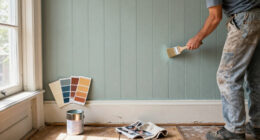
For readers considering one of the techniques, the designers’ practical next step is to test multiple large paint swatches in the room and observe them under different lighting conditions through the day. That can help show whether a shade’s undertones suit the space and whether it works with the existing light. Readers can then decide whether to try a limited treatment, such as an accent wall or partial-height paint, or a more extensive scheme that includes trim and ceiling.
The source does not announce a follow-up study, product launch or scheduled next development. The recommendations remain general design guidance; the result for any particular room will depend on its light, surfaces and the color selected.
Key Questions
What is the news in this report?
House Beautiful published seven paint techniques that interior designers say can make small rooms feel more spacious. The article is a design-advice report, not an announcement of a new paint product or a scientific test.
Does paint actually make a room larger?
No. The report describes ways paint may change the room’s visual perception. It does not claim that paint changes the room’s physical dimensions or provide measurements of the effect.
Which paint approach involves using one color throughout?
Color-drenching means applying one color across surfaces such as the walls, trim, doors and ceiling. Designer Jewel Marlowe says this can blur the visual boundaries between them.
Should small rooms always be painted a light color?
The designers do not give that as a universal rule. Waroquier says dark, saturated shades may blur corners and add visual depth, while also advising people to account for undertones and natural light.
How should I test a paint color in a small room?
Waroquier recommends trying several large swatches in the room and checking how they look at different times of day before choosing a shade. The report does not prescribe a specific brand or testing period.
Source: housebeautiful.com