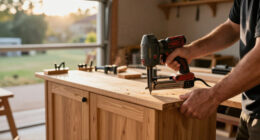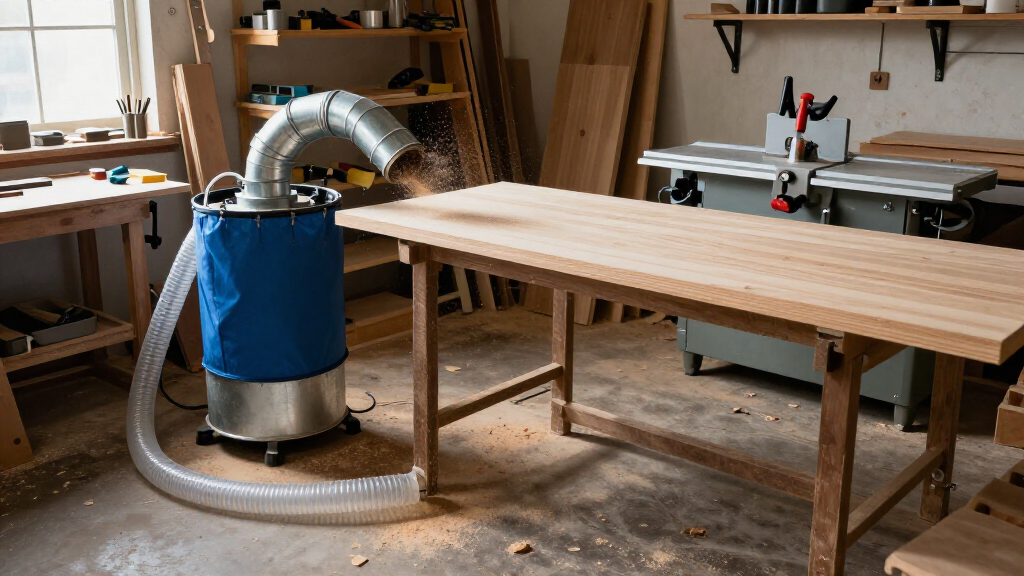

For a small woodshop, the WEN DC1300 is my best overall pick for its high stated airflow and large collection bag, while the VEVOR 1.5 HP Vortex Cone suits shops needing a stronger central collector and the WEN 3410 offers a simpler way to filter airborne dust. The main tradeoff is choosing between a collector connected to a machine and an air-filtration unit that cleans the room’s ambient air: they address different dust problems. Capacity, duct layout, floor space, filtration, and noise all affect how well a system fits a compact shop. I compare those tradeoffs across all 10 options below so you can match the setup to your tools and workspace.

Get business pricing on tools and workshop supplies
- Business-only prices and quantity discounts
- Tax-exempt purchasing
- Multiple users, one account, clear invoices
Complete the kit


Key Takeaways
- The roundup’s strongest central-collector choices are the WEN DC1300 and VEVOR 1.5 HP Vortex Cone: both list airflow above 1,000 CFM, while their bag and filtration arrangements shape how they fit a small shop.
- Wall-mounted units trade mobility for saved floor space. The VEVOR 1 HP and WEN 7.4-amp options suit shops where a permanent location can keep the floor clear.
- Room air filtration is a separate job from tool extraction. The DEWALT and WEN 3410 units, along with ABESTORM’s 360° model, circulate shop air rather than collect chips directly at a machine.
- The smaller WEN DC3401 favors portability over capacity. Its 12-gallon collection setup and mobile base make it a more compact choice than the WEN DC1300’s 50-gallon bag.
- More stated CFM does not automatically mean better capture at every tool. Duct length, hose diameter, fittings, filter condition, and the machine’s dust port all influence real-world performance.



| dust collection systems for small woodshop | Dimensions | Airflow | Weight | Noise level |
|---|---|---|---|---|
| Bucktool 1.2 HP Auto-Start Dus | 16-1/2 x 26-3/8 inches | 750 CFM | — | — |
| DEWALT Air Filtration System D | 10.2 x 15.9 x 20 inches | — | 20.9 pounds | 64 dB |
| ShopMax 20-Gallon Dust Collect | 37.8 x 20.08 x 59.84 inches | — | 55 pounds | — |
| ABESTORM 1350 CFM 360° Air Fil | 20.5 x 20.5 x 9.8 inches | 1350 CFM | 27 pounds | 69 dB |
| VEVOR Wall Mount Dust Collecto | 40.94 x 13.78 x 15.75 inches | 560 CFM | 24 pounds | Up to 90 dB |
| WEN DC1300 1,300 CFM Woodworki | — | Up to 1,300 CFM | — | — |
| WEN Woodworking Dust Collector | 43.3 × 17.7 × 20.1 inches | Up to 600 CFM | 41.1 pounds | — |
| WEN 12-Gallon Woodworking Dust | 34.25 × 13 × 14.2 inches | Up to 660 CFM | 17 pounds | — |
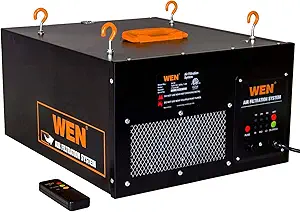
| WEN 3410 3-Speed Remote-Contro | 17 × 20.5 × 10 inches | 300 / 350 / 400 CFM | 31 pounds | 50–60 dB |
| VEVOR 1.5 HP Vortex Cone Dust | 36.22 × 29.13 × 75.59 inches | 1,100 CFM | 68.1 pounds | Under 90 dB |
More Details on Our Top Picks
Bucktool 1.2 HP Auto-Start Dust Collector, 750 CFM for Woodworking
The Bucktool suits a small shop where one mobile collector needs to move between machines and switch on with the tool. Its 750 CFM airflow exceeds the ShopMax’s listed 677 CFM, while the auto-start function can spare you from operating a separate switch each time you change tasks. Four casters, a five-piece reducer set, and a five-foot hose make it easier to reposition and connect to different ports. The tradeoff is a single-speed design and a 5.4-cubic-foot bag capacity, far smaller than the ShopMax’s 20-gallon container. This is a machine-side collector, not a substitute for ceiling air filtration like the DEWALT DWXAF101. Its listed cloth/HEPA filter description does not specify capture efficiency, so I would not treat it as a standalone fine-dust air cleaner.
Pros:- 750 CFM listed airflow and a 1.2 HP motor for machine-side dust pickup
- Auto-start function coordinates operation with connected tools
- Four caster wheels make it practical to move around a compact shop
- Three bags and a five-piece reducer set support varied machine connections
Cons:- 5.4-cubic-foot capacity requires more frequent emptying than the ShopMax’s 20-gallon bin
- Single-speed operation offers no airflow adjustment
- Five-foot hose limits reach without additional ducting
Best for: Small-shop owners who move one collector among benchtop machines and want tool-triggered startup with included adapters.
Not ideal for: Woodworkers seeking large-volume collection for long production runs or verified fine-particle air filtration; its capacity is modest and filtration performance is not quantified.
- Motor power:1.2 HP
- Airflow:750 CFM
- Voltage:120 V
- Full-load current:6.5 A
- Collection capacity:5.4 cubic feet
- Filter type:Cloth, HEPA
- Hose:4-inch diameter, 5 feet long
- Dimensions:16-1/2 x 26-3/8 inches
Our verdict“Choose the Bucktool if you want a mobile, auto-start collector for several small machines, but choose a larger-capacity unit for heavy, continuous chip production.”
DEWALT Air Filtration System Dust Collector (DWXAF101)
The DEWALT DWXAF101 addresses airborne dust rather than pulling chips directly from a saw or sander. Its ceiling-mountable format keeps the floor clear, while the cotton pre-filter and H11 HEPA stage are specified to capture over 95% of particles down to 0.3 microns. That makes it a useful complement to a machine-side collector such as the Bucktool, not a replacement for one. Four modes, a remote, and a programmable 1–8-hour timer make it easier to run after cutting without walking back to the unit. At 64 dB, it is quieter on paper than the ABESTORM’s 69 dB. The compromise is its limited role: it has no dust bag for chips or coarse debris, and mounting a 20.9-pound unit overhead takes suitable support and care.
Pros:- Two-stage filtration is specified to capture over 95% of particles down to 0.3 microns
- Ceiling mounting preserves valuable floor space
- Remote control and programmable 1–8-hour timer support hands-off operation
- Listed 64 dB noise level is lower than the ABESTORM’s 69 dB
Cons:- Does not collect chips or larger debris in a bag
- Its 20.9-pound weight makes ceiling installation more demanding
- Adds a second system rather than replacing a machine-side collector
Best for: Small-shop owners who already collect dust at the machine and want ceiling-level filtration for airborne fine particles without using floor space.
Not ideal for: Buyers seeking a standalone extractor for sawdust, planer shavings, or machine ports; this unit filters room air rather than collecting debris at the source.
- Power:105 W, AC
- Filtration:Cotton pre-filter and H11 HEPA filter
- Particle capture:Over 95% down to 0.3 microns
- Operating modes:4
- Timer:1–8 hours
- Noise level:64 dB
- Dimensions:10.2 x 15.9 x 20 inches
- Weight:20.9 pounds
Our verdict“Pick the DEWALT to filter airborne fine dust in a compact shop that already has source collection, not as your primary dust collector.”
ShopMax 20-Gallon Dust Collector, 6.3-Amp
The ShopMax is the capacity-focused choice in this group: its 20-gallon container holds substantially more debris than the Bucktool’s 5.4-cubic-foot bag, reducing interruptions when several tools generate chips. Five adapters help connect it to different woodworking machines, and wheels plus a carrying handle give it some mobility despite its size. Its listed 677 CFM airflow sits below the Bucktool’s 750 CFM, so buyers should weigh longer intervals between emptying against the Bucktool’s higher stated airflow and auto-start convenience. The ShopMax’s 55-pound weight and nearly five-foot height also make it a less natural fit for a crowded shop than a compact wall-mounted unit such as the VEVOR. Its plastic construction may matter to buyers who prefer a more substantial housing, and the supplied data does not specify filter efficiency.
Pros:- 20-gallon capacity reduces how often collection needs to be emptied
- Up to 677 CFM airflow for machine-side collection
- Five hose adapters support connections to different woodworking machines
- Wheels and carrying handle aid movement between work areas
Cons:- At 55 pounds and 59.84 inches tall, it takes substantial space and effort to reposition
- Plastic construction may be less reassuring than a metal-bodied collector
- Listed airflow is lower than the Bucktool’s 750 CFM
Best for: Small-shop woodworkers who generate plenty of chips and want a mobile collector with a large bin and multiple machine adapters.
Not ideal for: Owners of very tight shops who need a compact or wall-mounted unit, or buyers who prioritize a quantified fine-dust filtration rating.
- Motor:6.3 A, 120 V
- Maximum airflow:677 CFM
- Impeller diameter:12 inches
- Collection capacity:20 gallons (75 liters)
- Hose adapters:5
- Weight:55 pounds
- Dimensions:37.8 x 20.08 x 59.84 inches
- Warranty:2-year limited
Our verdict“Choose the ShopMax when bin capacity and machine compatibility matter more than a small footprint or the Bucktool’s higher listed airflow.”
ABESTORM 1350 CFM 360° Air Filtration System for Woodshop & Garage – Black
For a shop where airborne dust spreads beyond the machine, the ABESTORM emphasizes room coverage rather than hose-connected extraction. Its 1350 CFM airflow and 360-degree intake are designed to draw air from around the unit, and the stated coverage reaches 1,700 square feet. That makes it a larger-area alternative to the DEWALT DWXAF101, which offers finer specified particle capture—down to 0.3 microns—while the ABESTORM lists MERV-11 filtration down to 1 micron. Remote and touch controls give you two ways to operate it, but the 69 dB rating is louder than the DEWALT’s 64 dB. At 27 pounds, it also needs a secure placement or mounting plan. Like the DEWALT, it is an air cleaner, not a chip collector, so a source-capture system is still needed for sawdust and shavings.
Pros:- 1350 CFM airflow and 360-degree intake support broad room-air circulation
- Listed coverage extends to 1,700 square feet
- MERV-11 filtration is specified for particles down to 1 micron
- Remote and touch controls offer flexible operation
Cons:- Does not collect chips or debris directly from woodworking machines
- 69 dB operating noise is higher than the DEWALT’s listed 64 dB
- At 27 pounds, it is less convenient to relocate or mount
Best for: Woodworkers with a larger garage or open shop who want high-volume room-air circulation alongside machine-level collection.
Not ideal for: Anyone looking for a single unit to connect to a saw or planer, or a quieter air cleaner with a specified 0.3-micron capture rating.
- Airflow:1350 CFM
- Intake:360 degrees
- Filter class:MERV-11
- Particle retention:Down to 1 micron
- Listed floor coverage:Up to 1,700 square feet
- Noise level:69 dB
- Dimensions:20.5 x 20.5 x 9.8 inches
- Weight:27 pounds
Our verdict“Choose the ABESTORM for high-volume air cleaning across a larger shop, provided you have a separate collector at each dust-producing machine.”
VEVOR Wall Mount Dust Collector, 1 HP, 560 CFM, 2.5 Micron Bag for Woodworking and Industrial Use
The VEVOR’s main advantage is its wall-mounted layout: in a small shop, lifting the collector off the floor can free room for a mobile base, lumber, or a clear walking path. Its 21-gallon bag is larger than the Bucktool’s 5.4-cubic-foot capacity, and a bottom zipper is intended to make emptying easier. The listed 560 CFM airflow is lower than both the Bucktool’s 750 CFM and the ShopMax’s 677 CFM, so this is a better fit for a fixed machine or modest collection setup than a buyer prioritizing maximum stated airflow. Its 2.5-micron bag provides a filtration figure, but that is coarser than the DEWALT’s stated 0.3-micron air-cleaning capability. Installation is the tradeoff: at 24 pounds, it needs a suitable wall and fixed placement, unlike the wheeled Bucktool.
Pros:- Wall-mounted design preserves floor space in a compact shop
- 21-gallon (80-liter) bag limits frequent emptying
- Bottom zipper is intended to simplify bag disposal
- 2.5-micron filtration rating is specified
Cons:- Fixed mounting makes repositioning between machines inconvenient
- Listed 560 CFM airflow is lower than the Bucktool and ShopMax
- At 24 pounds, installation requires a suitable wall and secure mounting
Best for: Small-shop owners with a suitable wall and a preferred fixed machine who want a large collection bag without using floor space.
Not ideal for: Woodworkers who need to move the collector between machines, want higher listed airflow, or need finer air filtration than a 2.5-micron bag specifies.
- Motor power:1 HP
- Airflow:560 CFM
- Voltage:120 V
- Collection capacity:21 gallons (80 liters)
- Filtration:2.5-micron bag
- Noise level:Up to 90 dB
- Dimensions:40.94 x 13.78 x 15.75 inches
- Weight:24 pounds
Our verdict“Pick the VEVOR if floor space is scarce and you can dedicate a properly supported wall location to a moderate-airflow collector.”
WEN DC1300 1,300 CFM Woodworking Dust Collector with 50-Gallon Collection Bag
The DC1300’s 1,300 CFM airflow and dual 4-inch inlets make it the strongest fit here for a small shop that wants to connect two compatible tools rather than move a collector between them. Its 50-gallon bag also means less frequent emptying than the 12-gallon DC3401 or 15-gallon WEN collector. That capacity comes with a footprint and setup commitment: this is a larger floor unit, not the easy-to-tuck-away choice. The four swivel casters help reposition it, but they do not remove the need for room to park it and route hoses. I’d choose it over the VEVOR 1,100 CFM model when the second inlet and bigger bag matter more than compact storage; skip it if your shop mainly needs one portable tool connection.
Pros:- Up to 1,300 CFM airflow
- Two 4-inch inlets support connection to up to two tools
- 50-gallon collection bag reduces how often it needs emptying
- Four swivel casters make repositioning easier
Cons:- Large bag and floor-mounted format take substantial shop space
- Dual inlets only help when the shop has compatible ducting and tool connections
Best for: Small-shop owners who run two compatible 4-inch dust connections and want a large collection bag between emptying sessions.
Not ideal for: Woodworkers with very limited floor space or a single benchtop tool who would get more practical use from the smaller DC3401.
- Model:DC1300
- Airflow:Up to 1,300 CFM
- Motor:14 amp
- Impeller:10-inch steel, up to 3,450 RPM
- Inlets:Two 4-inch
- Collection bag capacity:50 gallons
- Mobility:Base with four swivel casters
Our verdict“Choose the DC1300 if two-tool connectivity and a 50-gallon bag outweigh the space demands of a larger floor collector.”
WEN Woodworking Dust Collector, 7.4-Amp Motor, 15-Gallon Bag, Mobile Base, Wall Mount Option
This WEN is a useful middle ground for a small shop that wants a 600 CFM, 4-inch-port collector without stepping up to the DC1300’s larger 50-gallon floor unit. Its wall-mount option can free floor space when the collector can stay near a machine; the casters offer another arrangement when it needs to move around. The 15-gallon bag is more modest than the DC1300’s, but larger than the DC3401’s 12-gallon bag. That makes this a practical choice for a modest one-tool setup, not a substitute for a larger system serving multiple machines at once. The listed weight is 41.1 pounds, so frequent repositioning is possible but less appealing than with the 17-pound DC3401. I’d pass if compact portability matters most or if your tool setup calls for more airflow.
Pros:- Optional wall mounting can reclaim floor space
- Swivel casters and a handle allow mobile use
- 600 CFM airflow through a 4-inch dust port
- 15-gallon collection bag offers more capacity than the DC3401
Cons:- At 41.1 pounds, it is heavier to move often than the DC3401
- Single 4-inch dust port limits it to a one-tool connection at a time
- The 15-gallon bag needs emptying sooner than the DC1300’s 50-gallon bag
Best for: Small-shop woodworkers who want the choice of mounting a one-tool collector on a wall or moving it between machines.
Not ideal for: Buyers who need a lightweight unit for frequent moves, or who want the DC1300’s higher airflow and dual inlets for multiple tools.
- Motor:7.4 amps
- Impeller:9 inches
- Airflow:Up to 600 CFM
- Dust port:4 inches
- Collection capacity:15 gallons
- Dimensions:43.3 × 17.7 × 20.1 inches
- Weight:41.1 pounds
Our verdict“Pick this WEN if you want a wall-mount-or-mobile collector for a modest one-tool setup and can accept its weight and smaller capacity.”
WEN 12-Gallon Woodworking Dust Collector, 5.7-Amp Motor, 660 CFM, Mobile Base (DC3401)
The DC3401 is the compact, lightweight option among these dedicated collectors: its listed dimensions are 34.25 × 13 × 14.2 inches, and it weighs 17 pounds. Four lockable casters and an optional wall mount give small-shop owners a choice between rolling it beside a machine and keeping it off the floor. Its 660 CFM rating is higher than the 600 CFM WEN collector, though the DC3401 has a smaller 12-gallon bag and one 4-inch port. That makes it a better fit for a single machine and limited storage, not a way to collect from several tools at once. The 5-micron zippered bag is part of the package, but this is not a whole-room air filtration unit like the WEN 3410. I’d skip it if larger bag capacity or multi-tool connections lead your priorities.
Pros:- Light 17-pound body and compact listed dimensions
- Four lockable swivel casters support mobile or stationary placement
- Optional wall mount can keep the unit off the floor
- 660 CFM rating and included 5-micron zippered bag
Cons:- One 4-inch port limits it to a single tool connection
- 12-gallon bag has less capacity than the other WEN collectors here
- Single-speed operation offers no airflow adjustment
Best for: Owners of compact shops who need a lightweight collector they can roll between one 4-inch-port machine and a wall-mount storage spot.
Not ideal for: Woodworkers collecting from several machines together or seeking a large-capacity bag; the DC1300 is better suited to that workload.
- Model:DC3401
- Motor:5.7-amp brushed motor
- Airflow:Up to 660 CFM
- Impeller:6-inch nylon
- Dust port:4 inches
- Collection bag:12 gallons, 5-micron zippered
- Dimensions:34.25 × 13 × 14.2 inches
- Weight:17 pounds
- Warranty:Two years
Our verdict“Choose the DC3401 for a space-conscious, one-machine setup where low weight and flexible placement matter more than bag capacity.”
WEN 3410 3-Speed Remote-Controlled Air Filtration System, 300/350/400 CFM
The WEN 3410 does a different job from the DC1300 and DC3401: it filters circulating workshop air rather than connecting directly to a tool’s dust port. Its two-stage setup combines a 5-micron pre-filter and 1-micron filter, while three speed settings let a small-shop owner choose between 300, 350, and 400 CFM. The RF remote works from up to 26 feet, even without a clear line of sight, and the timer can shut the unit off after work. Those conveniences make it a useful complement to source collection, but not a replacement for a collector at a saw or planer. Coverage is listed up to 400 square feet, and noise reaches 60 dB. Compared with the ABESTORM air filtration system in this roundup, the WEN’s stated coverage is more limited, so check room size before choosing it.
Pros:- Three airflow settings: 300, 350, and 400 CFM
- Two replaceable filter stages, down to a listed 1-micron filter
- RF remote works up to 26 feet, including without clear line of sight
- Programmable shutoff timer and stated coverage up to 400 square feet
Cons:- Does not connect to a machine to capture chips and dust at the source
- Listed coverage is limited to workshops up to 400 square feet
- Noise level reaches 60 dB
Best for: Woodworkers with a shop up to 400 square feet who already collect dust at the tool and want filtered air circulation with remote and timer controls.
Not ideal for: Buyers who need a hose-connected collector for chips at a machine, or who need air filtration for a larger workshop.
- Airflow:300 / 350 / 400 CFM
- Filter stages:5-micron pre-filter and 1-micron filter
- Coverage area:Up to 400 sq ft
- Noise level:50–60 dB
- Motor power:1/6 HP
- Dimensions:17 × 20.5 × 10 inches
- Weight:31 pounds
- Remote range:Up to 26 feet
- Warranty:Two years
Our verdict“Choose the WEN 3410 as supplemental air cleaning for a smaller shop, not as a replacement for a tool-connected dust collector.”
VEVOR 1.5 HP Vortex Cone Dust Collector, 1100 CFM, 2.5-Micron Filtration
The VEVOR pairs 1,100 CFM airflow with a 42-gallon bag and 2.5-micron filtration, making it a substantial floor collector for a small shop that produces a steady volume of chips and dust. Its bag holds less than the WEN DC1300’s 50 gallons, and the VEVOR’s stated airflow is also lower; the DC1300, however, lists dual 4-inch inlets, a useful distinction for buyers planning connections to two tools. The VEVOR’s clip-style bag access supports routine emptying, while its 68.1-pound weight and 75.59-inch listed height call for a fixed parking spot rather than frequent repositioning. Under-90 dB is not a quiet operating claim, so this may be a poor fit for noise-sensitive shared spaces. I’d choose it for its large bag and filtration, not for compactness.
Pros:- 1,100 CFM airflow for tool-connected dust and debris collection
- 42-gallon collection bag reduces emptying frequency
- Listed 2.5-micron filtration
- Clip-style access simplifies bag removal and emptying
Cons:- 68.1-pound weight and 75.59-inch height make it demanding to place and move
- Under-90 dB may still be loud for a shared or noise-sensitive workspace
- Lower airflow and smaller bag capacity than the WEN DC1300
Best for: Small-shop owners who want a large-capacity floor collector with listed 2.5-micron filtration and have room for a tall, heavy unit.
Not ideal for: Woodworkers with restricted floor or ceiling clearance, frequent repositioning needs, or a preference for the DC1300’s higher airflow and dual inlets.
- Airflow:1,100 CFM
- Filtration:2.5 microns
- Motor:1.5 HP induction motor
- Speed:3,400 RPM
- Collection bag capacity:42 gallons (159 L)
- Noise level:Under 90 dB
- Dimensions:36.22 × 29.13 × 75.59 inches
- Weight:68.1 pounds
- Voltage:120 volts
Our verdict“Pick the VEVOR if a large bag and 2.5-micron filtration matter more than a compact footprint or the DC1300’s higher airflow and dual inlets.”

How We Picked
I ranked these systems by how well their design matches the constraints of a small woodshop: limited floor space, varied machines, short or improvised duct runs, and the need to manage both chips and fine airborne dust. I compared stated airflow and collection capacity alongside portability, mounting options, filtration details, controls, and the maintenance each design is likely to require. Since the lineup includes both source collectors and room air filters, I judged them by their intended jobs rather than treating their CFM figures as directly interchangeable.
The top positions go to systems that can serve as practical primary collectors for common shop machines, with capacity and footprint factored into the ranking. Compact and wall-mounted models rank well when space saving is their main advantage, while air-filtration units are placed for buyers seeking supplemental room-air cleanup—not as substitutes for tool-connected extraction. Where specifications do not describe duct compatibility, filter performance, or noise, I avoid assuming those details and advise buyers to confirm fit for their own setup.
Factors to Consider When Choosing Dust Collection Systems For Small Woodshops
Before choosing a model, decide which dust problem you are trying to solve. A collector attached to a machine captures chips and dust near the source, while a room filter circulates airborne particles after they escape. Those jobs can complement each other, but neither design automatically replaces the other.
Match the System to the Dust Source
Start with the machines you use most and the kind of debris they create. Planer and jointer work can produce a large volume of chips, while sanding creates finer dust that may remain suspended in the air. A collector connected to a tool port is aimed at source capture; a ceiling or wall air filter handles room circulation instead. Buying an air filter as your only dust system can leave chips and dust escaping at the machine. If you need both types of control, budget space and electrical capacity for a source collector and a separate ambient filter.
Treat CFM as One Part of the System
A listed CFM figure describes airflow under specified conditions, but it does not tell you exactly how much air will reach a tool through your shop’s hoses and ductwork. Long runs, narrow hose, sharp bends, leaks, and clogged filters can all reduce effective airflow. A common mistake is comparing a room filter’s CFM directly with a collector’s and assuming the larger number means it can do the other unit’s job. Check the tool-port size and plan the shortest, smoothest practical route from collector to machine. If you intend to connect several tools, confirm whether the collector and duct layout can support that arrangement rather than relying on the headline rating alone.
Measure the Footprint and Plan the Route
In a compact shop, the collector’s parking spot and the path of its hose can matter as much as its motor. Measure the unit, bag clearance, filter access, and the space needed to move tools or stock around it. Wall-mounted designs can free floor area, but they need a suitable mounting surface and a workable hose route to the machines. Mobile units make it easier to serve more than one tool, though frequent repositioning can become a nuisance if the collector is bulky or the connections are awkward. Sketch the layout before buying so the system does not block a doorway, workbench, or storage zone.
Compare Capacity, Filtration, and Emptying
Collection capacity affects how often you stop to empty a bag, but a larger bag also takes up more room and may be harder to handle when full. Filtration details matter because a bag or filter that catches larger debris may not capture the finest dust to the same degree. Look for stated particle filtration information and check whether replacement filters are available for the model you choose. Think through how you will remove and reseal the collection bag; a messy emptying routine can put collected dust back into the shop. Avoid treating a micron figure as a complete picture without checking the filter configuration and how the unit is meant to be used.
Account for Noise, Power, and Maintenance
A dust system may run for long stretches, so noise and electrical demands can affect when and where you use it. Check the unit’s power requirements against the circuits in your shop, especially if other machinery shares the same circuit. Remote controls and automatic-start features can make operation easier, but they do not compensate for poor duct design or unsuitable filtration. Regular cleaning and timely filter replacement help maintain airflow, so consider how accessible those parts are before settling on a location. If you work in a shared or attached space, compare noise information from the manufacturer and plan for hearing protection where needed.
Frequently Asked Questions
Can an air-filtration unit replace a dust collector connected to my tools?
No. An ambient air filter circulates room air and captures some airborne dust, while a tool-connected collector is meant to draw chips and dust from a machine’s port. The DEWALT, WEN 3410, and ABESTORM models in this roundup are air-filtration options, not direct replacements for source collection. A small shop may benefit from using both, particularly when sanding or when some dust escapes during cutting. Choose the tool collector first if your main concern is visible chips and debris at the machine.
Is the highest listed CFM the best choice for a small shop?
Not by itself. The WEN DC1300 and ABESTORM both list high airflow figures, but they perform different roles: one is a source collector and the other filters room air. Even among source collectors, actual airflow at a tool depends on the hose, fittings, duct length, filter condition, and the machine’s port. A large unit can also occupy more space than a small shop can spare. Compare the system’s intended use and layout fit before using CFM as a deciding factor.
Should I choose a wall-mounted collector or a mobile model?
Choose wall mounting when your machines have stable positions, you can mount the unit securely, and keeping the floor open is a priority. A mobile model is more flexible if you move tools or need to connect one collector to several work areas. Mobility can still mean moving hoses and reconnecting ports, so it may not be convenient for frequent tool changes. Also account for bag access and filter maintenance when selecting a mounting spot. The VEVOR 1 HP wall unit and WEN wall-mount option make most sense when space saving outweighs the need to roll the collector around.
How much collection capacity do I need if I use my shop only occasionally?
Base capacity on the volume of debris your tools produce and how often you are willing to stop and empty the collector, not on shop size alone. Occasional hand-tool or light machine work may not require the same bag capacity as regular planer or jointer use. A smaller unit can be easier to store and move, while a larger collection bag reduces emptying interruptions but takes up more space. Check whether the bag is straightforward to remove and reinstall, since an awkward emptying process can discourage routine use. For a mixed-use shop, leave room to grow if you expect to add chip-producing machines.
Do I need a separate air filter if my collector has a filtration bag?
Possibly, because a collector’s bag and an ambient air filter address different parts of the dust problem. The collector captures debris drawn through the machine connection, while a room unit circulates air to catch dust that escaped or remained suspended. Whether a second unit is worthwhile depends on your tools, how much sanding you do, your shop’s ventilation, and the collector’s filtration details. Do not assume a bag’s stated particle rating means all airborne dust is controlled throughout the room. If fine dust is a concern, check the collector’s filtration specifications and consider a separate air-cleaning unit as added control.
Conclusion
For most small woodshops seeking one primary collector, I would start with the WEN DC1300 as best overall, thanks to its listed 1,300 CFM and 50-gallon bag, provided its footprint suits the shop. The best value for a compact setup is the WEN DC3401, which prioritizes a mobile base and smaller collection capacity; buyers who need more capacity should step up to a larger collector. For a best premium-style upgrade among these options, the VEVOR 1.5 HP Vortex Cone pairs a higher-power design with listed 1,100 CFM and 2.5-micron filtration, though buyers should confirm its fit and filtration needs. Beginners who want straightforward mobility can consider the WEN DC3401, while those seeking a space-saving fixed setup should compare the VEVOR 1 HP wall unit with the WEN wall-mount option. For specific needs, choose the DEWALT, WEN 3410, or ABESTORM for room-air filtration—not as a replacement for tool-connected dust collection.
Halloween Picks

Pumpkin Halloween Fog Machine with 12-Color LED Lights, Bluetooth Speaker, and Remote

10 ft Halloween Inflatable Archway with Built-in LEDs

MGparty 14.5 ft Halloween Inflatable Walk-In Pumpkin House with LED Lights
As an affiliate, we earn on qualifying purchases.