
TL;DR

Get business pricing on tools and workshop supplies
- Business-only prices and quantity discounts
- Tax-exempt purchasing
- Multiple users, one account, clear invoices
A Hunker report outlines granite edging as one way to create a durable boundary between a gravel driveway and lawn. It describes curbing, cobblestones and boulders, while noting that installation depth and the driveway’s shape affect which option may work.
A Hunker home-improvement report describes granite edging as a durable way to define the boundary between a gravel driveway and lawn, helping limit grass encroachment and gravel spread when properly installed. The report outlines three options—granite curbing, cobblestones and larger boulders—but provides no independent testing or cost comparisons.
Granite is a natural igneous rock used in landscaping and building finishes. The Hunker report points to its density, low porosity and heat tolerance as qualities that make it suitable for outdoor edging. A fixed border can help keep loose aggregate within the drive and establish a visible line between gravel and grass. The report cautions implicitly that the result depends on proper installation; edging is not presented as a substitute for removing weeds already growing through the gravel.
For straight drives, granite curbing can create a continuous line, while smaller granite cobblestones or Belgian blocks can accommodate more varied shapes and give the edge a more traditional appearance. The report says curbing units often come in four-foot lengths. As an example, it estimates that a 20-foot driveway bordered by lawn on both sides would need five units on each side, or 10 in total. That estimate assumes the dimensions and product lengths described; actual quantities depend on the chosen materials and layout.
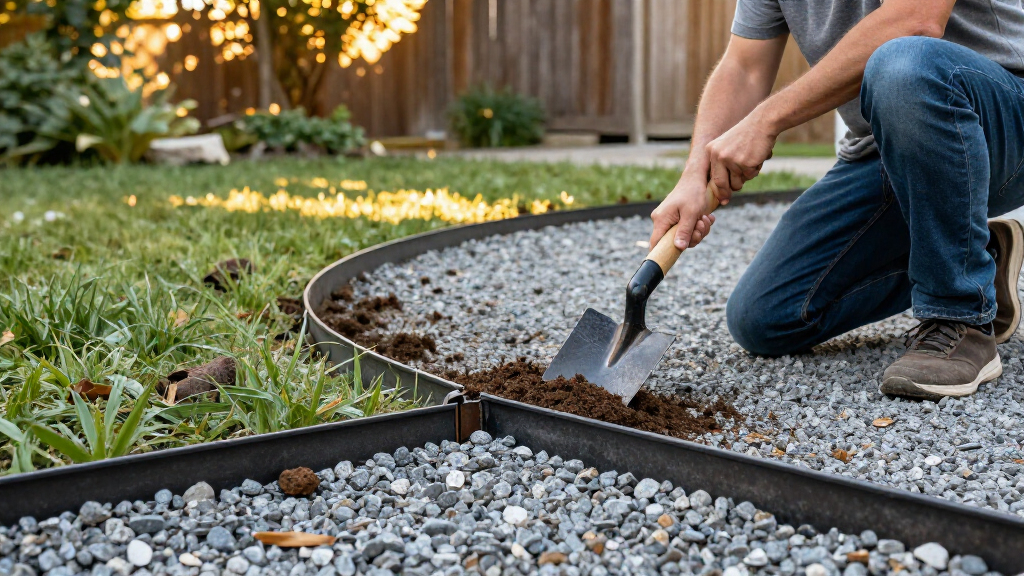
The report recommends setting edging four to six inches into the soil and leaving about two inches above ground, with the aim of obstructing underground grass runners and surface growth. It also mentions granite boulders as an alternative, including rocks found on private property in granite-rich areas. Their weight and size can make them difficult to move. The report says all three approaches can also frame a driveway and help limit erosion, but does not quantify those effects.
A Border Can Limit Lawn Encroachment
Grass and weeds can reach gravel drives from the lawn or grow through the gravel itself. A defined physical edge addresses the first problem by creating a boundary and helping keep gravel from spreading into the yard. It may reduce the frequency of raking material back into place and trimming grass along the drive, though the source does not provide measured maintenance savings.
The choice also affects the look of a property. Granite’s natural mineral patterns and range of colors, described by Hunker as including white, dark gray and red, can provide a more finished edge than an unbounded gravel-to-lawn transition. For homeowners, the practical decision is therefore both functional and visual: the edge needs to suit the driveway’s length, shape and desired style, while being installed deeply enough to serve its stated purpose.
These benefits should not be read as a guarantee that vegetation will stop completely. The report’s recommendation concerns edging at the lawn boundary; it says regular weeding and replenishing gravel may still be needed for plants growing within the drive. It does not establish how well granite performs compared with other edging materials under different soil, climate or maintenance conditions.
Popular right now

De'Longhi 15-Bar Pump Espresso Machine with Milk Frother & Temperature Control

Sony BRAVIA 5 85-Inch Mini LED 4K HDR Smart TV (K-85XR50)

KitchenAid Artisan 5-Quart Tilt-Head Stand Mixer, Almond Cream
As an affiliate, we earn on qualifying purchases.
Three Granite Formats, Different Fits
The Hunker report frames the decision around driveway geometry. Long, straight edges can be laid with curbing sections, while individual cobblestones offer more flexibility around curves or irregular borders. Its four-foot curbing example is a basic quantity calculation, not a full installation plan: curves, corners, gaps and product-specific dimensions can change the number of pieces required.
For cobblestones, the report gives a suggested installation depth of four to six inches below grade, with approximately two inches exposed. It says a standard 10-by-7-by-4-inch paver would need to be placed vertically to achieve those proportions. Actual installation needs can vary with the stone, soil and site, and the source does not provide detailed instructions for excavation, bedding or drainage.
Boulders are the least uniform option and may be available on a property in regions where granite is common. Their irregular shapes can suit a naturalistic border, but moving and positioning large rocks may require equipment or assistance. The report does not offer pricing, sourcing guidance or a comparison of the labor involved in installing each type.
““grass and weeds will try to grow through the gravel or encroach on it from the lawn.””
— Hunker report
Installation Results Are Not Quantified
The source does not provide installation costs, product comparisons or field-test results, so it is not possible to say from this report how granite edging performs against other materials or how long a particular installation will last. It also does not specify whether the suggested depth suits every soil type, climate or driveway construction.
The degree to which edging reduces grass growth will depend on installation and site conditions; the report does not claim that it eliminates weeds. Vegetation growing through the gravel may still require regular removal, and the source says gravel may need replenishing. It is also unclear how much maintenance or erosion reduction homeowners can expect in practice.
Measure the Drive Before Choosing
The report offers no announced follow-up or scheduled development. For a homeowner considering the approach, the next step is to measure the driveway’s length and identify straight sections, curves and access points before estimating material quantities. Comparing the dimensions of available curbing or cobblestones with the site can clarify how much edging is needed.
Before installation, homeowners would also need to account for the soil and the practical effort of moving stone, particularly if considering boulders. The source does not provide a complete installation method or project budget, so those details remain site-specific. Regardless of the option, the stated recommendation is to set the edge into the soil and retain some height above grade, while continuing to manage weeds within the gravel.
Key Questions
Can granite edging stop grass from growing in gravel?
The Hunker report says a properly installed border can help keep lawn grass from encroaching on the driveway. It does not claim that edging stops weeds or grass already growing through the gravel; regular weeding may still be needed.
How deep does the report recommend installing the edging?
It suggests setting the edging four to six inches into the soil and leaving about two inches above ground. Site conditions and product dimensions may affect what is suitable.
Which granite edging option suits a curved driveway?
The report says individual granite cobblestones or Belgian blocks can fit a wider range of driveway shapes than longer curbing sections. The best fit depends on the actual layout and available products.
How many curbing blocks might a 20-foot driveway need?
Using the report’s example of four-foot curbing, a 20-foot edge would require five units. If lawn borders both sides, the estimate is 10 units total. Corners, curves and product dimensions can change the actual quantity.
Does granite edging remove the need for driveway maintenance?
No. The report presents edging as a way to define the border and limit material spread, but says regular weeding and gravel replenishment may still be needed.
Source: hunker.com