
TL;DR

Get tools and workshop supplies delivered free — and shop member deals
- Fast, free delivery on millions of items
- Access to Prime Big Deal Days deals on October 6–7
- Prime Video, Amazon Music and more included
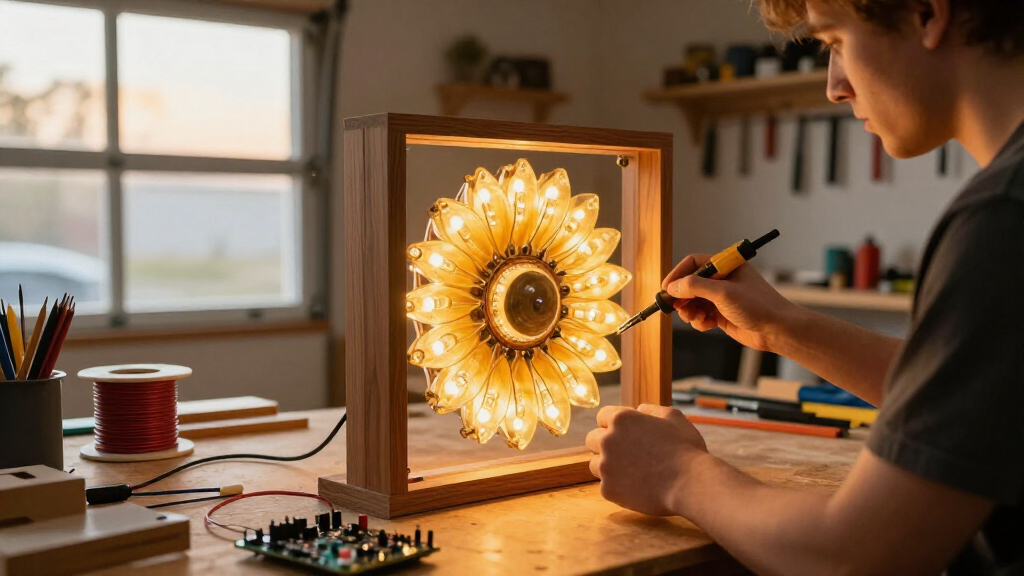
Maker Jagi Natarajan documented a build transforming the phyllotaxis spiral found in sunflowers into a physical LED display. Eighty-nine addressable LEDs sit in 3D-printed Voronoi cells, driven by an STM32 microcontroller and an I2S microphone so the pattern pulses in response to live audio.
Maker Jagi Natarajan has published a detailed build log of “Phyllotaxis,” an audio-reactive LED display that arranges 89 addressable RGB LEDs in the double-spiral pattern found in sunflower heads. The project, documented on the author’s site jagi.studio, turns a generative-code experiment into a physical object: a 3D-printed cellular panel, backed with translucent mulberry paper, that listens to sound in a room via a digital microphone and pulses its lighting patterns in response.
The display began as code. Natarajan generated points along a radial line, rotated each by successive multiples of the golden ratio (1.6180339887), and produced a point cloud that, in the author’s words, “already looks very much like a sunflower.” Applying a Voronoi tessellation to those points produced a cellular, seed-pod-like structure that became the physical template.
To move from screen to object, Natarajan exported the cell edge data from a Processing sketch and rebuilt it as printable geometry using the Python-based CadQuery library. The code subtracts each shrunk cell volume from a merged whole to form walls, then carves an LED-sized hole into every cell. The geometry was split into four quadrants to fit a consumer 3D printer bed, post-processed in FreeCAD, and finished with a thin faceplate backed by translucent mulberry paper — chosen, the author wrote, because its “beautiful organic fibers” diffuse light well. The panel is mounted on a bamboo cutting board routed into a circle.
Electronics are built around a spare STM32 “blackpill” board driving the LEDs over SPI, with an INMP441 digital I2S microphone added for audio input. Because the STM32 has floating-point support and ARM DSP instructions, Natarajan ran a Fourier transform on the microphone signal using the ARM CMSIS library, adding auto-gain control and multiband frequency splitting to measure energy at different frequencies. The author described the resulting audio-reactive sketch, built around a pulsating sine wave that modulates brightness outward from the center, as “the basis of what runs on the board to this day.” The controller and microphone were assembled on perfboard and housed in a 3D-printed box with a guitar pedal footswitch.
Why This Build Matters to Makers
The project is a working demonstration of a design pipeline that hobbyists increasingly use but rarely document end to end: generative code, CAD scripting, 3D printing, and embedded digital-signal processing in a single artifact. Natarajan’s approach — exporting mathematical cell data from a Processing sketch into CadQuery to build printable geometry — shows how a natural mathematical pattern can be converted directly into physical structure without manual modeling.
The audio side is equally instructive. Using a digital I2S microphone rather than an analog one, the author notes, means “no risk of analog noise,” and running the Fourier transform on the microcontroller itself keeps the display self-contained with no computer attached. For makers building reactive lighting, the write-up offers concrete, copyable choices: the INMP441 mic, CMSIS-based DSP, SPI-driven LED control, and a lookup-table scheme that lets LED code be written like a fragment shader.
The build also illustrates the realities of hobby projects. Natarajan is candid that the final firmware grew from “a very chaotic sketch with a lot of global timers and messy state,” and that the perfboard electronics were “janky and prone to noise” — a reminder that the published result is a personal experiment rather than a polished product.
From Nature’s Spiral to a Lamp
: “Phyllotaxis is the arrangement of leaves, seeds, and other plant elements around a stem or flower head. In sunflowers, pinecones, and many succulents, seeds form two families of spirals whose counts are consecutive Fibonacci numbers — a structure that emerges when each new element grows at a fixed angle from the previous one, an angle close to the golden ratio. Natarajan’s code reproduces exactly that rule.
The author notes this is a return to familiar territory: a rectangular Neopixel matrix was built in high school, and the goal since had been to find “a more interesting shape for the next one.” The phyllotaxis spiral, with its naturally irregular Voronoi cells, provided that shape. The author says the display “came alive” while listening to Jon Hopkins’ track “Neon Pattern Drum” during testing.
Open Questions in the Write-Up
Several practical details are incomplete or unresolved in the published report. The author’s description of the electronics cuts off mid-sentence, noting only that the perfboard circuitry was prone to noise; the full scope of that problem and any fixes are not documented. The published firmware is described by its own author as messy, and it is not clear whether the code, CadQuery models, or STEP files have been released publicly. There is also no stated parts cost, build time beyond anecdotes, or power supply specification, and no video of the audio-reactive behavior appears to be described in the text of the report itself.
Where the Project Goes From Here
The author indicates the current audio-reactive program continues to run on the board, and the remaining work described is refinement: tidying the electronics, improving the mounting surface, and cleaning up the firmware’s global state. Readers interested in replicating the pipeline — Processing sketch, CadQuery geometry, STM32 SPI LED driver, and CMSIS audio analysis — can follow the write-up at jagi.studio; whether Natarajan publishes the source files or a revised version of the hardware has not been announced.
Key Questions
What is phyllotaxis?
It is the pattern by which plants arrange leaves, seeds, or florets — most visibly the double spiral in the center of a sunflower. The pattern emerges when each new element is placed at a fixed angle from the last, close to the golden ratio of roughly 1.618.
How does the display react to sound?
An INMP441 digital I2S microphone feeds audio to an STM32 microcontroller, which runs a Fourier transform using the ARM CMSIS library. Auto-gain control and multiband splitting measure energy at different frequencies, and that data drives animation parameters such as a pulsating radial brightness wave.
How many LEDs does the build use, and how are they arranged?
Eighty-nine addressable RGB LEDs, one in each cell of a Voronoi-tessellated phyllotaxis pattern. The cells were generated in code, converted to 3D-printable geometry with CadQuery, printed in four quadrants, and fronted with a translucent mulberry-paper faceplate that diffuses the light.
Is the design or code available to reuse?
The write-up includes key code snippets — the point-generation sketch, the CadQuery geometry script, and a sample LED “shader” — but does not state that the full source, CAD models, or firmware have been publicly released.
Does the display need a computer to run?
No. According to the author, all processing — LED driving over SPI and audio analysis via Fourier transform — runs on the STM32 board itself, housed with the microphone in a 3D-printed controller box with a footswitch.
Source: hn
Fall Picks
fall essentials
As an affiliate, we earn on qualifying purchases.