
TL;DR

Get business pricing on tools and workshop supplies
- Business-only prices and quantity discounts
- Tax-exempt purchasing
- Multiple users, one account, clear invoices
Choose an air filtration system by first identifying whether you need to capture particles, reduce odors and gases, or address a source that filtration cannot fix. Match particle-cleaning capacity to the room and the speed you can comfortably run, then follow clearance, airflow, and filter-maintenance instructions. A shop air cleaner can reduce airborne dust, but it does not replace effective source collection at a saw or sander.
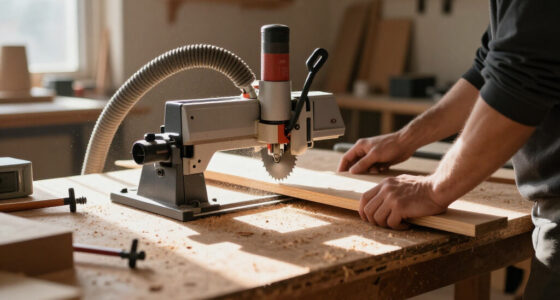
A table saw can fill a small garage with fine dust even after you wheel the shop vacuum over to the hose. The chips are gone, but a pale haze still hangs in the light above the bench. That is where a room air filtration system can help: it captures some airborne particles that escaped at the tool, provided you size and place it for the space.
To select and install a quality air filtration system, start with the problem you need to solve. Dust, odors, and gases need different filters, and a portable purifier cannot repair a leaking roof, remove a mold source, or replace dust collection at the blade. You’ll learn how to compare CADR, HEPA, and MERV claims, choose a system you can live with, and set up a maintenance routine that fits a real home or garage shop.
Identify the pollutant first: particle filters and gas-phase filters solve different problems.
Use CADR, room area, ceiling height, and tolerable operating noise to size a portable cleaner.
Check HVAC compatibility before choosing a higher-MERV filter; added resistance can reduce airflow.
In a woodshop, capture dust at the tool first and use room filtration for airborne dust that escapes.
Keep intakes clear, follow airflow arrows and manufacturer instructions, and inspect filters more often in dusty conditions.
Home & Workshop · Practical Guide
How to Select and Install a Quality Air Filtration System
Start with the pollutant, size for the room and the speed you can comfortably run, then install for clear airflow and maintain the filters. Room filtration can catch airborne dust that escapes a tool, but source collection still comes first.
Identify the problem before you shop
The right system depends on what you want to reduce. A filter can run for hours and still leave the thing you notice untouched if it is designed for a different pollutant.
Dust, pollen, smoke particles
HEPA media in a properly designed unit can capture fine airborne particles. Use a room cleaner to catch what remains suspended after source controls have done their work.
Odors and some gases
Activated carbon or other gas-phase media can reduce some odors and VOCs. Capacity depends on media quantity and type, airflow, and replacement schedule; a thin carbon sheet may fill quickly.
Problems a purifier cannot fix
Repair leaks and moisture that support mold. Reduce persistent chemical emissions at their source and ventilate appropriately. Treat combustion hazards with specialized controls.
Size for the air you actually have
Compare portable cleaner capacity with floor area, ceiling height, connected spaces, and the cleaning rate you want. Room-size claims may assume specific ceiling heights and air changes per hour.
A 12-by-16-foot garage bay with an 8-foot ceiling. A taller ceiling or open doorway adds air the cleaner may need to treat.
Read ratings in context
Each label describes one part of performance. Check clear test data for the whole unit, media compatibility, replacement guidance, and the conditions behind any room-size claim.
Install for clear airflow; maintain for steady performance
Follow the unit instructions and keep air moving freely. Dusty workshop conditions can load filters faster than ordinary room use.
Place the cleaner where intake and outlet air can move freely.
Follow the manufacturer’s spacing and installation instructions.
Fit filters with arrows pointing the way the unit specifies.
Inspect more often in dusty conditions; replace as directed.
Check the lifetime costs
Compare replacement filter price, availability, and expected service life. Consider energy use and the noise level at your everyday setting. Prefer devices that do not intentionally generate ozone; check independent emissions testing where available.
Keep the system working
Keep intakes clear, inspect filters, and follow the maker’s maintenance schedule. A sensor or app may help with scheduling, but its reading is not the same as a calibrated indoor-air assessment.
Choose a system that suits the space
No single option fits every home. Match coverage to how the air moves and how you will use the system.
Portable air cleaner
Useful for a bedroom, office, or individual workshop area. Particle performance depends on placement, appropriate capacity, and regular operation. Check for meaningful gas-phase media if odors are the concern.
HVAC or duct-mounted
An HVAC filter treats air moving through a compatible heating and cooling system; it may not filter air while the fan is off. Whole-house and duct-mounted systems depend on equipment, duct design, and airflow.
The decision path
Identify what you need the air system to remove
Choose a filtration system by identifying whether your main problem is airborne particles, gases and odors, or a source that needs repair. Particle filters capture dust and other suspended material; gas-phase media such as activated carbon can reduce some odors and gases. Filtration alone cannot stop pollutants at their source or fix a ventilation problem. This distinction matters because the wrong filter may run for hours without changing the thing you notice: a particle filter can collect dust while leaving a chemical smell largely unchanged.
In a woodshop, fine dust from sanding and cutting may linger after larger chips have settled. A room air cleaner can catch some of that airborne dust, but the first control should be source collection at the tool: connect a suitable dust collector or shop vacuum, keep the hood close to the blade or sanding surface, and capture dust before it drifts through the room. The overhead filter is a second line of defense. Capturing dust at the tool reduces how much enters the room in the first place; relying on room filtration means the dust must escape, disperse, and eventually pass through the cleaner.
Odors call for a different approach. A particle filter may capture smoke particles, but it does not automatically remove the smell or gases in the smoke. A thin carbon sheet has limited capacity compared with a substantial bed of gas-phase media, and the word “carbon” on a box does not tell you how much odor it can handle. As that media fills, odor reduction can fade even while the fan and particle filter continue to work, so replacement cost and availability matter.
If you smell persistent chemical fumes, find and reduce the source, ventilate appropriately, and check product safety directions. If you find mold, fix the moisture and affected material; circulating air through a purifier does not make mold growth go away. Match an air filtration system to the pollutant before shopping, or you may buy a well-rated unit that solves the wrong problem.
Popular right now

Ninja Flip Toaster Oven and Air Fryer, 8-in-1, Stainless Steel, SP151

KitchenAid Artisan 5-Quart Tilt-Head Stand Mixer, Almond Cream

KitchenAid Classic Series 4.5 Quart Tilt-Head Stand Mixer K45SS, Onyx Black
As an affiliate, we earn on qualifying purchases.
Match the unit’s clean-air capacity to your room
For a portable air cleaner, use its clean air delivery rate (CADR) and the room’s area and ceiling height to judge particle-cleaning capacity. CADR measures how quickly a unit delivers filtered air for particular particle types; it is useful for comparing portable units but says nothing about gas removal. Room-size claims also rely on assumptions about ceiling height and desired air changes, so check the test and room conditions behind the claim. A rating that looks ample for a small room may translate into slower cleaning in a larger or taller space, where the same airflow is spread through more air.
Imagine a 12-by-16-foot garage bay with an 8-foot ceiling. That is 1,536 cubic feet of air, and a unit selected for a small bedroom may struggle to keep up when you sand a tabletop. A taller ceiling or an open doorway to the rest of the garage adds more air to treat. When in doubt, compare the rated capacity with your actual space rather than relying on a large room-size number printed on the carton. In an open layout, the effective area may include connected spaces, so closing a door or choosing a higher-capacity unit can make the stated room rating more meaningful.
Noise changes how much capacity you’ll use. A purifier may have plenty of power on high, yet sound like a shop vacuum while you’re trying to read plans or talk over the bench. Check noise ratings at the speed you expect to run, then ask whether that setting still gives the cleaning rate you want. A quieter unit with lower CADR can be a practical choice in a bedroom; a louder, higher-capacity model may suit a workshop where hearing protection is already in use. The tradeoff is practical: a powerful unit turned down or switched off may clean less air over the day than a quieter model left running steadily.
CADR is only one part of the decision. Continuous airflow, room placement, and actual use affect real-world particle reduction. A sensor or app can help you set a schedule, but a sensor reading is not the same as a calibrated indoor-air assessment. Treat the rating as a comparison under test conditions, then check whether the unit can deliver useful airflow at a tolerable setting in your room.
Read HEPA, MERV, and carbon claims in context
HEPA, MERV, CADR, and activated carbon describe different things. HEPA refers to a high-efficiency particle filter standard used in some standalone air cleaners; MERV rates HVAC filters across specified particle-size ranges; CADR compares particle-cleaning output from portable units; and carbon media target some gases and odors. No one label tells you the whole story. Each describes one part of performance, so the useful question is whether the whole unit moves enough air through the right media for your space.
For a bedroom cleaner, look for clear particle performance data and a filter designed for the unit. A properly designed HEPA unit can capture fine particles, but HEPA media do not remove gases on their own. For smoke or a strong cooking odor, check whether the unit includes a meaningful gas-phase filter, and find out how often the manufacturer expects you to replace it. A lightweight charcoal-colored pad may offer little capacity for a sustained odor problem. Adding denser or more carbon media can increase odor capacity, but it can also add resistance to airflow; the unit’s tested performance and replacement guidance help show whether the design balances those needs.
For central HVAC, MERV can help you compare filters, but a higher number can also mean more resistance to airflow. If you install a restrictive filter in a system not designed to handle it, the fan may move less air, heating and cooling can suffer, or the equipment may operate poorly. Check the exact filter dimensions and the system guidance; don’t assume a high rating automatically makes a better HVAC choice. A filter that captures more particles per pass can still be a poor fit if it reduces the number of passes by restricting system airflow.
Be skeptical of vague labels such as “medical grade” when they come without a recognized test method and model-specific data. Ask what was tested, under what conditions, and for which pollutant. In a small garage shop, a correctly sized unit with a known particle rating, available replacement filters, and tolerable noise is more useful than an impressive label you cannot connect to your actual space.
Choose a system that fits how you use the space
Pick a portable cleaner for a defined room, an HVAC filter for compatible central equipment, or a duct-mounted system when the home’s airflow design can support it. The right system depends on coverage, airflow, and how the space is used; one portable unit generally will not clean every room behind closed doors. Matching the device to the space also avoids paying for capacity that cannot reach the rooms you care about or installing equipment that the existing system cannot support.
A portable unit is often the simplest choice for a bedroom, home office, or small workshop. In a one-car garage, you might run a ceiling-mounted shop air cleaner while doing dusty work, while your dust collector captures chips and fines at the table saw. This layered setup addresses dust near the tool and particles that remain airborne. It does not make the shop dust-free, and sweeping dry dust back into the air can undo part of the benefit. The two devices have different jobs: the collector intercepts dust before it disperses, while the room cleaner handles some of what remains suspended.
An HVAC filter can treat air that passes through a compatible heating or cooling system. It may do little while the fan is off, and a filter that does not fit or creates too much resistance can cause trouble. A whole-house or duct-mounted purifier can cover more space, but its success depends on the equipment, duct layout, and airflow. A device added to an undersized duct may not deliver the performance its rating suggests. This is why system compatibility matters as much as a product’s headline capacity: the rated output only helps if the home’s airflow can carry the air through the device.
Compare the purchase price with ongoing costs. Check replacement filter prices, stock, energy use, dimensions, and expected service life. A bargain unit with hard-to-find filters can cost more to keep running than a mid-priced model whose filters are easy to buy. For a small garage, budget first for effective tool collection and a correctly sized room cleaner; a whole-house installation makes sense only when the home’s system and needs support it. The best fit is the option whose coverage and upkeep you can sustain, since a unit that is too costly or inconvenient to maintain may eventually sit idle.
Install the system where air can move freely
Install a portable cleaner with its intake and outlet unobstructed, and follow the manufacturer’s clearance instructions. Air needs room to enter and leave; pushing a unit behind a curtain or tight against stacked lumber can reduce circulation. Place it where the room’s layout lets air mix, rather than hiding it in a corner behind a cabinet. When airflow is blocked, the fan may still run but circulate less room air, so the displayed setting can give a false sense of how much cleaning is happening.
For an overhead shop unit, hang it securely according to its instructions and keep it clear of lights, doors, and stored stock. Think about the path dust takes: if the sander sits at one end of the garage and the intake is blocked by a tall rack, the cleaner may pull mostly from the open side. After installation, run it while you work and check whether the intake remains clear as you move boards and tools around. Since airborne dust spreads with room currents, a clear path between dusty work and the cleaner can improve how much of it reaches the filter.
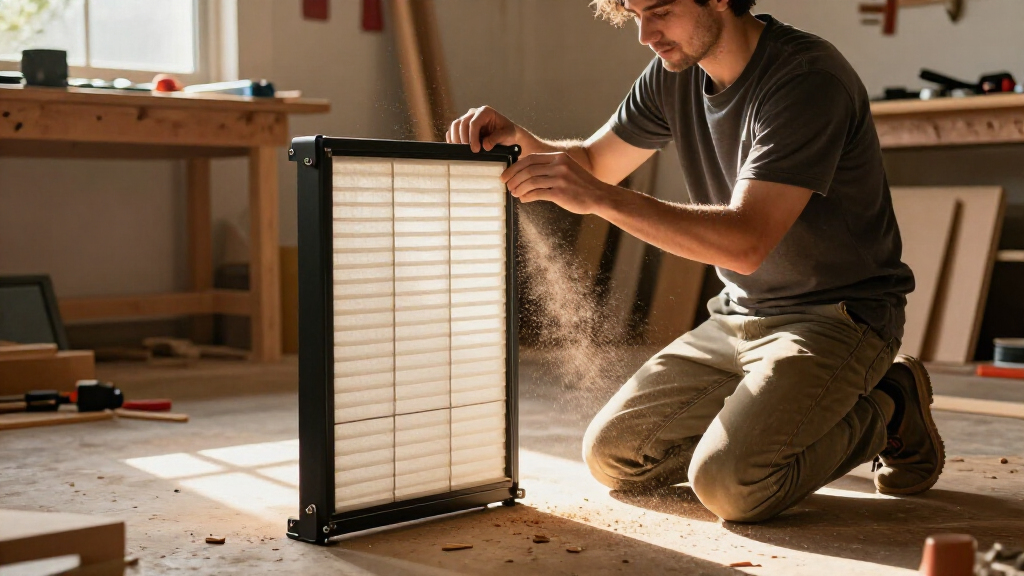
For HVAC filters, turn off the system before changing the filter, use the exact dimensions, and point the airflow arrow in the direction air travels. A filter installed backward or left with gaps around its edges may not perform as intended. If you try a higher-MERV filter and notice weak airflow, unusual equipment behavior, or a change in comfort, ask an HVAC professional to check compatibility instead of forcing the issue.
Duct-mounted systems can involve electrical connections, duct modifications, and changes to HVAC airflow. Have a licensed HVAC professional handle that work, follow local requirements, and keep power off while any authorized service work is performed. Do not treat electrical or duct changes as a casual weekend experiment. Dust collection and ventilation also need to keep working together: an air cleaner recirculates and filters room air; it does not supply outdoor air or remove every gas. That difference matters when a space needs fresh-air exchange or a pollutant source needs to be exhausted rather than recirculated.
Keep filters working with a simple inspection routine
Follow the manufacturer’s replacement schedule and inspect filters more often when you have pets, smoke, construction dust, or heavy shop use. A filter in a clean guest room may load slowly; the same model in a garage where you sand plywood can collect dust much faster. Actual conditions matter more than a calendar guess. As a filter loads, resistance can rise and airflow may fall, reducing how much room air the unit processes even if the fan still sounds normal.
In a woodshop, check the intake and prefilter after a few dusty sessions. If the prefilter is washable, clean it only as directed and let it dry fully before reinstalling. Replace disposable filters rather than washing them unless the manufacturer explicitly says they can be washed; water can damage media that was never designed for it. A clean prefilter can also protect the main filter from larger debris and help it last longer, which makes the brief inspection worthwhile.
For a central HVAC filter, inspect monthly at first so you can see how quickly it loads. Then set a routine that fits what you observe and the filter’s instructions. A filter can be due for replacement before it looks completely clogged, and a dirty filter may reduce airflow. If the system’s airflow or comfort changes after a filter swap, check the size, orientation, and filter compatibility.
Keep the unit’s exterior and air openings free of dust, and track the model number of replacement filters before you need one. A reminder in your phone or a note on the filter door can prevent the familiar problem of discovering a packed filter on the first cold morning. Reliable filtration comes from a working unit and a repeatable upkeep habit, not from buying the highest-rated filter and forgetting it. Replacing filters on time protects airflow and helps keep the unit’s performance closer to what you selected it for.
Use air cleaners as one layer of indoor air control
An air cleaner can reduce some airborne particles when it has enough capacity, runs consistently, and sits in the space where you need it. It does not prevent illness, remove every indoor pollutant, or correct a mold or combustion hazard. Source control and suitable ventilation still matter. This makes filtration one part of a plan: reduce or contain pollution where it starts, bring in or exhaust air where appropriate, and use a cleaner for the particles it can capture.
For example, if sanding a finish creates a sharp chemical smell, a particle-only HEPA purifier is not the fix. Stop and check the product’s directions, improve ventilation as appropriate, and use the protection specified for the job. If you have a combustion appliance and suspect a hazard, leave the area and contact the appropriate qualified service or emergency resource; do not rely on a purifier to make it safe. A purifier’s ability to trap particles should never be mistaken for removing hazardous gases or making an unsafe room safe to occupy.
Some products use ionizers, plasma features, or other active technologies. Since ozone can irritate lungs, prefer units that do not intentionally generate it and look for credible emissions information where available. App controls, quiet fan designs, and air-quality sensors can make routine use easier, but they do not replace model-specific particle performance or a clear filter-replacement plan. Convenience features help only if the unit’s underlying cleaning capacity suits the room and the selected mode actually runs often enough.
Portable HEPA filtration has drawn attention for reducing airborne particles in occupied rooms, but the result depends on room size, placement, runtime, and the particles present. If you have asthma or allergies, filtration may reduce some airborne triggers, but it does not treat the condition or remove every trigger; a clinician can help with health questions. Use the cleaner as one part of a broader plan, and be precise about what it can and cannot do. In practice, that means setting expectations around a reduction in certain airborne particles rather than assuming the room is free of all pollutants.
Frequently Asked Questions
What size air purifier do I need for my room?
Compare the unit’s CADR with the room’s floor area, ceiling height, and the cleaning rate you want. Check the room-size claim’s assumptions, since manufacturers may base it on a particular ceiling height and air-change rate. A tall room or open doorway can mean you need more capacity.
Is HEPA better than MERV?
They describe different filter contexts. HEPA is commonly used in standalone air cleaners, while MERV rates HVAC filters. Choose based on the device and its airflow limits, rather than treating the ratings as a direct one-to-one comparison.
Will a higher-MERV HVAC filter clean my home’s air better?
A higher MERV rating can improve capture across specified particle sizes, but the HVAC system must handle the filter’s resistance. If airflow weakens or comfort changes after installation, consult an HVAC professional about compatibility.
Do air purifiers remove odors, smoke, or VOCs?
Particle filters can capture some smoke particles, but odors and gases require suitable gas-phase media, often activated carbon. Results depend on the media’s type and quantity, airflow, and replacement schedule; a thin carbon sheet may have limited capacity.
Where should I place a portable air purifier?
Place it in the room where you need cleaner air, with the intake and outlet clear and the manufacturer’s spacing instructions met. Avoid curtains, furniture, or stored lumber that block circulation. In a shop, place it so racks and equipment do not wall off the intake.
Should I leave an air purifier on all day?
Continuous operation generally provides more consistent particle reduction because levels can rise again after filtration stops. Use a lower or automatic setting if noise is a concern, while checking that the chosen speed still provides the capacity you need.
How often should I change an air purifier filter?
Follow the unit’s instructions and inspect filters more often in dusty or high-use conditions. In a woodshop, check the prefilter after dusty sessions; for HVAC, monthly checks at first can show how quickly a filter loads in your home.
Can an air purifier help with allergies or asthma?
Particle filtration may reduce some airborne triggers, but it does not treat asthma or allergies and cannot remove every trigger. A clinician can advise you about health concerns and other ways to manage symptoms.
Conclusion
Start with the pollutant, then choose a system whose capacity, filter media, and operating cost fit the space. Install it with clear airflow, follow the manufacturer’s instructions, and keep the filter fresh enough to do its job.
In a small shop, the best air cleaner is the one that quietly keeps moving air while your dust collector catches the shavings at the blade. Make those two systems work together, and the sunbeam over your bench will show less dust drifting through it.