
TL;DR

Get business pricing on tools and workshop supplies
- Business-only prices and quantity discounts
- Tax-exempt purchasing
- Multiple users, one account, clear invoices
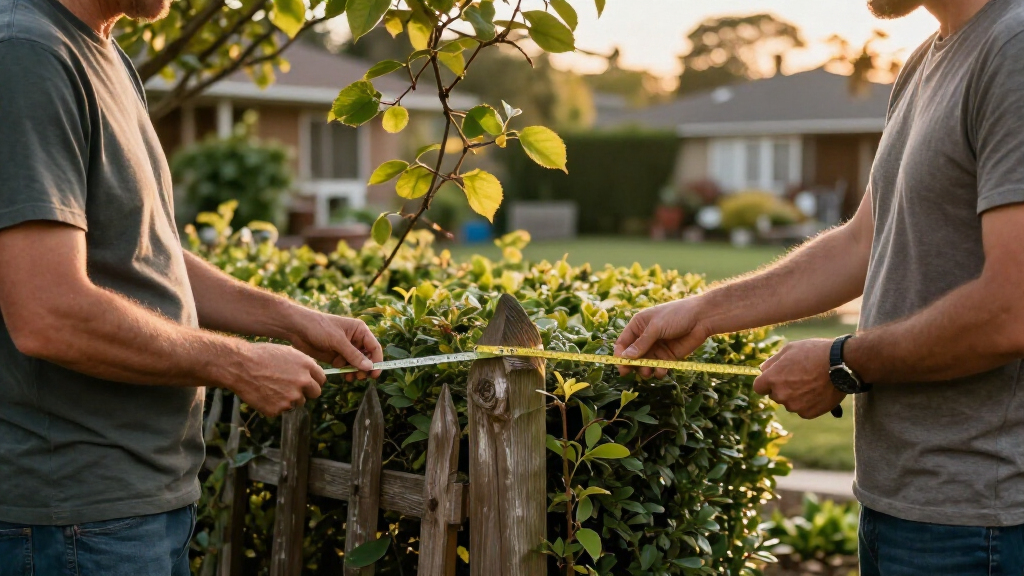
Ownership of a tree or hedge between neighbouring homes usually depends on the legal boundary and where the trunk or main stems sit, not simply on the position of a fence. Property deeds are a starting point, but boundaries may be imprecise; neighbours should check restrictions and discuss significant work before pruning or removal.
Homeowners trying to settle who owns a tree or hedge between adjoining gardens should begin with their property deeds and the position of the tree’s trunk, according to guidance reported by Ideal Home. The issue matters because ownership affects responsibility for care, while a neighbour’s right to trim overhanging growth is limited by the boundary and by protections that may apply to the tree.
Lucie Bradley, a gardening and greenhouse expert at Harvst Automatic Watering, told Ideal Home that deeds obtained through HM Land Registry can show the general extent of a property. A thick red line typically marks the boundary, while “T” marks may indicate responsibility for a boundary feature; matching marks on both sides, forming an “H”, can indicate shared responsibility. These signs are clues, not a precise survey of every boundary.
The location of a tree’s trunk or main stem in relation to the legal boundary is also relevant. MoneySuperMarket home insurance expert Kara Gammall told the publication that a tree with its trunk entirely on one property will generally belong to that landowner, even when branches or roots extend into a neighbour’s garden. A fence does not settle the question by itself: it may have shifted, and its position is not necessarily proof of the legal line.
If a trunk straddles the boundary, ownership and responsibility may be harder to determine. The report advises neighbours to discuss the tree or hedge and agree how to handle substantial pruning or removal. For growth crossing into a garden, Gammall said a person can generally prune back to the boundary on their own side, but should not enter the neighbour’s land or cut beyond the boundary without permission. She recommended speaking with the neighbour before major work that could affect the tree’s health or stability.
Why Boundary Ownership Matters
Disagreement over a hedge or tree can become a dispute about property rights, maintenance and damage. Establishing the likely boundary and ownership before work begins can help neighbours avoid cutting a tree they do not own, entering someone else’s land or making an irreversible change without agreement.
The practical right to trim encroaching branches is not the same as a right to remove or heavily prune a tree. The report says people cannot require a neighbour to cut down a healthy tree solely because they dislike its appearance. Local restrictions and wildlife protections may also apply, so checking first can prevent legal and financial consequences.
Popular right now

KitchenAid Classic Series 4.5 Quart Tilt-Head Stand Mixer K45SS, Onyx Black

Bose QuietComfort Wireless Bluetooth Headphones with Active Noise Cancellation, Mic, USB‑C Charging, Deep Bass, 24‑Hour Battery – White Smok

Ninja Hot & Iced XL Coffee Maker with Rapid Cold Brew, Black, CM371
As an affiliate, we earn on qualifying purchases.
Deeds, Fences and Tree Trunks
The guidance was published in an Ideal Home report responding to a common household question: how to resolve a tree or hedge problem when the boundary is uncertain. It also challenges the idea that homeowners automatically own the left-hand side of their garden, describing the “left-hand rule” as a widespread property myth.
Deeds can offer a useful first reference, but the report stresses that boundary lines on plans show the general extent of a property rather than a measurement accurate to the millimetre. Historic documents and the physical position of the trunk may help clarify the situation, but a fence alone should not be treated as conclusive.
Some trees may be protected by a Tree Preservation Order (TPO) or fall within a conservation area. Ian Wilson, managing director and home insurance expert at Tiger.co.uk, told Ideal Home that pruning a protected tree without permission can carry serious consequences, including fines of up to £20,000. He also warned that disturbing or harming nesting birds is illegal under the Wildlife and Countryside Act 1981. Homeowners can check with their local council; online tools may offer an indication, but the council is the source to contact for specific details.
“The place to start when trying to find out who owns a tree or hedge is to check your house deeds.”
— Lucie Bradley, gardening and greenhouse expert at Harvst Automatic Watering, speaking to Ideal Home
When the Boundary Is Disputed
The report provides general guidance, not a determination of ownership for any particular property. A deed’s boundary markings may not be precise, and the location of a fence or planting does not necessarily establish the legal boundary. Where a trunk crosses the line, the source says ownership can be more complicated; it does not set out a universal rule that resolves every such case.
Whether a specific tree has a TPO, lies in a conservation area or is subject to other local restrictions must be checked with the relevant council. The report’s stated potential fine of up to £20,000 concerns protected-tree work and is not a finding about any individual case. The appropriate response to a serious boundary disagreement will depend on the property records and circumstances.
Check Records Before Pruning
Homeowners should compare their deeds with the tree’s trunk position, then check with the local council for any TPO or conservation-area controls before carrying out work. If ownership appears shared or the boundary remains unclear, discussing care and proposed pruning with the neighbour is a sensible next step. The report does not announce a new rule or a scheduled policy change; it offers guidance for resolving individual garden disputes.
Key Questions
Does a fence show who owns a boundary tree?
Not necessarily. The report says fences can move over time, so their position is not definitive proof of the legal boundary. Check the property deeds and other relevant records before relying on a fence.
Who generally owns a tree whose trunk is entirely in one garden?
According to MoneySuperMarket expert Kara Gammall, the tree will generally belong to the owner of the land where its trunk sits, even if branches or roots extend into a neighbour’s garden.
Can I cut branches that cross into my garden?
The guidance says you can generally prune encroaching growth back to the boundary on your side. Do not cross onto the neighbour’s land or cut beyond the boundary without permission, and discuss substantial work first.
How can I check whether a tree is protected?
Contact your local council to check for a Tree Preservation Order or conservation-area restrictions. The report says online tools may provide an approximate indication, but the council can confirm details.
Source: rss