
TL;DR

Get business pricing on tools and workshop supplies
- Business-only prices and quantity discounts
- Tax-exempt purchasing
- Multiple users, one account, clear invoices
The best table saws for hobby woodworkers fall into three tiers: benchtop saws ($200–$400) for occasional small work, contractor and hybrid saws ($500–$1,500) for serious weekend projects, and safety-equipped saws like SawStop (over $1,000) for peace of mind. For most garage shops, a hybrid saw with a 1.5–2 HP motor, 30-inch rip capacity, a riving knife, and a 4-inch dust port hits the sweet spot of precision, safety, and space.
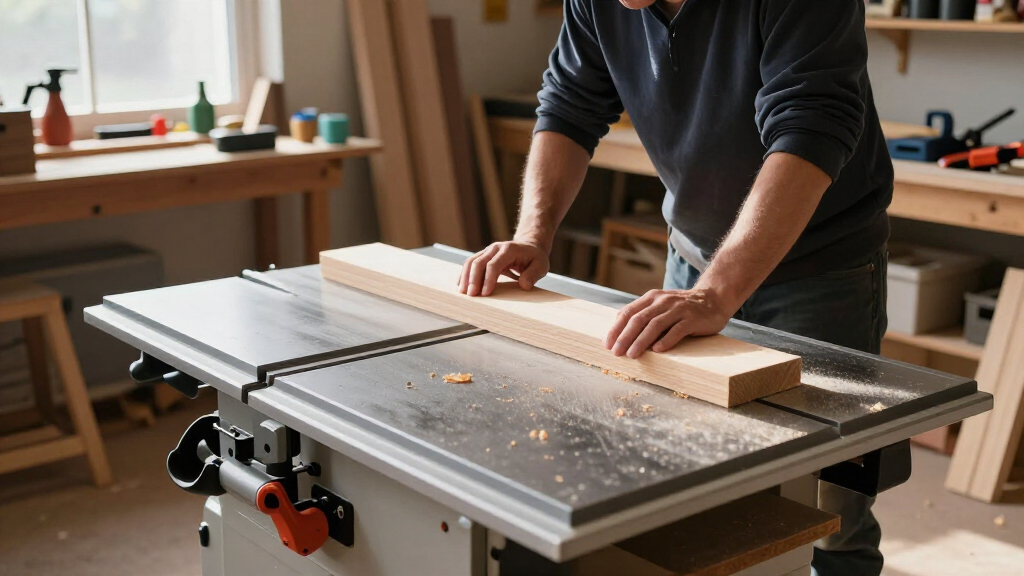
The first time you rip an 8-foot board of hard maple and the edge comes off glass-smooth, you understand why woodworkers call the table saw the heart of the shop. It’s the machine everything else orbits around — and it’s also the machine most beginners buy wrong, either overspending on capacity they’ll never use or cheaping out on a saw that fights them for years.
I’ve spent enough hours in a two-car garage shop to know what matters and what’s marketing. A 10-inch blade, a fence that locks dead straight, a riving knife, and a dust port that actually connects to your collector — those change your daily experience. WiFi-enabled apps and laser guides don’t.
This guide gives you a comprehensive overview of the most important aspects of choosing a table saw for a hobby shop: the four saw types and what each one is genuinely good at, the specs that predict accuracy, the safety features that are non-negotiable, and what to buy at three real budget levels. No affiliate fluff, no five-saw roundup — just the decision framework I wish someone had handed me before my first purchase.
Match the saw type to reality, not aspiration: benchtop for occasional small work, jobsite if the saw travels, hybrid if it lives in one garage spot.
Prioritize rip capacity of at least 24 inches (30 is better) — it determines whether sheet goods work is practical on your saw.
A riving knife, blade guard, and anti-kickback pawls are non-negotiable; flesh detection (SawStop) is a personal risk-versus-budget decision.
A $50–$100 quality 40-tooth ATB blade upgrades cut quality more than $500 of extra saw — replace the stock blade immediately.
Accuracy comes from setup: align blade to miter slot within 0.003 inches, parallel the fence, and recheck after any transport.
Best Table Saws for Hobby Woodworkers
The first time you rip an 8-foot board of hard maple and the edge comes off glass-smooth, you understand why woodworkers call the table saw the heart of the shop. A 10-inch blade, a fence that locks dead straight, a riving knife, and a real dust port change your daily experience. WiFi apps and laser guides don’t.
The 4 Types of Table Saws — And Which Fits Your Garage
Each type answers a different question about your shop: how much space you have, how thick the stock you cut, and whether the saw lives in one spot or travels. The trap I see constantly: a hobbyist buys a jobsite saw “for flexibility,” then never moves it once — paying for wheels and a folding stand while giving up cast iron and an induction motor.
Benchtop
8-1/4″–10″ blade, direct-drive universal motor, mostly aluminum table. Carries under an arm — almost. Cuts thousands of feet of pine for jigs, but screams like a circular saw.
$200–$400 · 40–70 lbs · 12–18″ ripJobsite
Benchtop saws that grew up: folding wheeled stand, better fences, 20–26″ rip capacity. DeWalt 7491 and Bosch 4100 territory. Right pick if the saw genuinely travels.
$400–$700 · 10″ blade · 20–26″ ripContractor
Induction motor — quieter, longer-lasting, more torque — hung out the back. Cast-iron ground table flat to a few thousandths. Serious ripping from a fixed shop position.
$600–$1,200 · 10″ blade · 30″+ ripHybrid
Contractor power with the motor enclosed in a cabinet — dramatically better dust collection. For a hobbyist with a fixed garage spot, hybrid is usually the endgame.
$900–$1,500 · 10″ blade · 30–36″ rip| Type | Typical Price | Blade / Rip Capacity | Best For |
|---|---|---|---|
| Benchtop | $200–$400 | 8-1/4″–10″ / 12–18″ | Small projects, tiny shops, beginners |
| Jobsite | $400–$700 | 10″ / 20–26″ | Portable use, mixed site/shop work |
| Contractor | $600–$1,200 | 10″ / 30″+ | Fixed shop position, serious ripping |
| Hybrid | $900–$1,500 | 10″ / 30–36″ | Dedicated hobby shop, best dust control |
The Specs That Actually Predict Accuracy (Ignore the Rest)
Three specs predict accurate cuts: fence quality, table flatness, and rip capacity. Motor horsepower gets the advertising attention, but a 1.5 HP saw with a dead-flat table and rigid fence will out-cut a 3 HP saw with a wobbly fence every day of the week.
The $50 upgrade that beats $500 of saw: a quality 40-tooth ATB blade upgrades cut quality more than $500 of extra machine. Replace the stock blade immediately.
Safety Features You Shouldn’t Compromise On
Kickback happens when the kerf closes behind the blade and pinches it — the saw hurls the board back faster than you can react. Per the Power Tool Institute, kickback and blade contact account for the majority of serious table saw injuries.
Riving Knife
Sits in the kerf behind the blade and physically holds it open. Stays mounted on every cut. Never remove it — and check any used saw: pre-2008 models often have no mount at all.
Guard + Pawls
Blade guard and anti-kickback pawls ship standard on every modern name-brand saw — DeWalt, Bosch, Delta, Makita — thanks to updated UL standards.
Flesh Detection
SawStop stops and drops the blade in milliseconds on skin contact. A contractor model runs $1,500+ — but one ER visit for a lacerated finger costs tens of thousands.
Setting Up Your Saw for Dead-Accurate Cuts
Accuracy comes from setup, not purchase price. Recheck after any transport.
Unbox & Level
Set the saw on a flat, stable surface. Bolt it down or lock the stand.
Zero wobble allowedAlign Blade to Miter Slot
Measure front and rear of blade to the miter slot; adjust the trunnion until parallel.
Within 0.003″Parallel the Fence
Lock the fence and measure to the blade at both ends. Correct any drift.
Dead parallelMount & Check Riving Knife
Confirm the knife aligns with the blade profile. Test-cut and verify a glue-ready edge.
Recheck after transportSheet goods become a wrestling match with a circular saw and straightedge.
Breaks down a full plywood sheet cleanly in two rips — 24″ rip, then flip.
Rips 4×8 sheet goods into cabinet-sized panels with room to spare.
The Decision Framework
- Match the saw type to reality, not aspiration: benchtop for occasional small work, jobsite if the saw travels, hybrid if it lives in one garage spot.
- Prioritize rip capacity of at least 24 inches (30 is better) — it determines whether sheet goods work is practical on your saw.
- A riving knife, blade guard, and anti-kickback pawls are non-negotiable; flesh detection (SawStop) is a personal risk-versus-budget decision.
- A $50–$100 quality 40-tooth ATB blade upgrades cut quality more than $500 of extra saw — replace the stock blade immediately.
- Accuracy comes from setup: align blade to miter slot within 0.003″, parallel the fence, and recheck after any transport.
The 4 Types of Table Saws — And Which One Fits Your Garage
The best table saws for hobby woodworkers come in four types: benchtop, jobsite, contractor, and hybrid. Each type answers a different question about your shop — how much space you have, how thick the stock you cut, and whether the saw lives in one spot or travels.
Benchtop saws are the lightweight contenders. Think a 8-1/4 to 10-inch blade, a direct-drive universal motor, and a mostly aluminum table. They weigh 40–70 pounds, cost $200–$400, and you can carry one under an arm — well, almost. My first saw was a benchtop model, and it cut thousands of feet of pine for birdhouses and shop jigs. It also screamed like a circular saw, because that’s basically what the motor is.
Jobsite saws are benchtop saws that grew up: a folding wheeled stand, better fences, and typically 20–26 inches of rip capacity. This is the DeWalt 7491 and Bosch 4100 territory. If you occasionally work on a deck or a friend’s kitchen, this is your category.
Contractor and hybrid saws live in the shop permanently. Both run an induction motor — quieter, longer-lasting, more torque — and carry a cast-iron ground table that stays flat to a few thousandths of an inch. The difference: contractor saws hang the motor out the back, hybrids enclose it in a cabinet with better dust collection. For a hobbyist with a fixed spot in the garage, hybrid is usually the endgame.
| Type | Typical Price | Blade / Rip Capacity | Best For |
|---|---|---|---|
| Benchtop | $200–$400 | 8-1/4″–10″ / 12–18″ | Small projects, tiny shops, beginners |
| Jobsite | $400–$700 | 10″ / 20–26″ | Portable use, mixed site/shop work |
| Contractor | $600–$1,200 | 10″ / 30″+ | Fixed shop position, serious ripping |
| Hybrid | $900–$1,500 | 10″ / 30–36″ | Dedicated hobby shop, best dust control |
The trap I see constantly: a hobbyist buys a jobsite saw “for flexibility,” then never moves it once. You paid for wheels and a folding stand you don’t use, while giving up cast iron and an induction motor. Be honest about whether the saw will actually travel.
best hybrid table saw for hobby woodworking
As an affiliate, we earn on qualifying purchases.
As an affiliate, we earn on qualifying purchases.
The Specs That Actually Predict Accuracy (Ignore the Rest)
Three specs predict whether a table saw will cut accurately: fence quality, table flatness, and arbor runout. Motor horsepower gets all the advertising attention, but a 1.5 HP saw with a dead-flat cast-iron table and a rigid fence will out-cut a 3 HP saw with a wobbly fence every single day of the week.
Start with the fence. A good fence locks parallel to the blade along its entire length, stays put when you crank down on it, and slides smoothly. Cheap fences flex — you lock them, and the far end drifts a few thousandths. That’s the difference between a glue-ready edge and one that leaves a visible gap in your panel glue-up. Hold the fence lock lever on any saw you’re considering in person and try to twist the fence by hand. If it moves, walk away.
Table flatness matters more than most beginners realize. A cast-iron ground table is typically flat within about 0.005 inches across its surface. Stamped steel and cast aluminum tables on benchtop saws can vary far more and can warp over years. Since the table is your reference surface for every cut, that flatness becomes the ceiling on your accuracy — you can’t cut straighter than your reference.
Here’s the spec I’d chase hardest: rip capacity. You need at least 24 inches to break down a full sheet of plywood cleanly in two rips (24-inch rip, then flip). At 30 inches, you can rip 4×8 sheet goods into cabinet-sized panels with room to spare. Under 20 inches, and sheet goods work becomes a wrestling match with a circular saw and a straightedge guide instead.
Miter gauges are the opposite story: almost all stock gauges are mediocre. Don’t pay extra for a fancy one — plan to add a third-party miter gauge or sled later. A crosscut sled you build yourself will outperform any included gauge anyway.
table saw with 30 inch rip capacity
As an affiliate, we earn on qualifying purchases.
As an affiliate, we earn on qualifying purchases.
Safety Features You Shouldn’t Compromise On
The non-negotiable safety features on any hobbyist table saw are a riving knife, a blade guard, and anti-kickback pawls. The optional-but-life-changing one is flesh-detection technology, pioneered by SawStop, which stops and drops the blade in milliseconds on skin contact.
Let’s talk about why the riving knife matters most. Kickback happens when the kerf closes behind the blade and pinches it — the saw grabs the board and hurls it back at you faster than you can react. A riving knife sits in the kerk behind the blade and physically holds it open. It stays mounted on every cut because it doesn’t interfere with the guard. According to the Power Tool Institute, kickback and blade contact account for the majority of serious table saw injuries — and a riving knife addresses the first cause directly.
Every modern name-brand saw — DeWalt, Bosch, Delta, Makita — ships with a riving knife now, thanks to updated UL standards. But I still see hobbyists removing them because they “get in the way.” They get in the way of the emergency room too. If you buy used, check this first: older saws from before roughly 2008 often have no riving knife mount at all.
Flesh detection is the honest budget question. A SawStop contractor saw runs over $1,500 — real money. But consider the math: an ER visit for a lacerated finger runs tens of thousands of dollars before you count lost work time. If you’re a beginner, you cut tired after work, or you have kids who’ll learn on this saw, the premium buys more than convenience. If you’re an experienced woodworker with disciplined habits, a well-maintained saw with standard safety features is defensible. Only you can price your own risk tolerance.
Buy the saw with every guard and knife installed — then learn to use push sticks, featherboards, and a proper stance before your first rip. Safety gear only works when it’s mounted.
Add the cheap layer too: a pair of push sticks ($15), featherboards ($40), and safety glasses. Never wear gloves at the table saw — a glove catches the blade and pulls your hand in with it.
As an affiliate, we earn on qualifying purchases.
What $300, $700, and $1,500 Actually Buy You
You can find a genuinely good table saw under $500, and you can also waste $500. The difference between budget tiers isn’t just quality — it’s which problems each tier has already solved. Here’s what your money buys at three realistic hobbyist price points.
Under $400: solve the basic-cut problem. You get a benchtop or entry jobsite saw, a 10-inch blade, and enough power for 3/4-inch hardwood if you feed it patiently. Expect a loud universal motor, a mediocre fence, and dust collection that amounts to a bag you’ll empty twice per project. This tier is right if you build occasionally, cut mostly dimensional lumber, and don’t yet know how often you’ll use it.
$500–$900: solve the fence and capacity problem. This is where jobsite saws get serious — better rack-and-pinion fences, 26–32 inches of rip capacity, and stands at working height. Most weekend woodworkers should land here. A saw in this range will handle plywood cabinetry, furniture-scale ripping, and years of regular use without fighting you.
$1,000–$1,600: solve the precision and dust problem. Hybrid territory: cast-iron table, induction motor that hums instead of screams, enclosed cabinet with a 4-inch dust port, and a fence you can trust for joinery like tenons and box joints. If you already know woodworking is a permanent hobby, buying this tier once beats upgrading through the lower two — which is exactly what I did, and what I’d skip if I started over.
- Under $400: buy for access, not precision — benchtop or basic jobsite
- $500–$900: the sweet spot for most hobby shops — jobsite with 26″+ rip capacity
- $1,000+: buy once, cry once — hybrid saw with cast iron and real dust collection
One honest note on used saws: an old Delta contractor saw for $300 can outperform a new $600 jobsite saw if the bearings and fence are sound. Check arbor runout by spinning the blade and watching a mark against a fixed point, and inspect the table for rust pitting deeper than surface orange.
benchtop table saw for small projects
As an affiliate, we earn on qualifying purchases.
As an affiliate, we earn on qualifying purchases.
Dust Collection and the Blade Nobody Talks About
A table saw can generate 5–10 gallons of chips and fine dust per hour of active cutting, and the fine fraction is the part that ends up in your lungs. Dust collection isn’t a shop-cleanliness issue — it’s a health issue, and it’s the most under-planned part of most hobby shops.
Here’s the tiered reality. Benchtop and jobsite saws have small dust ports (usually 2-1/2 inches) that capture maybe half the dust — the rest sprays out the bottom of the blade shroud. A shop vac moves around 100 CFM, which handles the port but not the overshoot. Hybrid and cabinet saws with 4-inch ports need a dust collector at 650–1,100 CFM to do the job properly. That’s the real hidden cost of stepping up to a cabinet-style saw: you should budget another $300–$600 for a collector.
Whatever tier you’re in, do two things. First, seal the cabinet on a hybrid saw with foam tape — a leaky cabinet bleeds fine dust into the shop air all session long. Second, add ambient air filtration (a $150 box fan unit moving 400 CFM catches what escaped the collector). Your sinuses at 60 will thank you. Wear a minimum of an N95 when cutting; fine dust runs 1–10 microns and passes straight through a bandana.
Now the blade — the cheapest accuracy upgrade in all of woodworking. The combination blade that ships with most saws is a compromise in the worst sense. Swap it for a quality 40-tooth ATB (alternate top bevel) combination blade from Freud or Forrest-class makers for $50–$100 and your cut quality jumps immediately — burned edges and tearout mostly disappear. A 24-tooth ripping blade for thick stock and an 80-tooth blade for plywood are the two additions worth making after that. A $70 blade on a $400 saw beats a stock blade on a $1,500 saw, every time.
Setting Up Your Saw for Dead-Accurate Cuts
Accuracy comes from setup, not purchase price. Even a mid-tier saw will cut within a few thousandths of an inch after a proper tune-up — and even an expensive saw will cut crooked if you skip one. Set up takes an hour, and it’s the difference between fighting your saw and trusting it.
- Align the blade to the miter slot. Using a combination square or dial indicator, measure the distance from blade tooth to miter slot at the front, rotate the blade 180 degrees, and measure again. Get the difference under 0.003 inches. Adjust the trunnions or table per your manual. This single step eliminates most burn marks and wander.
- Set the blade at exactly 90 degrees to the table using a reliable square, then verify with a crosscut of scrap — flip one piece over, mate the cut faces, and check for light gaps.
- Calibrate the fence parallel to the blade. A fence angled toward the blade’s rear causes kickback; angled away causes burn marks on the edge. Parallel is the only correct answer.
- Check the throat plate sits flush with the table. A raised plate catches workpieces mid-cut; a sunken one snags small offcuts.
- Wax the table with paste wax (not silicone-containing products — they interfere with finishes). A waxed cast-iron surface glides and resists rust.
Recheck alignment every few months, or whenever you’ve hauled the saw anywhere. Trunnions shift under vibration and transport; it’s normal, not a defect. The tell that you’re due: your rips start leaving a slightly shiny, burnished edge that’s hard to plane or sand out later.
A real example: a friend blamed his “cheap saw” for a year of slightly tapered drawer boxes. Twenty minutes of trunnion alignment — the blade was out 0.012 inches front to back — and the taper vanished. The saw was never the problem. The setup was.
Frequently Asked Questions
What is the best table saw for a beginner hobby woodworker?
A 10-inch jobsite saw in the $400–$700 range with at least 24 inches of rip capacity, a rack-and-pinion fence, and a riving knife is the best starting point for most beginners. Models in the DeWalt 4100/7491 and Bosch 4100 class give you enough accuracy and capacity to grow into without the cost or footprint of a hybrid saw. Pair it with a quality 40-tooth ATB blade and a $15 pair of push sticks.
Can a portable or benchtop saw handle larger projects like cabinets?
Yes, with limits. A benchtop saw with 15–18 inches of rip capacity can cut cabinet parts if you break down full plywood sheets with a circular saw and straightedge first, then use the table saw for finished edges. A jobsite saw with 26+ inches of rip capacity can rip sheet goods directly. What portable saws struggle with is thick hardwood — a 1.5 HP-class universal motor bogs down ripping 8/4 maple, so feed slowly and use a 24-tooth ripping blade.
How important are safety features like SawStop’s flesh detection?
Standard features — riving knife, blade guard, anti-kickback pawls — are essential and ship on every name-brand modern saw. Flesh-detection systems cost roughly a $1,000+ premium and stop the blade within milliseconds of skin contact. It’s worth strong consideration for beginners, anyone who cuts tired or distracted, or shops where family members use the tool. Experienced woodworkers with disciplined habits and standard safety equipment can reasonably opt out, but never operate a saw without the riving knife mounted.
What is the difference between a contractor saw and a hybrid saw?
Both use induction motors and cast-iron tables, but a contractor saw hangs the motor off the back of the saw on a bracket, leaving the cabinet open — simpler, cheaper, but poor dust collection. A hybrid saw mounts the motor inside an enclosed cabinet with belt drive and a 4-inch dust port, giving quieter operation and far better dust capture. For a hobby shop where the saw stays put, the hybrid’s dust collection advantage usually justifies its modest price premium.
Can I find a good table saw under $500?
Yes. Under $500 you’re choosing between a quality benchtop saw ($200–$400) and an entry-level jobsite saw on promotion ($400–$500). You’ll live with a loud universal motor, modest dust collection, and a smaller rip capacity — but cut quality can still be very good after proper blade alignment and a $60 aftermarket blade. The used market is also strong here: an older cast-iron contractor saw for $300 often outperforms new benchtop models if the bearings, fence, and table check out.
What maintenance does a hobby table saw need?
Monthly: wax the table surface to prevent rust and reduce friction, and clean dust from trunnions and gears. Yearly: check blade-to-miter-slot alignment (keep it under 0.003 inches), lubricate the fence rails and height/bevel adjustment screws with dry PTFE lubricant, and inspect the belt on belt-driven saws. Always unplug the saw before any blade change or internal work. With that routine, an induction-motor saw will outlast most hobbies — 20+ years is common.
Conclusion
If you take one thing from this guide: buy the saw that matches how you actually work, then spend an hour setting it up properly and put a good blade on it. A tuned $600 jobsite saw with a sharp 40-tooth blade and mounted riving knife will out-perform a neglected $1,500 machine, every project, for years.
Picture the saw five years from now — covered in shop dust, the fence worn shiny where your hand lands, the blade guard actually still mounted. Buy the one that earns that patina in your shop, not the one that impresses in the parking lot.
Fall yard work Picks
leaf blowers
As an affiliate, we earn on qualifying purchases.