
TL;DR

Get business pricing on tools and workshop supplies
- Business-only prices and quantity discounts
- Tax-exempt purchasing
- Multiple users, one account, clear invoices
A lumber stamp provides information a price tag and visual inspection cannot: the board’s grade, species, grading agency, mill and moisture condition. Those details connect framing lumber to published design values and building-code span tables, though a stamp does not guarantee every individual board is on grade.
A framing-lumber stamp tells buyers more than a board’s price or appearance: it identifies the grade, species, grading agency, mill and moisture condition, information used to determine whether lumber is rated for structural purposes and how it fits building-code span tables. A Family Handyman report, drawing on lumber graders and industry standards, says reading the mark can help buyers distinguish boards that look similar but carry different ratings.
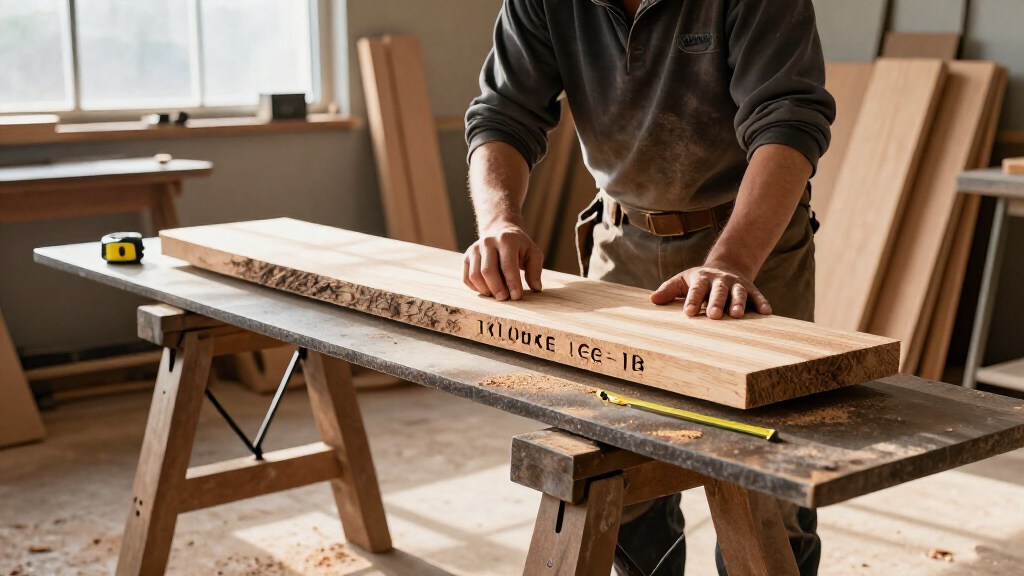
The report describes the stamp as a block of ink commonly found near one end of framing lumber such as 2-by-4s and 2-by-6s. Its five standard fields identify the mill, the grading agency, the grade, the species and the board’s moisture condition when it was surfaced. Some stamps also include a surfacing note. The mill identification can help trace a product, while the other fields speak more directly to how the board was graded and what published design values apply.
Under the 2024 International Residential Code, sawn lumber used for load-supporting floor, wall and roof framing must carry a grade stamp or a certificate of inspection. The grade and species connect to published strength values, which are used in span tables showing how far a joist or rafter of a specified size, grade, species and spacing can span between supports. A board’s grade reflects how features such as knots, splits and holes affect strength; it is not simply a cosmetic ranking.
The report also cautions that a stamp is not a guarantee that every board in a retail bin meets its printed grade. Paul Conway, executive vice president of the American Lumber Standard Committee (ALSC), said grading agencies check mills by shipped units, and a unit is considered on grade when at least 95% of its pieces qualify. The report says published design values are deliberately conservative, accounting for weaker pieces and long-term loading.
Why the Grade Affects Framing
For a homeowner or contractor buying material for a load-bearing job, the stamp helps answer a question the price tag cannot: what structural rating is this board assigned? Boards of the same dimensions can have different grades, species and design values. Selecting material based only on appearance—or assuming two boards are interchangeable because they are both 2-by-4s—can lead to a mismatch with the plans or applicable span requirements.
The mark also offers a way to check the grading system behind a board. The report says ALSC accredits grading agencies under the federal lumber standard, and the agencies’ rules for dimension lumber conform to a common National Grading Rule. That provides a shared basis for interpreting grades across participating agencies. Buyers can consult ALSC’s published agency list to check an unfamiliar mark rather than treating any printed logo as proof of accredited grading.
For people doing home construction or renovation, the practical takeaway is to use the grade and species specified for the project, not to treat the stamp as a substitute for plans, code requirements or professional judgment. The report concerns framing lumber; its explanation does not mean every stamped board is suitable for every structural use. Span, spacing, loads and local requirements still matter.
As an affiliate, we earn on qualifying purchases.
How Lumber Grading Is Overseen
The report’s account is based in part on the experience of Pete Austin, the Western Wood Products Association’s director of quality, who has worked in lumber grading for nearly 30 years. It recounts a buyer rejecting five boards for wane—the loss of wood or bark along an edge—then choosing five replacements that were all below grade. The example illustrates the report’s central point: visual selection alone may not reveal a board’s assigned structural grade.
According to the report, a qualified grader or an agency-approved grading machine assigns the grade under rules overseen by an ALSC-accredited agency. Agency supervision is separate from the mill’s production: the grader may work for the mill, while the agency inspects it. ALSC requires inspections at least 12 times a year, and the report says the standard bars accreditation of an agency controlled by a producer whose products it inspects.
The grade is one field, not the entire stamp. The species matters because published design values vary by species or species group. The moisture marking describes the wood’s condition when surfaced, or planed to its final dimensions; it can help buyers understand that some shrinking may occur after installation. The report does not give a single shrinkage amount for all boards, since that depends on the lumber and its conditions.
“I don’t think that they fully understand what it is they’re buying.”
— Pete Austin, director of quality at the Western Wood Products Association, as quoted in the Family Handyman report
As an affiliate, we earn on qualifying purchases.
Limits of What the Stamp Proves
The report does not identify a particular lumber product recall, code change or new grading rule; its development is an explanation of how existing stamps and standards work. It also does not provide product-specific span distances or a universal amount of shrinkage. Those figures depend on details such as species, grade, dimensions and installation conditions, and should not be inferred from the stamp alone.
The 95% unit threshold means a qualifying shipment can still contain individual pieces that do not meet the grade. The report gives no estimate of how often a shopper will encounter such a board in a particular store or bundle. Buyers should not assume that a stamp makes visual checks unnecessary, nor that a board without a recognizable mark is automatically defective; the report says an unrecognized logo should be checked against the ALSC list before its grade is relied upon.
Local code adoption and project-specific requirements may also differ. The cited 2024 International Residential Code provision describes the model code requirement reported by Family Handyman; the source does not establish which edition or local amendments apply to every reader’s project.
As an affiliate, we earn on qualifying purchases.
Check the Mark Before Buying
For a framing purchase, readers can start by comparing the stamp with the project specifications: check the grade and species, then confirm the grading-agency logo against ALSC’s agency list if it is unfamiliar. The report says its January 2026 list includes U.S. and Canadian grading agencies; Canadian stamps follow Canadian grading rules and use the agencies’ own logos.
Anyone planning to use lumber for a load-bearing floor, wall or roof should confirm the required grade, species, spacing and span against applicable plans and code tables rather than choosing solely by price or appearance. If those specifications are unclear, a qualified building professional or local building department can help interpret the requirements. The report sets out no new deadline or further policy action; the next practical step for buyers is to read the stamp and verify that the board matches the intended use.
As an affiliate, we earn on qualifying purchases.
Key Questions
What information is printed on a framing-lumber stamp?
According to the report, the standard fields identify the mill, grading agency, grade, species and moisture condition when the lumber was surfaced. Some stamps also include a surfacing note.
Does a grade stamp mean every board in the bundle meets its grade?
No. Paul Conway of ALSC said grading is checked by shipped unit, and a unit is considered on grade if at least 95% of its pieces qualify. The stamp does not guarantee every individual board is on grade.
Why do the grade and species matter?
Together, they connect the board to published design values used in span tables. Those tables account for lumber details such as size, grade, species and spacing when setting spans between supports.
What should I do if I do not recognize the grading logo?
Check the mark against the ALSC list of accredited grading agencies, as the report recommends. Do not rely on an unfamiliar logo as evidence of an accredited grade without verifying it.
Can I choose structural lumber by appearance alone?
The report says appearance can be misleading: visible features such as knots or edge damage do not, by themselves, tell a buyer the board’s assigned grade. For load-bearing work, match the stamp and project specifications, and follow applicable plans and code requirements.
Source: rss
Fall yard work Picks
leaf blowers
As an affiliate, we earn on qualifying purchases.