TL;DR

Get tools and workshop supplies delivered free — and shop member deals
- Fast, free delivery on millions of items
- Access to Prime Big Deal Days deals on October 6–7
- Prime Video, Amazon Music and more included
A Hunker report describes crushed granite as a driveway alternative that compacts into a more stable surface than loose gravel while still allowing drainage. It says the material averages $25 to $50 per cubic yard, but installation requires excavation, layered compaction and edging; long-term performance depends on proper installation and maintenance.
A Hunker report identifies crushed granite as an alternative to standard gravel for homeowners seeking a firmer-looking driveway surface that may need less frequent reshaping. The report puts crushed granite at an average of $25 to $50 per cubic yard, a range that overlaps with its stated $15 to $75 range for gravel, while cautioning that installation is more involved and durability depends on proper preparation.
Unlike naturally weathered gravel, whose pieces vary in shape, crushed granite is made from solid granite broken into uniform, angular pieces. According to Hunker, those edges interlock more tightly when compacted. The material can still allow water to drain, the report says, while its more stable surface may be less prone to shifting and rutting than loose gravel. Hunker says a properly installed and maintained crushed granite driveway can last 20 years or more; that is a source-reported estimate, not a guarantee for every site.
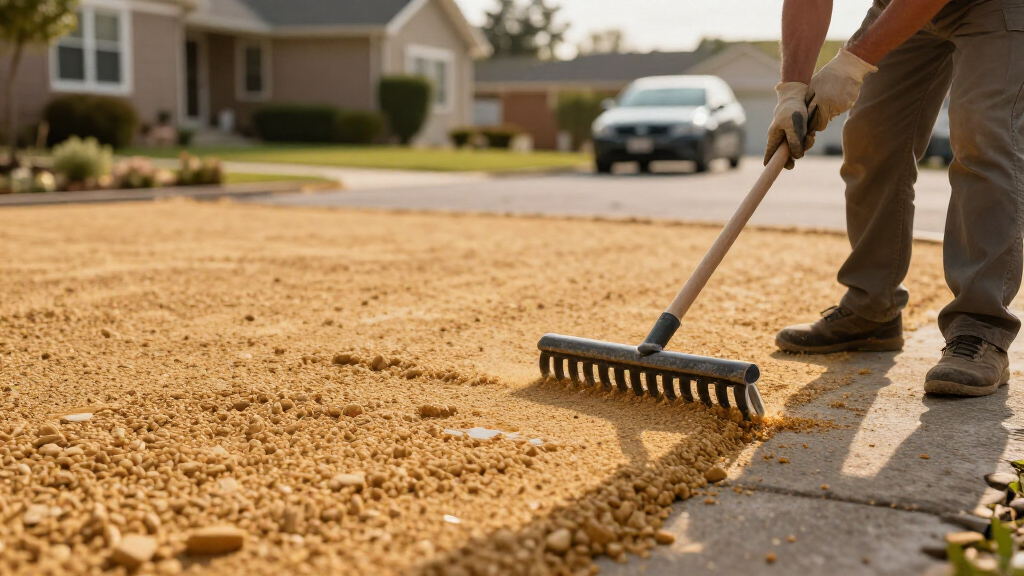
The report says a typical installation begins with excavation. For a driveway that will regularly carry vehicles, it cites a recommended depth of 6 to 8 inches. The base is graded to direct drainage, and installers may use landscape fabric to limit the stone sinking into the soil. Edge restraints help contain the material. Crushed granite is then spread and compacted in layers about 2 inches deep, with water applied to aid compaction. A finer grade is often used for the surface layer.
Those steps distinguish the project from simply spreading loose stone over a drive. Hunker warns that placing the entire depth at once can prevent proper compaction and contribute to later movement. The quoted material prices do not include a full installed-project estimate, and excavation, delivery, labor, edging and site preparation can affect the final bill.
A Firmer Surface With Upfront Work
For homeowners tired of filling ruts and regrading gravel, crushed granite offers a possible trade-off: a more tightly compacted surface, but a more demanding installation. Its stated material-price range is competitive with gravel, although the broad ranges overlap and do not establish which choice will be cheaper for a particular driveway. Comparing quotes should include delivery, labor, excavation and drainage work, rather than stone price alone.
Drainage and site conditions matter as much as appearance. The report says crushed granite remains permeable, but it does not provide performance data for different climates, soil types or driveway slopes. Poor grading or insufficient compaction can undermine the benefit. Homeowners should ask contractors how the base will be prepared, how runoff will be handled and what maintenance the installed surface is expected to need.
crushed granite driveway installation kit
As an affiliate, we earn on qualifying purchases.
As an affiliate, we earn on qualifying purchases.
How Granite Differs From Other Stone
The report also distinguishes crushed granite from decomposed granite, a much finer material with a sand-like texture. Though both come from granite, decomposed granite can shift or rut under heavy rain and vehicle traffic, according to Hunker. The two materials should not be treated as interchangeable when comparing bids or planning a driveway.
Crushed limestone is another option. Its angular pieces can compact well and it is usually cheaper than crushed granite, the report says. But Hunker notes that limestone is more vulnerable to weathering and erosion. It can also gradually raise soil pH, a consideration for gardens with acid-loving plants near the drive. The report says the choice between limestone and granite often depends on price and local availability.
Standard gravel remains a familiar and potentially less costly material, but its irregular pieces can move over time. The comparison is not simply about which stone looks better: the driveway’s expected traffic, drainage, soil and local supply all affect how each surface performs.
As an affiliate, we earn on qualifying purchases.
Costs and Lifespan Vary by Site
The source gives broad per-cubic-yard material ranges but does not specify a location, date for those prices, or a national pricing methodology. They should be treated as reported averages, not current quotes for every market. It also does not provide a direct, controlled comparison of maintenance costs or confirm that every crushed granite installation will last 20 years.
Details such as the required excavation depth, need for fabric, amount of edging and drainage design depend on the property and expected use. The source does not set out local permitting or construction requirements. Homeowners should check applicable rules and obtain site-specific estimates before choosing a material.
As an affiliate, we earn on qualifying purchases.
Get Site-Specific Driveway Quotes
For homeowners considering a change, the next step is to compare estimates for crushed granite, gravel and locally available alternatives on the same scope of work. Quotes should separate material from preparation and installation, and state the planned depth, base grading, compaction method, edging and drainage provisions.
Contractors can also assess whether the driveway’s soil and slope are suited to the chosen stone and what upkeep to expect. Until those details and local prices are known, crushed granite is best understood as a promising option described in the report—not a universally cheaper or maintenance-free replacement for gravel.
As an affiliate, we earn on qualifying purchases.
Key Questions
Is crushed granite cheaper than gravel?
Hunker reports average material costs of $25 to $50 per cubic yard for crushed granite and $15 to $75 for gravel. The ranges overlap, and the source does not give installed costs or local quotes, so the final comparison depends on location and project work.
How long can a crushed granite driveway last?
Hunker says a properly installed and maintained driveway can last 20 years or more. That is a reported estimate, not a guaranteed lifespan; site conditions, installation quality and maintenance can affect durability.
Is crushed granite the same as decomposed granite?
No. The report describes crushed granite as angular stone in varying grades, while decomposed granite is much finer, almost like sand. Hunker says heavy rain and vehicle traffic can cause decomposed granite to rut or shift over time.
What does crushed granite installation involve?
The process generally includes excavation, grading for drainage, optional landscape fabric, edge restraints and compaction in layers. For regular vehicle traffic, Hunker cites a recommended excavation depth of 6 to 8 inches, but a contractor should assess the specific site.
Could crushed limestone be a better option?
Crushed limestone may cost less and can compact well, according to Hunker. The report also says it erodes more readily than granite and may raise soil pH over time, which can matter for nearby acid-loving plants.
Source: rss
Halloween Picks
halloween
As an affiliate, we earn on qualifying purchases.