TL;DR

Get business pricing on tools and workshop supplies
- Business-only prices and quantity discounts
- Tax-exempt purchasing
- Multiple users, one account, clear invoices
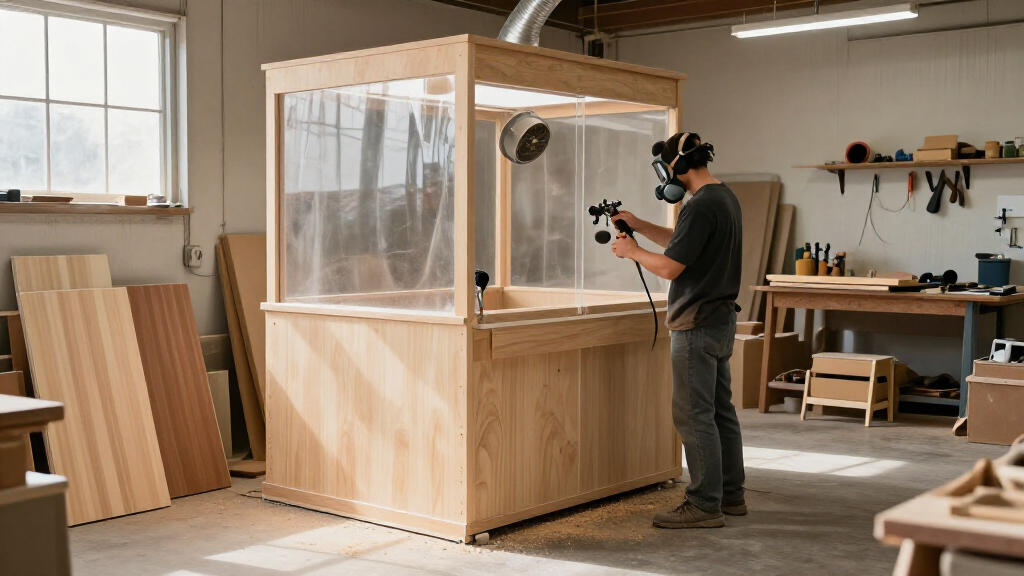
A dedicated finishing spray booth gives you a controlled place to spray, capture overspray, and move contaminated air outdoors. Choose the location and size around your largest workpiece, then have ventilation, electrical, fire, and permit requirements reviewed for your coatings and jurisdiction before building or spraying. A box fan and household filters are not a safe general-purpose solution for flammable coatings.
A beautiful finish can go sideways before the first coat dries: airborne dust lands in the wet film, overspray clouds the shop, or fumes drift toward the house. A dedicated finishing spray booth gives you a controlled place to spray, but the booth only works when its airflow, equipment, and safety plan match the coating.
This guide walks you through the decisions that matter in a small woodworking shop: what you plan to spray, where the booth can go, how to size it around real workpieces, and why ventilation cannot be picked from a casual fan-size rule. You’ll also see where a temporary setup may fit, when a permanent system needs professional design, and what maintenance keeps the booth working.
Think of a booth as a clean, one-way lane for air. The goal is to carry mist and fumes away from you and the work, while keeping dust, ignition sources, and unrelated shop activity out of the process. Before construction, check the product safety data sheets and contact the relevant local authorities.
Read the safety data sheet for every coating; waterborne and low-VOC products can still create inhalable spray mist.
Size the booth for your largest workpiece and your movement around it, then have airflow reviewed for the real layout.
Do not assume a standard shop fan, box fan, or household filter is suitable for flammable coatings.
Check exhaust placement, fire safeguards, permits, and electrical requirements with qualified professionals and local authorities before building.
Include filter inspection, airflow checks, cleaning, and safe waste disposal in the booth plan from day one.
Small shop • Finishing guide
Set Up a Dedicated Finishing Spray Booth
A booth creates a controlled place to apply coatings, capture overspray, and move contaminated air outdoors. Plan around your coating, largest workpiece, airflow, and local safety requirements before construction or spraying.
01 / Plan first
Make the booth match the finish
Waterborne, solvent-based, and catalyzed products can call for different ventilation, fire safeguards, and protective equipment.
Read the safety data sheet
Record the coatings, cleaners, solvents, spray frequency, and quantities you expect to store. “Low VOC” or “water-based” does not mean airborne mist is harmless.
Match PPE to the product
Follow manufacturer guidance for respiratory protection, gloves, and eye protection. Some two-part coatings pose severe inhalation risks and may require supplied-air protection.
Choose temporary or permanent
A curtain enclosure may suit limited, lower-risk hobby work when the safety plan fits. Frequent production work or hazardous coatings can require professionally designed ventilation and fire protection.
02 / Layout
Give the work a clean route
Think of the booth as a one-way lane: clean air enters, then carries mist and fumes away from the worker and workpiece.
Walk a real cabinet door or tabletop from the bench to the booth and drying rack. Mark the air inlet, exhaust outlet, nearest door, and workpiece footprint. Check that the route stays clear of exits, safety equipment, ignition sources, and dusty operations.
03 / Size & airflow
Build the plan before the walls
Room for the piece, person, gun, and hose helps keep movement safe and airflow unobstructed.
Review hazards, PPE, storage, and disposal guidance.
Map clean air, exhaust, access, and nearby hazards.
Dry-run the largest workpiece and operator movement.
Have airflow and equipment reviewed for the setup.
Resolve permits, fire protection, and electrical needs.
04 / Air path
Capture mist. Keep hazards out.
Fan, ductwork, filters, lighting, and wiring must suit the coating and environment. Ordinary shop equipment may create an ignition hazard around flammable vapors.
05 / Safeguards
Include safety and upkeep from day one
Requirements depend on materials, quantities, building, and jurisdiction. Check with qualified professionals and local fire or building authorities before construction.
Confirm suitable equipment, wiring, grounding, construction materials, extinguishers, and any required suppression.
Keep sanding, grinding, storage, and other dust-making activity out. Preserve access to exits and safety equipment.
Store coatings in approved containers; handle solvent-soaked rags, used filters, and leftover materials under local rules.
Plan filter inspection, airflow checks, cleaning, and safe disposal. A manufactured booth still needs correct installation and upkeep.
Start with the finish you plan to spray
A spray booth plan should start with the coating, because waterborne finishes, solvent-based lacquers, and catalyzed products can have different ventilation, fire, and protective-equipment requirements. Read each product’s safety data sheet before choosing a booth, fan, filter, or respirator. A label that says “low VOC” does not mean the spray mist is harmless.
For example, if you usually spray a waterborne cabinet finish but want to try a two-part polyurethane, your existing routine may no longer fit. Some catalyzed coatings carry serious inhalation risks and may call for supplied-air respiratory protection. Follow the manufacturer’s instructions and get qualified guidance on the coating, ventilation, and respiratory protection before spraying it.
Write down the products you expect to use, how often you spray, and the largest quantity you store. Include cleaners and solvents. These details help a ventilation professional and local fire or building officials understand your actual use, rather than guessing from the booth’s dimensions alone.
- Check the safety data sheet for ventilation, PPE, storage, and disposal guidance.
- Separate coating types in your notes; do not assume one set of safeguards covers every finish.
- Get advice before spraying high-hazard products, especially two-part or catalyzed coatings.
A practical example: if a weekend project calls for one occasional coat of waterborne finish, that still creates airborne droplets that you can inhale. The right setup follows the product directions and captures the mist; “water-based” is not a reason to skip respiratory protection or ventilation.
Popular right now

Vitamix Propel Series 750 Professional-Grade Blender, 4 Programs, Black

Bose QuietComfort Wireless Bluetooth Headphones with Active Noise Cancellation, Mic, USB‑C Charging, Deep Bass, 24‑Hour Battery – White Smok

Ninja Hot & Iced XL Coffee Maker with Rapid Cold Brew, Black, CM371
As an affiliate, we earn on qualifying purchases.
Choose a location that keeps dust and fumes away
A good booth location gives you a clear route for the workpiece, clean air entering the booth, and contaminated air leaving without blowing back into the shop or toward people. Keep the area away from ignition sources, busy work zones, and dust-making operations. The booth should not block an exit or access to safety equipment.
Walk a typical cabinet door from the assembly bench to the booth and then to a drying rack. If you have to turn it sideways through a narrow aisle, you may bump the wet face or block the airflow with your body. A booth can look roomy when empty yet feel cramped when you carry a four-foot door with a spray gun in hand.
Plan the exhaust route early. It should discharge outdoors where contaminants will not re-enter through windows, doors, or air intakes, or drift toward neighbors and public areas. Local emissions rules may also apply. A short, convenient duct path does not automatically make a safe exhaust location.
Dust control matters as much as the booth walls. Keep sanding, grinding, and general storage out of the spraying area. If the garage doubles as a lumber store and sanding room, establish a clean-up routine and allow dust to settle or clear before spraying. A dust collector sized for woodworking is not a substitute for a spray-booth exhaust system; the two systems serve different jobs.
For a small shop, sketch the workpiece route, the air inlet, the exhaust outlet, and the nearest door before settling on a corner. That simple drawing may reveal that the “unused” wall is beside a furnace, an air intake, or the only clear exit. Resolve those conflicts before you buy materials.
Size the booth around your largest project
Size the booth for the largest workpiece you expect to spray and leave enough room to move around it without blocking airflow. Oversized or badly positioned objects can create stagnant pockets where vapor and overspray collect. A booth that only fits the workpiece with the operator pressed against a wall is not a workable layout.
Try a dry run with a real item. If you build dining tables, mark out the footprint of a tabletop and its legs on the floor, then walk around them as if you were spraying each face. A tabletop suspended in the middle may need clearance for your spray pattern, your reach, and a safe path to step back. For cabinet doors, a rack can save floor space, but it must not crowd the air path or make you reach across wet surfaces.
A booth’s opening and interior layout affect ventilation, so dimensions are not just a matter of comfort. Do not use a generic “air changes per hour” or fan-size shortcut as your final design. A qualified ventilation professional should calculate or review airflow for the actual booth configuration, coatings, and applicable requirements.
For a low-volume hobby setup, a temporary curtain enclosure may work for limited, lower-risk spraying if the ventilation and safety plan are suitable. That does not make a curtain booth automatically appropriate for frequent production work or hazardous materials. A permanent booth often brings professional ventilation and fire-protection design into the project.
Leave room for the person, the gun, the hose, and the piece to move together. If a 30-inch cabinet door needs to rotate between coats, test that maneuver before construction. A few inches of thoughtful clearance can prevent a wet edge from scraping a wall and keep the operator from standing in the exhaust path.
Build the airflow plan before you build the walls
A spray booth needs a planned path for clean air to enter and contaminated air to leave, and the airflow must suit the booth, coating, and applicable rules. There is no one fan-size figure that works for every design. Have a qualified ventilation professional design or review the system, especially when flammable or toxic products are involved.
Imagine spraying a cabinet side in a booth where intake air enters behind you but the exhaust sits beside your shoulder. The mist may cross your breathing zone before it reaches the outlet. In another layout, a wide table may block the path and leave a slow-moving pocket underneath. Airflow has to be considered with the operator and workpiece in place, not just on an empty-room sketch.
Do not assume an ordinary shop fan is safe around flammable vapors. The fan, ductwork, lighting, wiring, and other equipment may need ratings suitable for a hazardous location. Electrical work and any required changes to the building should go to licensed professionals, with power shut off before work begins and appropriate PPE used. Follow permits and code requirements; a homemade wiring fix can create an ignition source.
Exhaust should leave the building at a location that avoids re-entry and reduces exposure for neighbors or passersby. The right discharge point depends on the building and local requirements. A qualified professional can assess the route, fan selection, and controls together instead of treating the fan as a stand-alone purchase.
Filters need regular attention because loading changes how air moves. Use filters designed for the booth and coating process, then inspect them and check airflow or pressure indicators according to the manufacturer’s guidance. If a filter is visibly loaded or the airflow reading changes, do not keep spraying on the assumption that the fan will compensate.
Cover fire, health, and waste before the first coat
A booth does not remove the hazards of spraying: you still need controls for inhalation, ignition, fire, and waste. Follow each coating’s safety data sheet for respirators, gloves, eye protection, and ventilation. Some products may require supplied-air respiratory protection, so do not rely on a general-purpose mask choice or a guess about the coating.
For instance, a woodworker spraying solvent-based lacquer in a garage may think an open door clears the fumes. That does not establish adequate capture, prevent vapors from reaching an ignition source, or meet local rules. The booth’s fan and electrical equipment may need to meet hazardous-location requirements. Ask a qualified ventilation professional and the local fire authority what applies to your materials and layout.
Fire safeguards vary with the coating, quantity, building, and jurisdiction. Requirements may cover approved construction materials, grounding and bonding, extinguishers, automatic fire suppression, or separation from other operations. Check before construction with the local fire marshal and building department; commercial shops may also need environmental permits or emissions controls.
Plan waste handling as part of the setup. Store coatings and solvents in approved containers, handle solvent-soaked rags safely, and dispose of used filters and leftover products under local rules. Keep a clear route to exits and safety equipment, and do not let empty cans, dusty lumber, or oily waste turn the booth area into storage.
Pause before spraying if you do not know what the safety data sheet requires, where exhaust will go, or whether your fan and electrical equipment suit the coating. Resolve those questions before opening the can.
In a home garage, the household adds another layer: exhaust should not drift toward a neighbor’s window or return through your own air intake. Check the relevant authorities in your area, since rules differ by location and the coating quantities you use.
Compare a temporary enclosure with a permanent booth
A temporary enclosure can suit limited, lower-risk hobby work, while frequent production spraying or hazardous coatings may call for a professionally designed permanent booth. Neither option is automatically safe or compliant; the right choice depends on coatings, throughput, ventilation, building conditions, and local rules.
Picture a small garage shop that sprays a few waterborne cabinet doors each month. A carefully planned curtain enclosure might keep stray dust and overspray contained, but the owner still needs suitable ventilation, PPE, and a safe exhaust plan. If that same shop begins spraying solvent finishes every day, the demands on airflow, equipment, fire protection, and waste handling change. The original setup may no longer fit.
A manufactured booth can offer known performance specifications and a clearer path to compliance, but it still needs correct installation and maintenance. A DIY enclosure may cost less at first, yet online plans cannot replace code review or a hazardous-materials assessment. Compare the full project cost, not just panels and a fan.
| Choice | May fit when | What still needs review |
|---|---|---|
| Temporary curtain enclosure | Work is occasional and materials are suitable for the planned setup | Capture, exhaust location, PPE, fire and local rules |
| Compact manufactured booth | Space is tight and the booth specifications match the task | Installation, exhaust route, coating compatibility, upkeep |
| Permanent professionally designed booth | Spraying is frequent or coatings and volume raise the risk | Building, electrical, ventilation, fire protection, permits |
Build your estimate around the complete system: enclosure, exhaust, ducting, filters, electrical work, fire protection, permits, and ongoing maintenance. A bargain enclosure can become an expensive project if it cannot safely handle your coatings or meet local requirements.
Use this setup sequence before you spray
Set up a finishing spray booth by confirming the coating, location, workpiece clearance, ventilation design, safety provisions, and maintenance plan in that order. This sequence catches expensive conflicts early: there is little value in building an enclosure before you know whether its exhaust route or electrical equipment will work for the coating.
- List the coatings and quantities. Read each safety data sheet and note ventilation, PPE, storage, and disposal instructions.
- Map the location. Mark the workpiece path, clean-air entry, exhaust route, exits, ignition sources, and nearby air intakes.
- Size for real work. Test the largest piece and the operator’s movement with cardboard, floor tape, or a full-size mock-up.
- Get professional review. Have a qualified ventilation professional review airflow and equipment; ask the building and fire authorities about permits and safeguards.
- Install and verify. Use licensed professionals for required electrical or building work, then confirm the system’s airflow and operation as designed.
- Write the upkeep routine. Set inspection, filter-change, cleaning, and waste-handling steps before the first spray session.
Here is how that works for a two-door cabinet job: the woodworker checks the waterborne product’s instructions, tapes out a booth footprint large enough for the doors and spray pass, and confirms a suitable outdoor exhaust route. They then get the airflow and equipment reviewed before fitting the enclosure. If the review finds an unsuitable fan or a discharge too close to an air intake, the plan changes while the walls are still just pencil lines.
Keep records of product instructions, professional reviews, filter changes, and airflow checks. A simple maintenance log helps you spot a gradual loss of capture before overspray starts drifting across the shop. It also gives you useful information when you service or revise the system.
Keep the booth clean and the airflow steady
A booth stays useful when you clean it, inspect the filters, verify airflow, and handle waste safely on a routine. A clean-looking filter is not the only way to judge performance, and a calendar date alone does not tell you whether it needs service. Follow the booth and filter manufacturers’ guidance, and use pressure or airflow indicators where the system provides them.
Say you spray several cabinet doors in a week and notice the exhaust indicator has shifted from its usual reading. Check the filter and system rather than assuming the fan is fine. Filters load at different rates depending on the coating and workload. A change in airflow can affect capture and let mist escape into the shop.
Keep sanding and grinding out of the booth, remove settled dust, and avoid using the space as a shelf for lumber or finishing supplies. Before a spray session, clean the area and let airborne dust clear. That routine can make the difference between a smooth, even coat and tiny specks trapped in the finish like grit under glass.
Inspect fans, wiring, ductwork, and fire-safety equipment according to the system’s requirements. Arrange licensed service for electrical or building work, and follow lockout or power-off steps and PPE instructions when maintenance requires access to equipment. Do not alter hazardous-location equipment casually or keep operating a system that shows damage.
Dispose of filters, leftover coatings, and solvent-soaked rags under local rules. Keep approved containers closed and stored as directed. A small written checklist by the booth can make the routine practical: filter condition, airflow reading, visible dust, clear exits, and waste containers are easy items to check before each session.
Frequently Asked Questions
Can I build a spray booth in my garage?
Possibly, but the coating, ventilation route, fire safeguards, building, and local rules determine whether the setup is suitable. Check with the local building and fire authorities before construction, and have ventilation reviewed by a qualified professional.
Can I use a box fan and furnace filters?
Do not treat that as a safe general-purpose solution for flammable coatings. Ordinary fans may create an ignition hazard, and household filters may not provide suitable capture or filtration. Match the fan and filters to the coating and booth design with qualified guidance.
How much ventilation does a spray booth need?
There is no single reliable airflow number for every booth. Required airflow depends on the booth opening, layout, coating, and applicable rules. Ask a qualified ventilation professional to design or review the system and its exhaust route.
Are water-based finishes safe to spray without a respirator?
Not automatically. Spraying creates airborne droplets that you can inhale, and the product instructions may require respiratory protection even when the finish is water-based. Follow the safety data sheet and use suitable ventilation and PPE.
Can I spray two-part polyurethane in a small shop?
Some catalyzed products pose serious inhalation hazards and may require supplied-air respiratory protection. Read the safety data sheet and get qualified advice on ventilation and protection before spraying. Do not assume a small booth or an ordinary respirator makes the product safe to use.
Where should the booth exhaust go?
Exhaust should discharge outdoors where contaminants will not re-enter through doors, windows, or air intakes, or drift toward neighbors and public areas. The correct location depends on the building and local emissions rules, so include it in the ventilation review.
How often should I change spray booth filters?
Use the filter and booth manufacturer’s instructions, inspect filters, and track pressure or airflow readings if your system provides them. Change filters based on their condition and system guidance rather than relying only on a calendar. Handle used filters under local waste rules.
Conclusion
Build your booth plan around the finish, the airflow, and the rules that apply to your shop. Get qualified review before construction or spraying when ventilation, electrical, fire, or permit questions arise, and follow the coating’s safety instructions every time.
A clean finish starts with air moving the right way. Make that path deliberate, and your booth becomes a useful part of the shop rather than another corner full of mist and guesswork.