
For most small woodworking shops, I would start with the WEN DC1300: its 1,300 CFM rating and mobile base suit a shop that needs one collector moved between machines. The Rockler Dust Right 650 CFM is a more compact wall-mounted choice, while the WEN DC3401 favors portability and a smaller footprint. The main tradeoff is between airflow and collection capacity on one side, and space, mobility, and ease of setup on the other. Wall-mounted models can free floor space but limit where the collector sits, while larger units need room for their bags and ducting. Read on for how all six options compare and which setup best fits a small-shop layout.

Get business pricing on tools and workshop supplies
- Business-only prices and quantity discounts
- Tax-exempt purchasing
- Multiple users, one account, clear invoices
Complete the kit



Key Takeaways
- The WEN DC1300 ranks first for flexible, higher-volume collection: its 1,300 CFM rating and mobile base suit shops that move a collector among machines, though its 50-gallon bag takes more room than compact options.
- Wall-mounted models trade mobility for floor space: the POWERTEC DC5371, Rockler Dust Right 650, and VEVOR 560 CFM are better fits when a fixed collection point works with the shop layout.
- The Rockler 650 CFM and two 560 CFM units are not interchangeable by name alone: their stated airflow ratings differ, so buyers should match the collector to the tool, hose, and duct setup rather than assume every wall unit performs alike.
- The VEVOR 1100 CFM vortex-cone model fills the middle ground: it offers more stated airflow than the wall-mounted 560 CFM options without the WEN DC1300’s 50-gallon bag, but still needs space for two collection bags.
- The WEN DC3401 is the compact, entry-level fit: its 12-gallon capacity suits lighter workloads and tight storage, but frequent heavy machining can make its smaller collection capacity a limitation.
| WEN DC1300 1,300 CFM Woodworking Dust Collector with 50-Gallon Bag and Mobile Base |  | Best Overall for a Flexible Two-Tool Setup | Airflow: Up to 1,300 CFM | Motor: 14 amps | Filter: 5 microns | VIEW LATEST PRICE | See Our Full Breakdown |
| POWERTEC DC5371 1 HP Wall-Mount Dust Collector, 560 CFM |  | Best for Fine Filtration in a Compact Shop | Motor: 1 HP induction motor | Voltage: 120V/240V | Current: 12A at 120V; 6A at 240V | VIEW LATEST PRICE | See Our Full Breakdown |
| Rockler Dust Right 650 CFM Wall-Mount Dust Collector |  | Best for a Dedicated Single Machine | Airflow: 650 CFM | Motor: 3/4 HP | Voltage: 110 V | VIEW LATEST PRICE | See Our Full Breakdown |
| VEVOR 1 HP Wall-Mount Dust Collector, 560 CFM |  | Best Wall-Mount Bag Capacity | Airflow: 560 CFM | Motor power: 1 HP | Collection bag capacity: 21 gallons (80 L) | VIEW LATEST PRICE | See Our Full Breakdown |
| VEVOR 1100 CFM 2.5-Micron Vortex Cone Dust Collector, 1.5 HP, 35-Gallon Collection Bag & 42-Gallon Filter Bag, 3400 RPM for Woodworking |  | Best for Longer, Higher-Volume Sessions | Airflow: 1,100 CFM | Motor: 1.5 HP induction motor | Filtration: 2.5 microns | VIEW LATEST PRICE | See Our Full Breakdown |
| WEN DC3401 12-Gallon Woodworking Dust Collector |  | Best Compact Mobile Pick | Motor: 5.7 amps, brushed | Airflow: Up to 660 CFM | Impeller: 6-inch nylon | VIEW LATEST PRICE | See Our Full Breakdown |
| dust collection systems for small woodworking shop | Airflow | Motor | Voltage | Noise level |
|---|---|---|---|---|
| WEN DC1300 1,300 CFM Woodworki | Up to 1,300 CFM | 14 amps | — | — |
| POWERTEC DC5371 1 HP Wall-Moun | — | 1 HP induction motor | 120V/240V | 80 dB |
| Rockler Dust Right 650 CFM Wal | 650 CFM | 3/4 HP | 110 V | 80–85 dB at 3 m |
| VEVOR 1 HP Wall-Mount Dust Col | 560 CFM | — | — | ≤ 90 dB |
| VEVOR 1100 CFM 2.5-Micron Vort | 1,100 CFM | 1.5 HP induction motor | 120 volts | — |
| WEN DC3401 12-Gallon Woodworki | Up to 660 CFM | 5.7 amps, brushed | — | — |
More Details on Our Top Picks
WEN DC1300 1,300 CFM Woodworking Dust Collector with 50-Gallon Bag and Mobile Base
The WEN DC1300 is my strongest all-around fit for a small shop that needs more than a single-machine collector: it pairs up to 1,300 CFM with two 4-inch inlets and a mobile base, so it can serve different tools without claiming to be a permanent multi-branch system. Its 50-gallon bag also means less interruption for emptying than the smaller collection capacity on the Rockler Dust Right 650 CFM. The tradeoff is size: this is a floor-standing unit, not the space-saving wall-mounted choice that the POWERTEC DC5371 offers. Its single speed gives less control over operation, and the listed 5-micron filtration may not suit buyers prioritizing finer particle capture. I’d choose it for airflow and flexibility, not for a compact footprint or variable-speed control.
Pros:- Up to 1,300 CFM offers more airflow capacity than the 560–650 CFM wall-mounted options here.
- Two 4-inch inlets provide connection flexibility for compatible tools.
- The 50-gallon collection bag reduces how often shop work must pause for emptying.
- Four swivel casters make it easier to reposition than a fixed wall-mounted collector.
Cons:- The floor-standing design takes up more shop space than the POWERTEC or Rockler wall-mount models.
- Single-speed operation offers no airflow adjustment.
- The listed 5-micron filtration is less fine than the 1-micron POWERTEC bag or 2.5-micron VEVOR options.
Best for: Small-shop woodworkers who move one collector between tools and want two 4-inch connections with a large bag.
Not ideal for: Woodworkers with very limited floor space, or those who need variable speed or finer filtration than the listed 5-micron filter.
- Airflow:Up to 1,300 CFM
- Motor:14 amps
- Filter:5 microns
- Inlets:Two 4-inch inlets
- Collection bag capacity:50 gallons
- Impeller:10-inch steel; up to 3,450 RPM
- Mobility:Mobile base with four swivel casters
- Warranty:Two years
Our verdict“Choose the WEN DC1300 if you want high airflow, two tool connections, and a mobile base more than a compact footprint or fine filtration.”
POWERTEC DC5371 1 HP Wall-Mount Dust Collector, 560 CFM
The POWERTEC DC5371 is a practical pick when reclaiming floor space matters and a reusable 1-micron filter bag is more appealing than the coarser included bag on the Rockler Dust Right. Its 560 CFM capacity is suited to collection at a compatible machine, rather than the broader airflow ambition of the WEN DC1300 or VEVOR 1100 CFM unit. Mounting options also let buyers place it on a wall, workbench, or floor, which gives a small shop more layout choices. The 4-inch inlet limits connection options, and the inlet grate needs regular checks because debris can collect there. At 80 dB, it is not silent, but its compact format and finer listed filtration make it a more focused choice than a high-capacity mobile collector.
Pros:- Wall, workbench, or floor mounting gives small shops several placement options.
- Reusable 1-micron cloth bag offers finer listed filtration than the included Rockler 30-micron bag.
- Viewing window and bottom zipper make fill checks and bag emptying more manageable.
- Vortex base is designed to improve airflow efficiency.
Cons:- 560 CFM is below the WEN DC1300 and VEVOR 1100 CFM collector capacities.
- The single 4-inch inlet can restrict compatibility with machines using other hose sizes.
- The inlet grate needs regular clog checks.
Best for: Hobbyist woodworkers who have one compatible 4-inch machine connection, limited floor space, and want a reusable 1-micron bag.
Not ideal for: Shops that need higher airflow for larger machines, multiple connected branches, or hose connections other than 4 inches.
- Motor:1 HP induction motor
- Voltage:120V/240V
- Current:12A at 120V; 6A at 240V
- Airflow capacity:560 CFM
- Inlet size:4 inches
- Filter:Reusable 1-micron cloth bag
- Height:44 inches with bag inflated
- Noise level:80 dB
- Mounting options:Wall, workbench, or floor
Our verdict“Pick the POWERTEC DC5371 for a space-conscious, single-machine setup where its reusable 1-micron bag matters more than high airflow.”
Rockler Dust Right 650 CFM Wall-Mount Dust Collector
The Rockler Dust Right 650 CFM makes sense for a small shop that wants a fixed collector beside one machine and would rather keep floor space open. Its 650 CFM sits above the POWERTEC DC5371 and its 560 CFM, but the included 30-micron bag is much coarser than POWERTEC’s 1-micron bag or the VEVOR wall-mount’s 2.5-micron filtration. Rockler offers optional finer filters, though that means the included setup is not its strongest point for fine dust. The 15-gallon bag is also smaller than the VEVOR 21-gallon wall-mount bag, so it may need more frequent emptying. Most importantly, this model is not recommended for plumbed, multi-branch systems; I’d treat it as a wall-mounted, point-of-use collector rather than shop-wide infrastructure.
Pros:- Wall mounting frees floor space around a dedicated machine.
- 650 CFM exceeds the POWERTEC DC5371’s listed 560 CFM capacity.
- Viewing window and zippered bottom help with fill checks and emptying.
- Optional 5-micron bag and 1-micron canister filter provide upgrade paths.
Cons:- The included 30-micron bag captures less finely than the POWERTEC 1-micron bag or VEVOR wall-mount’s 2.5-micron filtration.
- Not recommended for plumbed, multi-branch collection systems.
- The 15-gallon bag has less capacity than the VEVOR wall-mount’s 21-gallon bag.
Best for: Small-shop owners dedicating a wall-mounted collector to one machine and willing to add optional finer filtration if needed.
Not ideal for: Woodworkers planning a plumbed, multi-branch network or wanting fine-particle filtration from the included bag.
- Airflow:650 CFM
- Motor:3/4 HP
- Voltage:110 V
- Current:12 A
- Noise level:80–85 dB at 3 m
- Bag capacity:15 gallons
- Included filter:30-micron bag
- Optional filtration:5-micron bag or 1-micron canister filter
- Weight:49.9 lb
Our verdict“Choose the Rockler Dust Right for a dedicated wall-mounted machine setup, not for a multi-branch system or fine filtration without an upgrade.”
VEVOR 1 HP Wall-Mount Dust Collector, 560 CFM
Among the wall-mounted choices, the VEVOR 1 HP pairs 560 CFM with a 21-gallon bag, giving it more collection capacity than the Rockler Dust Right’s 15-gallon bag. Its 2.5-micron filtration is also finer than Rockler’s included 30-micron bag, although the POWERTEC DC5371 goes finer with its listed 1-micron filter. That puts this VEVOR between those two: more bag capacity and finer included filtration than Rockler, without matching POWERTEC’s filtration specification. The bottom zipper should simplify emptying, but the noise rating of up to 90 dB is a real drawback in a compact shop where the collector may sit near the work area. Its stated fit for small and medium projects also makes it a less compelling choice for demanding, higher-airflow setups like the WEN DC1300.
Pros:- 21-gallon bag holds more than the Rockler Dust Right’s 15-gallon bag.
- 2.5-micron filtration is finer than Rockler’s included 30-micron bag.
- Wall mounting can preserve floor space in a small shop.
- Bottom zipper provides a straightforward way to empty the collection bag.
Cons:- Noise can reach 90 dB, higher than the listed 80 dB POWERTEC level.
- 560 CFM is well below the WEN DC1300 and VEVOR 1100 CFM unit.
- Its stated fit is for small and medium projects, limiting its appeal for more demanding collection needs.
Best for: Small or medium-shop woodworkers who want a wall-mounted collector with a larger bag and finer listed filtration than Rockler’s included setup.
Not ideal for: Noise-sensitive shops, or buyers who need airflow beyond 560 CFM or finer filtration than 2.5 microns.
- Airflow:560 CFM
- Motor power:1 HP
- Collection bag capacity:21 gallons (80 L)
- Filtration:2.5 microns
- Noise level:≤ 90 dB
- Mounting:Wall mount
- Bag material:Non-woven
- Bag feature:Bottom zipper for emptying
Our verdict“Pick this VEVOR wall-mount if bag capacity and 2.5-micron filtration matter more than low noise or higher airflow.”
VEVOR 1100 CFM 2.5-Micron Vortex Cone Dust Collector, 1.5 HP, 35-Gallon Collection Bag & 42-Gallon Filter Bag, 3400 RPM for Woodworking
The VEVOR 1100 CFM is the high-capacity step up in this group, with more airflow than the 560–650 CFM wall-mounted collectors and a 2.5-micron filter. Its 42-gallon collection bag and 35-gallon filter bag are suited to longer runs with less frequent emptying than the WEN DC1300’s 50-gallon single collection bag may suggest, though the two bag capacities describe different functions and should not be treated as one total. That setup adds bulk: at 68.1 pounds and roughly 36 by 29 by 76 inches, it is less convenient to relocate and demands a substantial shop footprint. Compared with the WEN, it has lower listed airflow but finer filtration; compared with the compact POWERTEC, it is a much larger commitment. It may be more collector than a small hobby shop needs.
Pros:- 1,100 CFM provides more listed airflow than the wall-mounted options in this group.
- The 2.5-micron filter offers finer listed filtration than the WEN DC1300’s 5-micron filter.
- Separate 42-gallon collection and 35-gallon filter bags support longer collection runs.
- Clip-style bag access is designed to make emptying quicker.
Cons:- At 68.1 pounds and about 36.22 x 29.13 x 75.59 inches, it is heavy and bulky for a small shop.
- Its capacity may be unnecessary for a light-duty hobby setup compared with compact wall-mounted models.
- Requires a 120V AC outlet, which may limit placement options.
Best for: Woodworkers running longer sessions with substantial dust output who have room for a large floor-standing collector and a suitable 120V outlet.
Not ideal for: Hobbyists with tight shop layouts, frequent machine-to-machine moves, or modest dust loads better served by a wall-mounted collector.
- Airflow:1,100 CFM
- Motor:1.5 HP induction motor
- Filtration:2.5 microns
- Collection bag:42 gallons
- Filter bag:35 gallons
- Speed:3,400 RPM
- Voltage:120 volts
- Weight:68.1 pounds
- Dimensions:36.22 x 29.13 x 75.59 inches
Our verdict“Choose the VEVOR 1100 CFM if your shop produces enough dust to justify its large dual-bag system and you can dedicate space to it.”
WEN DC3401 12-Gallon Woodworking Dust Collector
For a small shop where floor space and machine layout change often, the WEN DC3401 offers a compact, movable alternative to larger collectors such as the WEN DC1300. Its 17-pound body, carrying handle, and lockable swivel casters make it easier to position beside a tool or tuck away between tasks; the optional wall mount can free up floor space altogether. The up to 660 CFM airflow and 4-inch port suit a modest setup, but this is not the choice for a shop needing the DC1300’s higher stated airflow and larger collection capacity. The main compromise is filtration: its 5-micron bag is less fine than the VEVOR 1100 CFM model’s 2.5-micron setup, and the DC3401 runs at a single speed. I’d choose it for compact convenience, not fine-dust control or larger multi-machine demands.
Pros:- Compact 17-pound design with a carrying handle is easy to reposition.
- Lockable swivel casters help keep it in place beside a machine.
- Optional wall mount can reclaim scarce floor space.
- Up to 660 CFM airflow and a 4-inch port fit a modest dust-collection setup.
Cons:- The included 5-micron bag offers less fine filtration than the VEVOR 1100 CFM model’s 2.5-micron setup.
- Single-speed operation provides no airflow adjustment.
- The 12-gallon bag needs more frequent emptying than larger-capacity collectors such as the WEN DC1300.
Best for: Solo woodworkers with a space-constrained shop who need a portable collector for one machine at a time and value the option to wall-mount it.
Not ideal for: Shops running several machines or buyers prioritizing finer particle collection; its 5-micron bag and stated airflow make it a more limited fit than larger, finer-filtered options in this lineup.
- Motor:5.7 amps, brushed
- Airflow:Up to 660 CFM
- Impeller:6-inch nylon
- Dust port:4 inches
- Collection bag:12 gallons, 5-micron zippered
- Dimensions:34.25 x 13 x 14.2 inches
- Weight:17 pounds
- Mounting and mobility:Optional built-in wall mount; four 1-3/4-inch lockable swivel casters
- Warranty:Two years
Our verdict“Choose the DC3401 if you want a compact, easy-to-move collector for a small shop, but opt for a larger or finer-filtered model if capacity or dust filtration takes priority.”
How We Picked
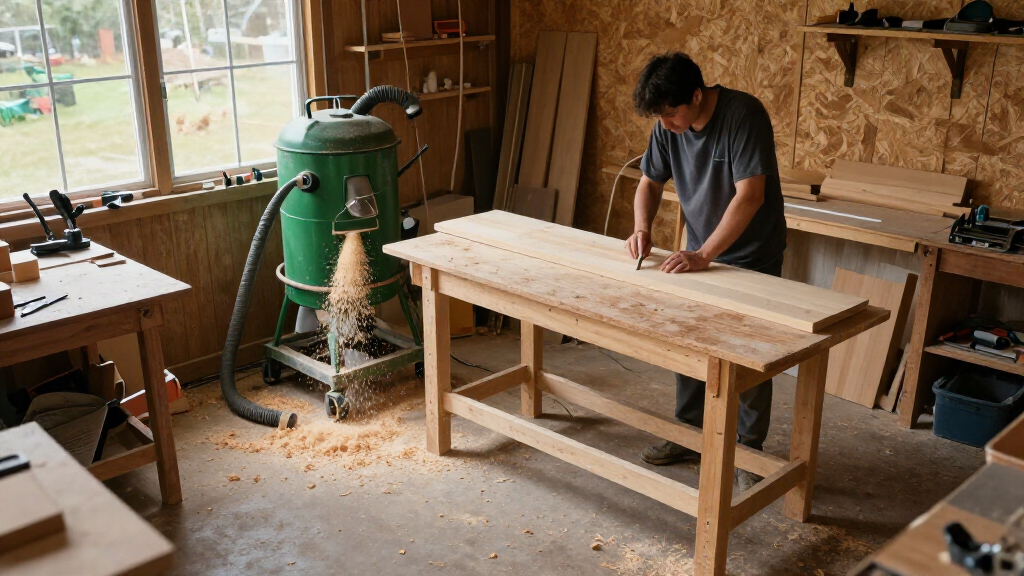
I compared these six systems around the problems small-shop owners actually face: limited floor area, changing tool locations, collection capacity, and the need to pair airflow with the machines and ductwork in use. I considered each model’s stated airflow, collection and filter arrangements, mounting or mobility, and how its footprint may affect day-to-day shop use. A higher CFM figure alone did not guarantee a higher rank; the fit between capacity, flexibility, and space mattered more.
The WEN DC1300 ranks first because its stated 1,300 CFM and mobile base make it the broadest fit for a shop that moves between machines. The VEVOR 1100 CFM follows for buyers seeking a substantial floor-standing option with a vortex-cone design. The wall-mounted units rank for shoppers who value reclaimed floor space, with the Rockler’s 650 CFM separating it from the 560 CFM POWERTEC and VEVOR models. The WEN DC3401 sits at the compact end: it makes sense for light-duty use, but its 12-gallon capacity is less suited to sustained, high-volume work. These rankings reflect stated specifications and practical fit, not hands-on performance testing.
Factors to Consider When Choosing Dust Collection Systems For Small Woodworking Shops
Choosing a collector is only part of building a useful dust-control setup. I would start with the machines, their ports, and the paths a hose or duct must take through the shop; a large airflow number cannot make a poor layout work well. These broader checks can help avoid buying capacity you cannot use—or a compact unit that fills too quickly.
Match the Collector to the Tool and Its Port
Start with the machine that creates the most dust and check its port size, the manufacturer’s collection guidance, and whether it produces chips or fine dust. A collector’s stated CFM is not the same as the airflow delivered at a tool after air moves through hoses, fittings, and filters. A small port or restrictive adapter can bottleneck a larger unit, while a low-demand tool may not need the largest collector in this group. Avoid choosing solely by the biggest number on a product listing. If you plan to connect several machines at once, check whether the system and duct plan are intended for that use rather than assuming a single-connection rating covers a multi-branch network.
Plan the Duct and Hose Route Before Buying
Measure the route from the collector to each machine, including bends, branches, and the space needed to move around equipment. A long, narrow, or sharply curved hose can reduce useful airflow, so a unit’s rating should be read alongside your planned connection path. A portable collector can serve separate machines one at a time, while a wall-mounted collector is more convenient when its fixed position reaches the tools. Common mistakes include buying a wall unit before checking reach or adding several branches without considering how airflow is divided. Sketching the layout first can reveal whether a short flexible hose, a dedicated run, or a different collector position makes more sense.
Choose Between Floor Space and Mobility
A wall-mounted collector keeps its body off the floor, but it still needs wall space, safe mounting, and room for bags or filters to be changed. It also stays tied to one location, which may be awkward in a shop where machines move or the collector must serve tools on opposite sides. A wheeled or otherwise mobile floor-standing model uses more floor area but can follow the tool in use. Measure the full operating footprint, including access for emptying, rather than only the unit’s body. If the shop is shared with storage or vehicle parking, that clearance can matter more than a modest difference in the listed airflow.
Size Collection Capacity for Your Workload
Collection capacity affects how often work must stop for emptying, but a large bag does not automatically mean better dust capture. Think about how long typical sessions run, how much material your machines remove, and whether the bag can be emptied without disrupting the shop. The WEN DC1300’s 50-gallon bag suits a different workload from the WEN DC3401’s 12-gallon collection capacity. Smaller shops can still favor a smaller bin if projects are brief and storage is tight. A common misstep is sizing only for the machine’s power rating while ignoring how quickly the collection container fills during actual work.
Treat Filtration and Source Capture as Separate Questions
Chip collection and fine-dust control are related but not identical jobs. Check the included filter’s stated particle rating and whether the system’s design sends exhaust back into the shop; a collection bag alone does not answer what happens to the finest dust. A collector also works best when connected close to the dust source, so a larger unit placed far away may not solve poor capture at the tool. Do not assume that a vortex-cone design or a higher CFM figure means all airborne particles are removed. Buyers concerned about fine dust should check the full filtration specifications and consider whether additional room filtration or respiratory protection is needed for their work.
Compare Setup and Ongoing Maintenance
Before choosing, check how the unit mounts or rolls, how bags and filters are accessed, and what replacement parts are available. Wall-mounted systems may need suitable wall structure and clear working space for installation; floor-standing units require room to park and maneuver them. Bags and filters need periodic attention, and a collector that is hard to empty can be neglected even if its capacity looks attractive. Check the connection sizes too, since adapters can add expense and restrictions. Paying more can make sense for a shop that needs greater capacity or a better fit with its layout, but not if the added size or setup makes the system inconvenient to use.
Frequently Asked Questions
Can one of these dust collectors serve every machine in a small shop?
It may serve several machines if you connect them one at a time and the hose or duct path fits each tool. That is different from running multiple machines simultaneously, which can divide available airflow and call for a planned duct system. Compare each tool’s port and collection needs with the collector’s specifications, then account for hose length and fittings. The WEN DC1300’s mobile base favors moving between tools, while the wall-mounted models suit machines within reach of a fixed location. I would not assume any single collector will handle every tool equally well without checking the complete setup.
Is a wall-mounted dust collector a better choice when floor space is limited?
A wall-mounted unit can free floor area, which is useful in a compact shop, but it does not remove the need for clearance around the bags and filter. Its fixed position can also limit access to machines across the room. Measure the wall, mounting area, and service space before deciding, then map the hose route to each tool. If the machines move often or sit far apart, a mobile collector may be easier to use despite taking floor space. The best choice depends on whether your layout is fixed or frequently rearranged.
Does the highest CFM rating guarantee better dust collection?
No. A stated CFM figure is useful for comparison, but the airflow delivered at the machine depends on the full path, including hoses, fittings, filters, and duct branches. A large collector connected through a restrictive or oversized route may not capture dust well at the tool. Check port compatibility and the machine manufacturer’s collection guidance before comparing ratings. Also consider whether the collector’s capacity and placement suit your workflow. For small shops, a well-matched setup can be more useful than choosing by the largest number alone.
When does it make sense to choose the WEN DC3401 over a larger collector?
The DC3401 makes more sense when work is light, storage is tight, and a smaller collection capacity fits your routine. Its 12-gallon capacity is less suited to long sessions that produce a large volume of chips, since more frequent emptying may interrupt work. Compare that tradeoff with the larger WEN DC1300, which offers a 50-gallon bag and a mobile base but requires more room. Also check whether the tools you use can work with the smaller model’s stated specifications. A compact collector is a practical fit only when its limits match the workload.
What should I check before buying a dust collector for fine-dust concerns?
Look up the filter’s stated particle rating and check whether the product information describes the filtration arrangement and exhaust path. The collection bag or a vortex-cone design does not, by itself, tell you how effectively fine particles are filtered. Also assess how well the collector captures dust at the tool, since poor source capture can leave particles in the shop air. If fine-dust exposure is a concern, consider whether a separate ambient air cleaner and suitable respiratory protection are part of your plan. Do not rely on a CFM figure as a substitute for filtration details.
Conclusion
For most small-shop owners who need one collector to move between machines, I recommend the WEN DC1300 as the best overall because its stated airflow, mobile base, and 50-gallon bag combine flexibility with higher collection capacity. The best value-style fit for a fixed, space-conscious layout is the POWERTEC DC5371, while the Rockler Dust Right 650 CFM is the wall-mounted pick for buyers who want a higher stated airflow than the 560 CFM options. For a more substantial floor-standing alternative with a vortex-cone design, choose the VEVOR 1100 CFM. Beginners with light workloads and little storage space can start with the WEN DC3401; buyers who want a straightforward wall-mounted option can compare it with the VEVOR 560 CFM. Match the final choice to your tool ports, duct route, and collection routine before committing.