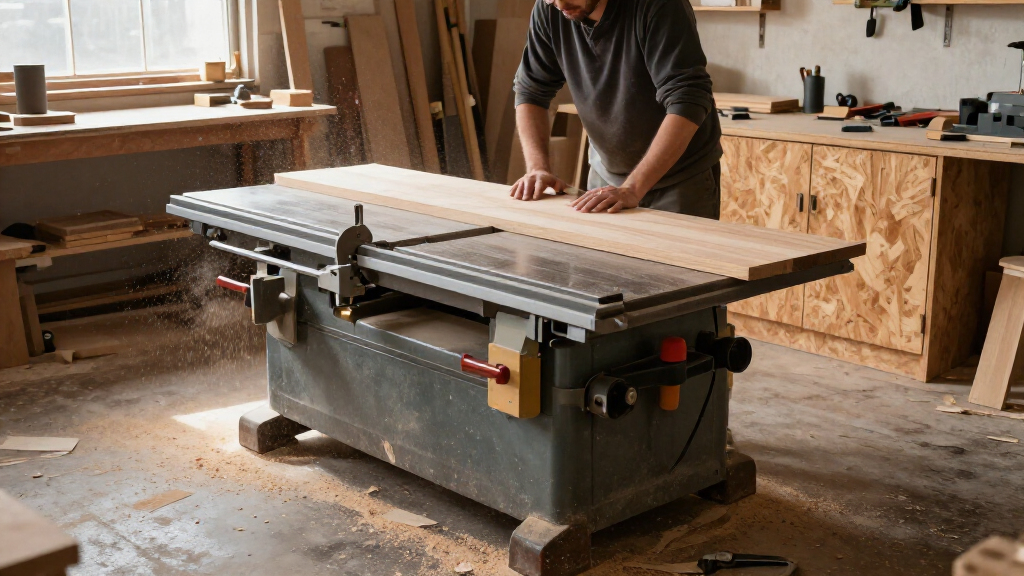

Choosing a hybrid table saw for a small shop means balancing cutting capacity against power requirements, floor space, and the practicalities of moving a machine that weighs hundreds of pounds. I put the Laguna F2 Fusion first for shops that need a 36-inch rip capacity but want to keep a standard 110-volt supply; the Laguna F3 Fusion suits demanding work where a 3 HP motor and sealed-cabinet dust collection matter more than electrical convenience. The JET ProShop II takes a different route, offering a 52-inch rip capacity and a 120-volt motor for wide-panel work.

Get business pricing on tools and workshop supplies
- Business-only prices and quantity discounts
- Tax-exempt purchasing
- Multiple users, one account, clear invoices
The tradeoff is not simply power versus price: each saw asks something different of a compact workspace. The F3 needs 220-volt service and substantial space, the F2 gives up motor strength while remaining very heavy, and the JET’s long rails can complicate shop layout even though its machine weight is lower. I’m ranking them by how well their combination of capacity, power, dust management, and footprint fits a small-shop woodworker’s actual constraints.
Complete the kit


Key Takeaways
- The Laguna F2 is my leading fit for a small shop with 110-volt power and a need to rip panels up to 36 inches.
- The Laguna F3’s 3 HP motor is the strongest choice here for demanding cuts, but it requires 220-volt service.
- The JET ProShop II offers the widest listed rip capacity at 52 inches, while its long rails need careful space planning.
- All three machines are heavy stationary saws; delivery, placement, and future relocation deserve planning before purchase.
- Choose by matching electrical supply and usable rail clearance to your shop before comparing cutting capacity or included accessories.
| Laguna F2 Fusion 10-Inch Table Saw, 36-Inch Rip Capacity, 1.75 HP, 110V |  | Best Overall for 110-Volt Small Shops | Motor: 1.75 HP, 110V TEFC | Rip capacity: 36 inches | Blade diameter: 10 inches | VIEW LATEST PRICE | See Our Full Breakdown |
| Laguna F3 Fusion 10-Inch Table Saw, 36-Inch Rip, 3 HP, 220V |  | Best for Power-Hungry Work | Motor power: 3 HP | Voltage: 220 volts | Rip capacity: 36 inches | VIEW LATEST PRICE | See Our Full Breakdown |
| JET ProShop II 10-Inch Table Saw, 52-Inch Rip, Steel Wings, 1-3/4 HP, 120V (JPS-10) |  | Best for Wide Panels and Long Rip Cuts | Motor: 1-3/4 HP | Voltage: 120 V | Rip capacity: 52 inches | VIEW LATEST PRICE | See Our Full Breakdown |
| hybrid table saws for small shop | Rip capacity | Blade diameter | Blade speed | Weight |
|---|---|---|---|---|
| Laguna F2 Fusion 10-Inch Table | 36 inches | 10 inches | 4500 rpm | 359 pounds |
| Laguna F3 Fusion 10-Inch Table | 36 inches | 10 inches | 4500 rpm | 397 pounds |
| JET ProShop II 10-Inch Table S | 52 inches | 10 inches | 4000 rpm | 285.9 pounds |
More Details on Our Top Picks
Laguna F2 Fusion 10-Inch Table Saw, 36-Inch Rip Capacity, 1.75 HP, 110V
The Laguna F2 Fusion earns my top spot by pairing a useful 36-inch rip capacity with a 1.75 HP, 110-volt motor. That combination is a practical middle ground for a small shop that needs to break down broad panels but does not have a 220-volt circuit available or planned. Compared with the more powerful F3, the F2 asks less of the shop’s electrical setup; compared with the JET ProShop II, it has a much shorter listed overall length and a smaller stated rip capacity.
Its cast-iron table and body-mounted trunnion support the stable, precise-cutting role the saw is meant to fill, while over- and under-blade dust collection addresses cleanup around both the blade area and cabinet. The package also includes a blade guard, riving knife, miter gauge, and push stick, giving a buyer useful starting accessories rather than requiring every basic safety item to be sourced separately. A 4-inch dust port means a shop needs compatible collection equipment and a hose arrangement that suits its layout.
The compromise is that a 110-volt motor is not the same proposition as the F3’s 3 HP setup for demanding cuts. I would not choose the F2 simply because it runs on household-voltage service if the work regularly calls for more motor capacity. Nor is it a light, casually movable machine: 359 pounds makes delivery and final placement a planning task. It is the most balanced pick here, not a compact benchtop solution.
Against the JET, the F2 gives up 16 inches of listed rip capacity, but its stated dimensions are more manageable for many tight rooms. Against the F3, it keeps the 36-inch capacity and dust-collection concept while avoiding the stated 220-volt requirement. For a small shop with ordinary 110-volt availability, those distinctions make the F2 the strongest all-around match.
Pros:- 36-inch rip capacity supports broad boards and many panel-cutting tasks.
- 1.75 HP, 110-volt motor avoids the stated 220-volt requirement of the F3.
- Cast-iron table and body-mounted trunnion support stable, accurate work.
- Over- and under-blade dust collection and included safety accessories provide a useful shop-ready foundation.
Cons:- At 359 pounds, it requires a deliberate delivery and placement plan.
- Its 1.75 HP motor has less stated power than the F3’s 3 HP setup.
- The 36-inch capacity is narrower than the JET’s listed 52-inch capacity.
Best for: Small-shop woodworkers who have 110-volt service, need to rip panels up to 36 inches, and want cast-iron support with integrated over- and under-blade dust collection.
Not ideal for: Buyers who regularly make demanding cuts that call for the F3’s 3 HP motor, anyone needing the JET’s 52-inch rip capacity, or woodworkers who need a lightweight saw that can be moved frequently.
- Motor:1.75 HP, 110V TEFC
- Rip capacity:36 inches
- Blade diameter:10 inches
- Maximum cut depth:3-1/8 inches at 90°; 2-1/8 inches at 45°
- Blade speed:4500 rpm
- Dust port:4 inches
- Weight:359 pounds
- Dimensions:66.81 x 65.75 x 34.75 inches
- Warranty:2 years
Our verdict“I’d choose the F2 for a small shop that needs substantial rip capacity on 110-volt power and can accommodate a heavy stationary saw.”
Laguna F3 Fusion 10-Inch Table Saw, 36-Inch Rip, 3 HP, 220V
The Laguna F3 Fusion is my pick when cutting capacity alone is not enough and the work demands the strongest listed motor in this group. Its 3 HP motor sets it apart from both 1.75 HP alternatives, while the 36-inch rip capacity matches the F2 rather than the JET’s wider 52-inch setup. For a small shop that repeatedly cuts demanding stock, the F3 makes a stronger case than the F2; for a shop focused on breaking down very wide panels, the JET still offers more stated rip capacity.
Laguna combines that motor with a cast-iron table and trunnions, a precision fence, and a sealed steel cabinet. Over-and-under dust collection is a welcome feature for a shop where airborne sawdust and cleanup can quickly affect the work area. The supplied blade, miter gauge, push stick, safety accessories, and outfeed and rip tables give the package useful equipment for setting up a stationary cutting station. The 14-gauge steel cabinet is another specific construction detail, but the stated weight and dimensions still make this a large machine rather than a space-saving one.
The defining drawback is also straightforward: 220-volt power is required. A buyer without suitable service needs to factor electrical readiness into the decision before treating the F3 as a direct substitute for the F2. Its 397-pound weight is the highest of these three, and its listed dimensions of 56.13 x 69 x 43 inches call for careful layout planning. Freight delivery also requires a valid phone number for scheduling, so receiving the saw is part of the logistics.
Compared with the F2, the F3 trades electrical convenience and easier handling for a 3 HP motor and a more fully specified included table setup. Compared with the JET, it does not offer the same stated rip width, but its sealed cabinet and over-and-under collection give it a strong case for buyers prioritizing dust management. I rank it second overall because those advantages matter most when the shop already has the power and room to support them.
Pros:- 3 HP motor is the highest stated power in this comparison.
- Cast-iron table and trunnions support stable cutting.
- Sealed cabinet and over-and-under dust collection suit dust-conscious shops.
- Includes blade, miter gauge, safety accessories, and outfeed and rip tables.
Cons:- Requires a 220-volt power supply.
- At 397 pounds, it is the heaviest saw in this lineup.
- Freight delivery requires a valid phone number for scheduling.
Best for: Woodworkers with 220-volt service who regularly make demanding cuts and want a 3 HP motor, sealed cabinet, and over-and-under dust collection.
Not ideal for: Small-shop owners limited to 110-volt power, buyers who need 52 inches of rip capacity, or anyone who cannot handle the footprint and 397-pound weight.
- Motor power:3 HP
- Voltage:220 volts
- Rip capacity:36 inches
- Blade diameter:10 inches
- Blade speed:4500 rpm
- Weight:397 pounds
- Dimensions:56.13 x 69 x 43 inches
- Cabinet:14-gauge steel
- Warranty:2 years
Our verdict“I’d pick the F3 over the F2 when 3 HP capability matters more than 110-volt convenience and the shop can accommodate its size.”
JET ProShop II 10-Inch Table Saw, 52-Inch Rip, Steel Wings, 1-3/4 HP, 120V (JPS-10)
The JET ProShop II is the specialist in this group: its 52-inch rip capacity is 16 inches greater than either Laguna’s 36-inch setup. That extra reach makes it the clearest choice for woodworkers who regularly handle wide sheet goods or need to rip broad stock without giving up the task to another tool. It runs on 120 volts and uses a 1-3/4 HP motor, so its appeal is capacity rather than a power advantage over the F3.
Its safety and convenience details are well matched to routine shop work. A quick-release riving knife simplifies blade-area changes, while the transparent blade guard helps keep the blade visible during a cut. The improved dust shroud supports collection around the blade, and a magnetic paddle switch gives the operator a prominent shutoff control. Onboard accessory storage can also help keep the miter gauge and other small items from disappearing into a crowded shop. The package includes steel wings, riving knives, a blade guard, a miter gauge, and a wood extension table.
The long capacity comes with a spatial cost. At 82 inches long in the stated dimensions, the JET may be harder to fit into a compact room than either Laguna, even though its 285.9-pound weight is lower than both. A 52-inch rip capacity is not useful if the rails or workpiece support interfere with doors, benches, or walkways. The 1-3/4 HP motor also does not match the F3’s stated 3 HP, so buyers should not mistake its wider capacity for greater cutting power.
I rank it third for a general small-shop roundup because its best feature calls for a specific need and a suitable layout. Compared with the F2, it sacrifices a shorter listed footprint for much wider ripping. Compared with the F3, it runs on 120 volts and weighs less, but it offers less stated motor power. Its five-year warranty is longer than the two-year warranties listed for the Laguna saws, with a stated two-year term for commercial or industrial use; warranty duration is useful context, though it does not remove the need to check shop fit and power first.
Pros:- 52-inch rip capacity is the widest listed in this comparison.
- 120-volt, 1-3/4 HP motor suits buyers who do not want the F3’s stated 220-volt requirement.
- Quick-release riving knife, transparent guard, and magnetic paddle switch add practical safety and control features.
- Onboard storage and improved dust shroud support a more organized work area.
Cons:- The 82-inch listed length can be difficult to accommodate in a small shop.
- Its 1-3/4 HP motor has substantially less stated power than the F3’s 3 HP motor.
- At 285.9 pounds, it remains a heavy stationary machine despite weighing less than both Laguna saws.
Best for: Small-shop woodworkers who often break down wide sheet goods, have room for long rails, and want a 120-volt saw with a 52-inch rip capacity.
Not ideal for: Shops with very limited floor clearance, buyers seeking the highest stated motor power, or woodworkers who do not need more than 36 inches of rip capacity.
- Motor:1-3/4 HP
- Voltage:120 V
- Rip capacity:52 inches
- Blade diameter:10 inches
- Blade speed:4000 rpm
- Weight:285.9 pounds
- Dimensions:82 x 40 x 43 inches
- Included safety features:Quick-release riving knife, transparent blade guard, magnetic paddle switch
- Warranty:5 years; 2 years for commercial or industrial use
Our verdict“I’d choose the JET when 52-inch ripping is a regular need and the shop can give its long rails enough working clearance.”
How We Picked
I ranked these saws for the particular constraints implied by small shops: limited floor area, finite electrical capacity, and the need for one machine to handle a range of woodworking jobs. I compared the stated motor and voltage, rip capacity, weight and dimensions, dust-collection provisions, and the safety and setup items included with each saw. I gave extra weight to practical fit: a wide rip capacity is useful only if the shop can accommodate the rails and support long stock, while extra motor power is less useful if installing the required circuit is out of reach.
The ranking favors versatility without pretending that every shop has the same needs. The F2 Fusion ranks first because its 36-inch capacity and 110-volt motor make a balanced combination for many small-shop setups, though its weight remains a serious placement issue. The F3 ranks next for buyers who can supply 220 volts and routinely cut demanding stock. The JET ranks third overall, not because its 52-inch capacity lacks value, but because its long overall dimensions favor shops that specifically need wide-panel capacity and can spare the clearance. I relied on the supplied product details; I do not treat unprovided performance, noise, or fit measurements as established facts.
Factors to Consider When Choosing Hybrid Table Saws For Small Shops
I would make the choice in this order: confirm the power supply, map the saw and its rail clearance, then decide how much rip capacity and motor power your work actually uses. Those checks can quickly narrow the field before included accessories or secondary features enter the decision.Start With the Shop’s Electrical Supply
The F2 and JET list 110-volt and 120-volt operation, respectively; the F3 calls for 220 volts. That difference can determine whether a saw is a practical match before you compare motor power. If your shop has only standard 110-volt service, the F3 is not a straightforward plug-in alternative. If you are considering an electrical upgrade, treat it as part of the saw’s installation plan and check that the intended circuit is suitable rather than assuming a nearby outlet will do.
Once power is settled, compare the motors in context. The F3’s 3 HP rating is the highest listed here and suits a buyer prioritizing more motor capacity. The F2 and JET list 1.75 HP and 1-3/4 HP, so they share a similar stated power level despite differences in rip capacity and design. I would choose the F3 for its motor only if the work justifies it and the shop can supply the required voltage.
Match Rip Capacity to the Work You Do
The two Laguna models each list 36 inches of rip capacity, while the JET lists 52 inches. For many shop tasks, 36 inches already provides considerable room for breaking down boards and panels. The JET becomes more compelling when wide sheet goods or broad stock are a repeated part of the workload, not just an occasional possibility.
More capacity also demands more room to operate safely and comfortably. Check the full rail and table arrangement, not only the saw cabinet, and allow space to feed and support the workpiece. The JET’s listed 82-inch length makes this especially relevant. If you rarely need the extra width, the F2’s shorter stated dimensions may be a better use of limited floor area; if wide ripping is central to your work, its 36-inch limit may become a recurring constraint.
Plan for Weight, Delivery, and Placement
None of these is a lightweight portable saw. The F3 is listed at 397 pounds, the F2 at 359 pounds, and the JET at 285.9 pounds. The JET weighs less, but its overall length is greatest; the Laguna models are heavier, with the F3 the heaviest of the three. Those facts affect how you get a saw into the shop and where it can stay, even after setup.
Measure doorways, access paths, and the intended work zone before arranging delivery. Think about whether the saw needs to be moved later for cleaning, a layout change, or a home move. The supplied details note that freight delivery for both Laguna models requires a valid phone number for scheduling. Do not treat delivery as an afterthought: a saw that cannot reach its planned location is a poor fit regardless of its cutting features.
Consider Dust Collection as a Shop-System Choice
The F2 and F3 list over- and under-blade dust collection, with the F2 specifying a 4-inch dust port and the F3 describing a sealed cabinet. The JET lists an improved dust shroud around the blade. Each arrangement makes dust collection part of the buying decision, but a collection feature only works as part of a shop system. Confirm that your collector, hose, and available routing suit the saw you are considering.
In a small room, dust control has an outsized practical role because debris can spread across nearby benches and stored materials. Still, the supplied details do not establish a comparative capture rate, so I would not assume one model collects more effectively based on wording alone. Compare the specified setup, connection size where provided, and how easily the hose can reach your existing equipment.
Check Safety Equipment and Everyday Controls
The Laguna packages list useful starting items such as a blade guard, riving knife, miter gauge, or push stick, depending on the model. The JET highlights a quick-release riving knife, transparent blade guard, magnetic paddle switch, and onboard accessory storage. These details matter because safety components and controls are part of regular setup and operation, not decorative extras. Confirm the exact included components for the specific configuration before purchase.
I would also plan for adequate infeed and outfeed support, particularly when handling long or wide boards in a small shop. The F3 description includes outfeed and rip tables; the JET includes a wood extension table. The listed package contents differ, so compare what comes with each saw against the supports you already own and the work you plan to do.
Choose the Saw That Fits the Most Common Job
There is no benefit in selecting the highest listed capacity or motor rating if the feature does not solve a regular shop problem. I see the F2 as the balanced choice for a shop that needs 36-inch ripping without 220-volt service. The F3 suits a buyer who can power it and values its 3 HP motor and sealed-cabinet dust collection. The JET is the width specialist for a shop that can fit its long layout and frequently processes broad panels.
Before deciding, write down your common workpiece widths, check the available circuit, and mark the saw’s footprint and operating clearance on the floor. That simple comparison will reveal whether the real limiting factor is power, rip width, or shop space. If two models still fit, weigh their included accessories and dust provisions against your existing equipment rather than paying attention to a single headline specification.
Frequently Asked Questions
Which of these saws is the best general fit for a small shop?
I rank the Laguna F2 Fusion first for a general small-shop setup because it pairs 36-inch rip capacity with a 110-volt motor and integrated over- and under-blade dust collection. It is not compact or light at 359 pounds, so that recommendation assumes the shop can accommodate a stationary machine. Choose the F3 instead if 3 HP is more important and 220-volt service is available; choose the JET if you need 52 inches of rip capacity.
Do I need 220-volt power for any of these models?
The Laguna F3 requires 220 volts according to its listed specifications. The Laguna F2 is specified as 110 volts, and the JET ProShop II as 120 volts. Check the electrical requirements and your shop’s circuit before purchase, especially if you are considering the F3. A model’s voltage listing does not by itself confirm that any particular outlet or circuit is suitable for installation.
Is the JET’s 52-inch rip capacity worth choosing over the Laguna saws?
The JET’s extra capacity is useful when wide-panel ripping is a regular task; it gives 16 more inches of stated rip capacity than either Laguna. If your projects seldom need more than 36 inches, the added reach may not justify the JET’s 82-inch listed length in a compact shop. I would choose it for a real, recurring wide-stock requirement and first confirm there is room for the rails and workpiece support.
Which saw is the most powerful?
The Laguna F3 Fusion has the highest stated motor power at 3 HP, compared with 1.75 HP for the F2 and 1-3/4 HP for the JET. That makes the F3 the clearest choice by listed motor rating for buyers who prioritize power, but it also requires 220-volt service and weighs 397 pounds. The motor specification alone does not describe every cutting condition, so match it to your usual stock and shop setup.
How should I plan for delivery and installation?
Measure the route from the delivery point to the final location, including doorways and turns, and leave room for the rails, infeed, and outfeed. The saws weigh between 285.9 and 397 pounds, so plan for appropriate moving equipment and help rather than assuming they can be shifted casually. The Laguna product details specify that freight delivery requires a valid phone number for scheduling. Also confirm power and dust-collection arrangements before the machine arrives.
Conclusion
My pick for most small shops is the Laguna F2 Fusion: it offers 36-inch ripping, cast-iron support, and 110-volt operation without asking for the F3’s higher motor power and 220-volt supply. Select the Laguna F3 if you have 220-volt service, value its 3 HP motor, and can plan around its 397-pound weight. Choose the JET ProShop II when wide panels are the defining need and the shop can accommodate its 52-inch capacity and long footprint.
Before buying any of them, verify the electrical setup, measure the machine and working clearance, and plan delivery and dust collection. Those shop-specific constraints matter more than choosing the model with the biggest number on a single specification line.