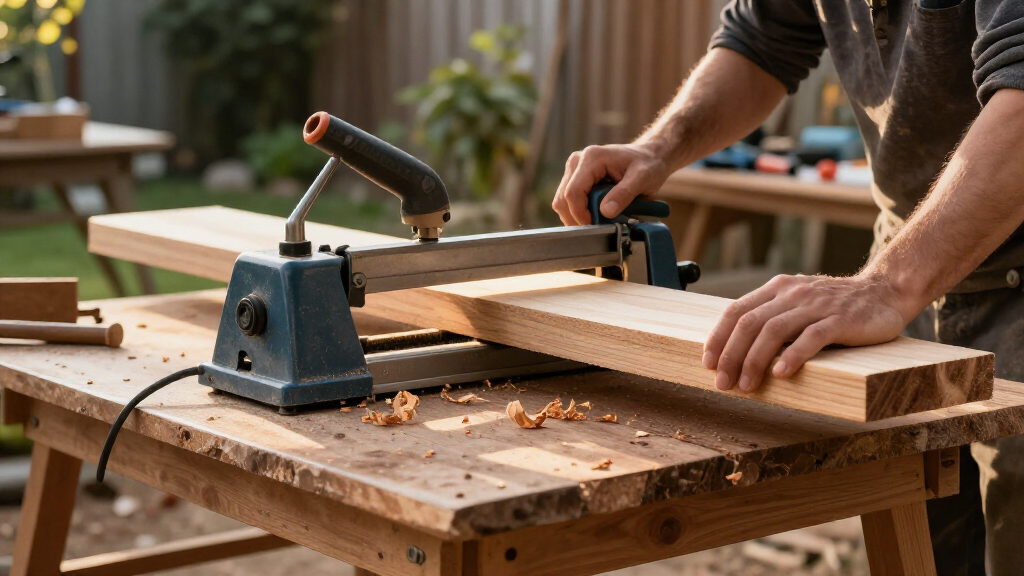

For most woodworkers, I’d start with the DEWALT DW735X: its two-speed feed and three-knife cutterhead make it a strong all-round choice for dimensioning boards and refining surfaces. The WEN PL1326 stands out for buyers who want a spiral cutterhead, while the JET 13-Inch Helical Planer is a premium option built around carbide inserts. Portable thickness planers differ most in cutterhead finish, feed-rate control, noise, maintenance, and how much space they need around the machine. A helical head can reduce the effort of replacing knives, while conventional blades may better suit buyers focused on straightforward upkeep. Read on for the full breakdown and a guide to matching a planer to your shop and projects.

Get business pricing on tools and workshop supplies
- Business-only prices and quantity discounts
- Tax-exempt purchasing
- Multiple users, one account, clear invoices
Complete the kit



Key Takeaways
- The DEWALT DW735X is the strongest all-round pick for buyers who value two feed speeds and a three-knife cutterhead; its larger footprint and dust-collection needs make it less suited to a cramped, frequently moved setup.
- Helical and spiral cutterheads define the main upgrade path. The JET, WEN PL1326, WEN PL1337, FindBuyTool, and several VEVOR and WOODERS options use insert-style heads, trading a higher-complexity cutter system for easier localized insert changes.
- Two-speed models are not interchangeable. The DEWALT DW735 and DW735X, plus the VEVOR three-blade two-speed model and WEN PL1337, offer feed-rate choice that can help balance finish and material removal.
- Basic two-knife and three-knife models suit simpler priorities. The CRAFTSMAN CMEW320 and VEVOR two-blade model keep the cutterhead approach straightforward, while the DEWALT DW734 adds a three-knife head in a slightly narrower capacity.
- Portability depends on the whole setup, not the word “benchtop.” The VEVOR model with a foldable stand adds a ready-made support option, but all 13-inch machines still need stable infeed and outfeed space and a plan for chip collection.
| WOODERS 13-Inch Benchtop Thickness Planer, 15A, 2000W |  | Best for Extra Blade Stock | Planing width: 13 in (330 mm) | Planing height range: 1/4–6.3 in (6–160 mm) | Motor: 2000 W, 15 A | VIEW LATEST PRICE | See Our Full Breakdown |
| VEVOR 13-Inch Benchtop Thickness Planer with Foldable Stand and Dust Exhaust |  | Best for a Space-Saving Setup | Maximum cutting width: 13 in (330 mm) | Cutting thickness range: 0.2–6.3 in (6–160 mm) | Motor: 15 A; power listed as 1800 W, with a separate description citing 2000 W | VIEW LATEST PRICE | See Our Full Breakdown |
| VEVOR 13-Inch Spiral Benchtop Thickness Planer, 2000W |  | Best for Spiral-Cutterhead Value | Cutting width: 13 in | Maximum cutting depth: 0.13 in | Motor: 2000 W, 15 A, 110 V | VIEW LATEST PRICE | See Our Full Breakdown |
| FindBuyTool FB132H 13-Inch Benchtop Thickness Planer with Helical Cutterhead |  | Best for Adjustable Finish Control | Cutting width: 13 in | Cutterhead: Four-row helical head with 40 carbide inserts | Motor: 2.5 HP, 15 A, 120 V | VIEW LATEST PRICE | See Our Full Breakdown |
| VEVOR 13-Inch Two-Blade Benchtop Thickness Planer, 15-Amp, 2000W |  | Best for Straightforward Two-Knife Planing | Cutting width: 13 in | Maximum board thickness: 6 in | Motor: 2000 W, 15 A, 110 V | VIEW LATEST PRICE | See Our Full Breakdown |
| DEWALT DW735X 13-Inch Two-Speed Thickness Planer |  | Best for Adjustable Finish Quality | Cutting width: 13 inches | Motor: 15 A | Cutterhead: Three knives | VIEW LATEST PRICE | See Our Full Breakdown |
| DEWALT DW734 12-1/2-Inch Benchtop Planer, 15 Amp, 3-Knife Cutter Head, Corded |  | Best for Repeatable Everyday Planing | Cutting width: 12.5 inches | Motor: 15 A | Cutterhead: Three disposable, reversible knives | VIEW LATEST PRICE | See Our Full Breakdown |
| WEN PL1326 15-Amp 13-Inch Spiral Benchtop Thickness Planer |  | Best Spiral-Head Pick | Motor: 15 A | Cutterhead: Spiral, with 26 staggered and rotatable HSS blades | Maximum board width: 13 inches | VIEW LATEST PRICE | See Our Full Breakdown |
| WOODSTARTER 13-Inch Benchtop Wood Planer |  | Best for Flexible Dust-Hose Setups | Motor power: 2000 W | Speed: 10,000 RPM | Cutterhead: Three HSS blades | VIEW LATEST PRICE | See Our Full Breakdown |
| DEWALT DW735 13-Inch Two-Speed Thickness Planer with Three-Knife Cutterhead |  | Best for Two-Speed Planing Without the Accessory Bundle | Planing width capacity: 13 inches | Planing depth capacity: 6 inches | Motor: 15 A | VIEW LATEST PRICE | See Our Full Breakdown |
| JET 13-Inch Benchtop Thickness Planer with Helical Cutterhead and 30 Carbide Inserts |  | Best for Quiet, Refined Cuts | Model: JWP-13BTHH | Planing capacity: 13 in. wide × 6 in. thick | Cutterhead: Helical, 30 four-sided carbide inserts | VIEW LATEST PRICE | See Our Full Breakdown |
| VEVOR 13-Inch Two-Speed Benchtop Thickness Planer with Three Blades |  | Best for Feed-Rate Choice on a Budget | Model: M1B-LS-3305 | Power: 2000 W, corded electric | Maximum cutting width: 13 in. | VIEW LATEST PRICE | See Our Full Breakdown |
| WOODERS 13-Inch Thickness Planer with Spiral Helical Cutterhead |  | Best for Included Dust Collection | Model: WDS-PL13-15S | Planing width: 13 in. | Material height range: 1/4–6 1/4 in. | VIEW LATEST PRICE | See Our Full Breakdown |
| CRAFTSMAN 12.25-Inch Benchtop Thickness Planer, 15 Amp, Two-Knife (CMEW320) |  | Best for Simpler Knife Changes | Model: CMEW320 | Motor: 15 A, 120 V | Cutter head speed: 8,000 RPM | VIEW LATEST PRICE | See Our Full Breakdown |
| WEN PL1337 13-Inch Two-Speed Benchtop Thickness Planer with Spiral Cutterhead |  | Best for Adjustable Feed Speed | Model: PL1337 | Planing capacity: 13 in. wide × 6 in. thick | Motor: 15 A | VIEW LATEST PRICE | See Our Full Breakdown |
| portable thickness planers for woodworking | Motor | Cutterhead |
|---|---|---|
| WOODERS 13-Inch Benchtop Thick | 2000 W, 15 A | — |
| VEVOR 13-Inch Benchtop Thickne | 15 A; power listed as 1800 W, with a separate description citing 2000 W | — |
| VEVOR 13-Inch Spiral Benchtop | 2000 W, 15 A, 110 V | Spiral-style with 24 alloy blade inserts |
| FindBuyTool FB132H 13-Inch Ben | 2.5 HP, 15 A, 120 V | Four-row helical head with 40 carbide inserts |
| VEVOR 13-Inch Two-Blade Bencht | 2000 W, 15 A, 110 V | Two-blade hardened steel |
| DEWALT DW735X 13-Inch Two-Spee | 15 A | Three knives |
| DEWALT DW734 12-1/2-Inch Bench | 15 A | Three disposable, reversible knives |
| WEN PL1326 15-Amp 13-Inch Spir | 15 A | Spiral, with 26 staggered and rotatable HSS blades |
| WOODSTARTER 13-Inch Benchtop W | — | Three HSS blades |
| DEWALT DW735 13-Inch Two-Speed | 15 A | Three knives |
| JET 13-Inch Benchtop Thickness | 2 HP, 15 A, 120 V | Helical, 30 four-sided carbide inserts |
| VEVOR 13-Inch Two-Speed Bencht | — | — |
| WOODERS 13-Inch Thickness Plan | 15 A, 2000 W | Spiral helical with tungsten carbide inserts |
| CRAFTSMAN 12.25-Inch Benchtop | 15 A, 120 V | — |
| WEN PL1337 13-Inch Two-Speed B | 15 A | 26 staggered, rotatable HSS blades |
More Details on Our Top Picks
WOODERS 13-Inch Benchtop Thickness Planer, 15A, 2000W
The WOODERS suits a shop that wants 13-inch capacity and a strong motor without paying for a cutterhead with replaceable inserts. Its dual-edge HSS blades have another practical advantage: two extra blades are included, giving the owner spares for maintenance. The adjustable depth crank and height indicator also make repeat thickness settings easier to track. Compared with the VEVOR 13-Inch Two-Blade Benchtop Planer, this model supplies replacement blades and lists overload protection, while the VEVOR lists a 35-inch extended worktable. The WOODERS is still a heavy-duty benchtop machine, not a grab-and-go planer, and its blade-count description is inconsistent: the specs say four blades while other wording refers to a dual-edge design. I would favor it for a fixed workshop that values spare cutting edges over portability.
Pros:- 13-inch planing width accommodates broad boards.
- 2000W, 15A motor is specified for hardwood and softwood work.
- Two extra blades are included.
- Depth crank, height indicator, dust port, and overload protection support controlled shop use.
Cons:- Heavy-duty benchtop construction calls for a sturdy mounting surface.
- Blade-count wording is inconsistent, making the supplied cutter configuration unclear.
Best for: Woodworkers with a sturdy, permanent bench who want a wide planer and included replacement blades for ongoing shop use.
Not ideal for: Anyone who needs to move a planer between jobsites or wants unambiguous cutterhead and blade specifications before buying.
- Planing width:13 in (330 mm)
- Planing height range:1/4–6.3 in (6–160 mm)
- Motor:2000 W, 15 A
- Cutterhead speed:10,000 RPM
- Blades:HSS, dual-edge design; listed as 4 blades
- Overload protection:Yes
- Included extras:Dust collector, 2 replacement blades, lifting handle
Our verdict“Choose the WOODERS if you have a fixed, sturdy bench and value included spare blades more than easy portability.”
VEVOR 13-Inch Benchtop Thickness Planer with Foldable Stand and Dust Exhaust
Among these five, this VEVOR is the clearest fit for a small shop that needs its planer to store away: it includes a foldable stand and extension plates, rather than assuming a permanent bench. Automatic feed and return rollers help move boards through the cut, while adjustable infeed and outfeed tables give longer stock more support. Compared with the VEVOR 13-Inch Spiral Benchtop Planer, this model prioritizes fold-away storage and a conventional two-blade setup over a spiral cutterhead with many inserts. Its dust exhaust is a connection point, not a built-in collector, so buyers still need extraction equipment. There is also conflicting motor-power information in the supplied description—1800W in one place and 2000W in another—so I would not choose it based on the higher figure alone.
Pros:- Foldable stand and extension plates help conserve shop space.
- 13-inch width and 0.2–6.3-inch thickness range cover a broad range of stock.
- Automatic feed and return rollers assist board movement.
- Dust exhaust port can connect to a separate collector.
Cons:- A separate dust collector is needed for connected extraction.
- Motor power is listed inconsistently as 1800W and 2000W.
- Two double-sided HSS blades offer a different cutterhead approach from the spiral-insert VEVOR model.
Best for: Home woodworkers with limited floor space who want a planer and stand that can be folded away between projects.
Not ideal for: Buyers seeking a spiral cutterhead, self-contained dust collection, or a clearly consistent motor-power specification.
- Maximum cutting width:13 in (330 mm)
- Cutting thickness range:0.2–6.3 in (6–160 mm)
- Motor:15 A; power listed as 1800 W, with a separate description citing 2000 W
- Blade speed:8000 rpm
- Feed speed:236 in/min (6 m/min)
- Blades:2 double-sided HSS blades
- Dust port:1.8 in inner diameter; 2 in outer diameter
- Included components:Planer, foldable stand, accessory set, 2 blades
Our verdict“Pick this VEVOR if fold-away storage matters more than a spiral cutterhead or fully specified motor output.”
VEVOR 13-Inch Spiral Benchtop Thickness Planer, 2000W
The standout here is its 24-insert spiral-style cutterhead, which makes this VEVOR a better match for woodworkers who want an insert-based cutting system without stepping up to the FindBuyTool FB132H’s 40-insert helical head. A spiral arrangement can spread the cut across multiple small edges, a useful approach for smoother results and localized insert replacement. Its dual rollers and broad worktable also support steadier feeding, while compatibility with 2-inch and 4-inch hoses gives dust setups more flexibility than the WOODERS planer’s listed dust port. The tradeoff is a single speed, so there is no feed-rate choice for balancing throughput and finish. At 61.7 pounds, it is benchtop portable in the category, but not convenient to carry often; plan on a dedicated spot.
Pros:- 24 alloy inserts form a spiral-style cutterhead.
- Dual rollers help steady board feeding.
- Wide worktable supports longer or less cooperative boards.
- Accepts both 2-inch and 4-inch dust hoses.
Cons:- Single-speed operation provides no feed-rate adjustment.
- At 61.7 pounds, it is awkward for frequent relocation.
- The FindBuyTool FB132H offers two feed rates and more listed inserts for buyers prioritizing speed choice and cutterhead capacity.
Best for: Small-shop woodworkers who want an insert-style cutterhead, broad hose compatibility, and a planer that can stay set up on a bench.
Not ideal for: Frequent jobsite users or buyers who want selectable feed speeds to tune roughing and finishing passes.
- Cutting width:13 in
- Maximum cutting depth:0.13 in
- Motor:2000 W, 15 A, 110 V
- Cutterhead:Spiral-style with 24 alloy blade inserts
- Maximum rotational speed:23,500 rpm
- Planing rate:Up to 8,000 CPM
- Dust hose compatibility:2 in and 4 in
- Weight:61.7 lb
Our verdict“Choose this VEVOR for an insert-style cutterhead and flexible dust hookups, provided it can remain mostly stationary.”
FindBuyTool FB132H 13-Inch Benchtop Thickness Planer with Helical Cutterhead
The FindBuyTool FB132H is the most finish-focused choice in this group, pairing a 40-insert helical cutterhead with two feed rates. The slower 12 FPM setting gives a buyer a way to favor a finer finish, while 21 FPM supports quicker stock processing; neither the single-speed VEVOR spiral planer nor the conventional two-blade models offer that same choice. Its anti-snipe device and extendable feed tables add useful support for managing board ends and longer workpieces. The tradeoff is weight: at 70 pounds, it is the least appealing pick for frequent lifting or jobsite moves. It also needs a corded 120V supply and dust extraction through its 4-inch port. I would place it ahead of the other listed machines for controlled feed options, not for portability in the carry-it-anywhere sense.
Pros:- 40 carbide inserts on a four-row helical cutterhead.
- Two feed rates allow a choice between faster processing and slower finishing.
- Anti-snipe device and feed-table extensions support board handling.
- Fine height-adjustment precision is specified at ±0.05 mm.
Cons:- At 70 pounds, it is difficult to relocate regularly.
- Corded operation limits use to a suitable power source.
- Its 4-inch dust port may call for a larger collection setup than the VEVOR models’ smaller hose options.
Best for: Furniture makers and serious hobbyists who want two feed rates, a helical insert head, and table support for longer boards.
Not ideal for: Woodworkers who move their planer often, have limited space for a 70-pound machine, or lack a 4-inch dust-collection setup.
- Cutting width:13 in
- Cutterhead:Four-row helical head with 40 carbide inserts
- Motor:2.5 HP, 15 A, 120 V
- Maximum rotational speed:20,000 rpm
- Feed rates:12 FPM and 21 FPM
- Cutting depth:0.03 in
- Feed-table extension:Up to 45 in
- Dust port and weight:4 in; 70 lb
Our verdict“Choose the FB132H if feed-rate choice and a 40-insert helical head matter more than keeping weight and setup demands low.”
VEVOR 13-Inch Two-Blade Benchtop Thickness Planer, 15-Amp, 2000W
This VEVOR keeps the setup conventional: a hardened two-knife cutterhead, 15A motor, overload protection, and a vacuum port, with no foldable stand or insert-head system to shape the buying decision. Its main practical distinction is the 35-inch total worktable length with extensions, which gives boards more support than the WOODERS planer’s listed package, while its 54-pound weight is lower than the spiral VEVOR and FindBuyTool models. That still makes it a machine to move occasionally rather than casually. The two-knife design is simpler than the VEVOR spiral planer’s 24 inserts, but buyers should expect a different blade-maintenance routine. The listed cutting depth is 3 mm, so I would treat it as a measured-pass planer rather than a machine for aggressive stock removal.
Pros:- 13-inch width and listed 6-inch maximum board thickness accommodate substantial stock.
- 35-inch worktable length with extensions supports boards during feeding.
- 2000W, 15A motor and overload protection are specified.
- Vacuum port provides a route to dust extraction.
Cons:- At 54 pounds, it is still cumbersome to move often.
- The two-knife cutterhead lacks the multiple-insert design of the VEVOR spiral and FindBuyTool models.
- The listed cutting depth is 3 mm, limiting how much material can be removed per pass.
Best for: A home-shop woodworker who wants a conventional two-knife planer, extended board support, and overload protection for occasional furniture or renovation work.
Not ideal for: Buyers seeking a spiral or helical insert cutterhead, selectable feed rates, or a genuinely lightweight planer for frequent transport.
- Cutting width:13 in
- Maximum board thickness:6 in
- Motor:2000 W, 15 A, 110 V
- Cutterhead:Two-blade hardened steel
- Maximum rotational speed:23,500 rpm
- Worktable length with extensions:35 in
- Listed cutting depth:3 mm
- Weight and dust collection:54 lb; vacuum port
Our verdict“Pick this VEVOR for a straightforward two-knife setup with extended table support, not for frequent transport or insert-head finishing.”
DEWALT DW735X 13-Inch Two-Speed Thickness Planer
The DW735X is the strongest fit here for woodworkers who want one portable planer to handle both stock removal and finer finishing. Its two feed settings let me choose between faster dimensioning and a denser 179-cuts-per-inch finish, while the 13-inch capacity matches the widest boards in this group. Compared with the DEWALT DW734, it adds that slower finishing feed and fan-assisted chip ejection, which can make repeated shop work more convenient. The tradeoff is portability: at 102 pounds, this is a benchtop machine to move occasionally, not a tool to carry between jobs. It also needs a corded outlet and a plan for chip collection. The included tables and spare knives help make it a more ready-to-work package.
Pros:- 13-inch capacity accommodates wide boards.
- Two feed rates let users favor faster stock removal or a finer finish.
- Three-knife cutterhead and included spare knives support continued shop use.
- Infeed and outfeed tables and fan-assisted chip ejection are included.
Cons:- At 102 pounds, it is difficult to move regularly.
- Corded operation limits placement and requires a suitable outlet.
- Chip ejection still calls for a dust hose or collection setup.
Best for: Woodworkers processing a mix of wide hardwood stock and finish-sensitive boards in a shop where the planer can stay set up.
Not ideal for: Mobile woodworkers or small-shop users who need to lift and stow a planer often; its 102-pound weight makes frequent relocation cumbersome.
- Cutting width:13 inches
- Motor:15 A
- Cutterhead:Three knives
- Cutterhead speed:10,000 rpm
- Feed rates:96 or 179 cuts per inch
- Power source:Corded electric
- Weight:102 pounds
- Included components:Infeed and outfeed tables, extra knives, dust hose adapter, dust-ejection chute
Our verdict“Choose the DW735X if adjustable finish quality and wide-board capacity matter more than easy lifting or frequent transport.”
DEWALT DW734 12-1/2-Inch Benchtop Planer, 15 Amp, 3-Knife Cutter Head, Corded
The DW734 suits a woodworker who values straightforward, repeatable setup over multiple feed choices. Its four-column carriage lock, turret depth stop, and long material-support tables help keep boards steady and repeated cuts consistent. The 12.5-inch width is slightly narrower than the DW735X and WEN PL1326, but it still covers many cabinet and furniture parts. Its three-knife head runs at a fixed 96 cuts per inch, so it is less adaptable to fine finishing than the two-speed DW735 models. Reversible disposable knives are convenient to change, though worn blades mean replacing rather than sharpening them. For a stationary home shop, this is a more focused choice than a spiral-head planer: useful support and familiar knife changes, without a second feed setting or a spiral cutterhead.
Pros:- Four-column carriage lock helps limit movement during planing.
- Turret depth stop supports repeatable thickness settings.
- Extended infeed and outfeed tables support longer boards.
- Reversible knives simplify changes and provide another usable edge.
Cons:- The 12.5-inch capacity is narrower than the 13-inch models in this group.
- Fixed 96-cuts-per-inch feed offers less finish adjustment than the DW735 models.
- Disposable knives must be replaced when both edges wear.
Best for: Home-shop woodworkers who want stable board support, repeatable depth settings, and a conventional three-knife planer for regular hardwood work.
Not ideal for: Users who routinely plane boards wider than 12.5 inches or want a slower feed setting for finer finishing.
- Cutting width:12.5 inches
- Motor:15 A
- Cutterhead:Three disposable, reversible knives
- Cutterhead speed:10,000 rpm
- Cuts per inch:96
- Maximum cutting depth:0.13 inches
- Material support length:33.5 inches
- Power source:Corded electric
Our verdict“Pick the DW734 for steady, repeatable work in a fixed shop if you can accept its narrower capacity and single feed rate.”
WEN PL1326 15-Amp 13-Inch Spiral Benchtop Thickness Planer
The PL1326 brings a spiral cutterhead to a portable 13-inch planer, making it the clearest choice in this group for woodworkers who prioritize surface finish across varied stock. Its 26 rotatable HSS blades are staggered across the head, rather than arranged as the three straight knives on the DEWALT DW734. That design is intended to smooth hard and soft woods while letting the user rotate individual blades when edges wear. The machine accepts boards up to 6 inches thick and includes a depth stop and adjustable dust port. Its 26-feet-per-minute feed is a fixed rate, unlike the DW735X’s selectable speeds, and the maximum 1/8-inch removal per pass favors lighter cuts over aggressive dimensioning. The tradeoff is a more measured pace in exchange for its spiral-head approach.
Pros:- Spiral cutterhead has 26 staggered, rotatable HSS blades.
- 13-inch width and 6-inch thickness capacity cover substantial stock.
- Depth stop supports repeatable thickness settings.
- Adjustable dust port and height-adjustable tables aid shop setup.
Cons:- Maximum material removal is limited to 1/8 inch per pass.
- Fixed 26-feet-per-minute feed lacks the finish-speed choice of the DW735X.
- Corded power requires a nearby outlet.
Best for: Furniture makers and small-shop woodworkers who plane varied hardwoods and prefer a spiral cutterhead with individually rotatable blades.
Not ideal for: Users who want two selectable feed speeds or need to remove material quickly in heavy passes.
- Motor:15 A
- Cutterhead:Spiral, with 26 staggered and rotatable HSS blades
- Maximum board width:13 inches
- Maximum board thickness:6 inches
- Rotational speed:10,000 RPM
- Feed rate:26 feet per minute
- Maximum material removal per pass:1/8 inch
- Power source:Corded electric
Our verdict“Choose the PL1326 if a spiral cutterhead and broad board capacity matter more than variable feed speed or fast, deep cuts.”
WOODSTARTER 13-Inch Benchtop Wood Planer
The WOODSTARTER stands out for shops that need to connect dust extraction through different hose sizes. Its three-size dust port supports several common connections, while overload and overheat protection add safeguards during demanding sessions. The 13-inch capacity and 29-inch worktable put it in the same broad-board class as the WEN PL1326, but its three HSS blades use a conventional cutterhead rather than WEN’s 26-blade spiral design. That makes it a simpler alternative for buyers who do not specifically want a spiral head, though the supplied information gives less detail about blade maintenance. The listed maximum thickness is inconsistent: the title says 6-1/4 inches, while the description says 6-3/16 inches. I would verify that capacity before buying for stock near the limit.
Pros:- Three dust-port sizes suit different vacuum and collector hoses.
- Overload and overheat protection add motor safeguards.
- 13-inch planing width handles broad boards.
- 29-inch worktable and adjustable infeed and outfeed tables support stock.
Cons:- Maximum thickness is listed inconsistently as 6-1/4 and 6-3/16 inches.
- Maximum material removal is 1/8 inch per pass.
- Three-blade cutterhead lacks the individual blade layout of the WEN PL1326 spiral head.
Best for: Woodworkers with an existing dust-collection setup who need a 13-inch planer that can connect to different hose diameters.
Not ideal for: Buyers planning to plane stock at the machine’s stated maximum thickness; the listing gives conflicting capacity figures that should be confirmed.
- Motor power:2000 W
- Speed:10,000 RPM
- Cutterhead:Three HSS blades
- Maximum planing width:13 inches
- Maximum planing thickness:Listed as 6-3/16 inches in the description; title lists 6-1/4 inches
- Feed rate:21 feet per minute
- Maximum cut per pass:1/8 inch
- Worktable length:29 inches
- Dust port sizes:1-2/5, 2-1/2, and 4 inches
Our verdict“Consider the WOODSTARTER if flexible dust-port sizing is a priority, but confirm its maximum thickness before planning work around that limit.”
DEWALT DW735 13-Inch Two-Speed Thickness Planer with Three-Knife Cutterhead
The DW735 offers the same core appeal as the DW735X: a 13-inch capacity, three-knife cutterhead, and two feed settings for choosing between faster dimensioning and a finer finish. Its fan-assisted chip ejection and depth gauge make it a capable choice for a dedicated shop. Compared with the DW735X, the main distinction in the supplied product data is the package: the X version explicitly includes infeed and outfeed tables and extra knives, while this model lists a dust adapter and ejection chute. That makes the DW735 a better fit for buyers who want the two-speed planer itself and do not need the X bundle’s listed extras. At roughly 80–92 pounds, it is still a heavy benchtop tool, and contained chip removal depends on connecting a hose. It is less finish-focused than the WEN spiral-head option by cutterhead design, but more adjustable in feed rate.
Pros:- Two feed rates offer a choice between dimensioning and finer finish work.
- 13-inch width and 6-inch depth capacity cover broad, thick stock.
- Fan-assisted chip ejection moves debris away from the cutterhead.
- Depth gauge and turret stop support repeatable settings.
Cons:- At approximately 80–92 pounds, it is cumbersome to move often.
- Dust collection requires a connected hose for contained chip removal.
- The supplied data does not list the infeed and outfeed tables or spare knives included with the DW735X.
Best for: Shop-based woodworkers who want a 13-inch, two-speed planer and already have suitable material support and dust collection.
Not ideal for: Buyers who need a lighter machine for frequent transport or want the tables and spare knives specifically listed with the DW735X.
- Planing width capacity:13 inches
- Planing depth capacity:6 inches
- Motor:15 A
- Cutterhead:Three knives
- Cutterhead speed:10,000 RPM
- Cuts per inch:96 or 179
- Maximum cut depth:1/8 inch
- Dust management:Fan-assisted chip ejection; dust-hose adapter and dust-ejection chute included
Our verdict“Choose the DW735 if you want two-speed control in a 13-inch planer and do not need the DW735X’s explicitly listed accessory bundle.”
JET 13-Inch Benchtop Thickness Planer with Helical Cutterhead and 30 Carbide Inserts
The JET’s standout advantage is its 30 four-sided carbide inserts: when an edge dulls or gets nicked, it can be rotated rather than replacing a full knife. That makes this a strong fit for woodworkers who value a smoother, quieter cut and want a more maintainable cutterhead. Its 13-inch capacity matches the WEN PL1337, but the WEN adds two feed speeds for switching between throughput and finer finishing; the JET instead emphasizes its helical head and space-saving upright storage. The tradeoffs are practical: it weighs 66 pounds, needs a dust collector rated for at least 550 CFM, and is specified for solid wood only. I would skip it for mixed-material work or shops without effective dust extraction.
Pros:- Helical cutterhead with 30 four-sided carbide inserts is designed for smoother, quieter cuts.
- Rotatable insert edges can extend cutter life when an edge dulls or gets nicked.
- Folding tables and upright storage help reduce its storage footprint.
- Includes five spare inserts and adjustment tools.
Cons:- Intended for solid wood only, limiting its usefulness for mixed-material projects.
- Requires a dust collection system rated for at least 550 CFM, which is not included.
- At 66 pounds, it is cumbersome to move or set up alone.
Best for: Woodworkers processing solid-wood boards who prioritize a helical cutterhead, replaceable cutting edges, and compact upright storage.
Not ideal for: Makers who plane plywood, painted or reclaimed stock, or end grain, and anyone without a dust collector capable of at least 550 CFM.
- Model:JWP-13BTHH
- Planing capacity:13 in. wide × 6 in. thick
- Cutterhead:Helical, 30 four-sided carbide inserts
- Motor:2 HP, 15 A, 120 V
- Cutterhead speed:9,500 RPM
- Maximum cut per pass:1/8 in. up to 6 in. wide; 1/16 in. at full width
- Dust port:4 in. and 2-1/2 in.; 550 CFM minimum recommended
- Weight:66 lb
- Warranty:5-year limited
Our verdict“Choose the JET if refined helical-head cuts and upright storage matter more than two-speed feeding or easy portability.”
VEVOR 13-Inch Two-Speed Benchtop Thickness Planer with Three Blades
The VEVOR gives buyers two feed speeds and three HSS blades without moving to a spiral or helical cutterhead. That makes it a straightforward option for woodworkers who want to adjust feed pace for different planing jobs, while its 13-inch width covers common benchtop-planer stock. Compared with the WEN PL1337, it uses three conventional blades rather than 26 spiral blades, so it lacks the WEN’s segmented cutting arrangement and its listed 16- and 26-FPM feed rates. The VEVOR’s product data does not specify its feed speeds, so buyers cannot compare those settings closely from the listed information. Its 58.4-pound weight also works against frequent transport, and its stated maximum cut is 0.13 inch. I’d choose it for basic shop use, not for a highly specified finish-focused setup.
Pros:- Two feed speeds allow a choice of pace for different planing tasks.
- Three HSS blades are designed to produce smooth cuts.
- Dual rollers help feed boards steadily and reduce vibration.
- Accepts 2-inch and 4-inch dust hoses.
Cons:- The listed specifications do not state the two feed speeds.
- Three conventional blades do not offer the segmented cutting arrangement of the WEN PL1337.
- At 58.4 pounds, it is not an easy planer to move frequently.
Best for: Woodworkers seeking a 13-inch benchtop planer with two feed settings and conventional HSS blades for general hardwood and softwood work.
Not ideal for: Buyers who need documented feed-rate figures, a spiral cutterhead, or a planer they can carry between work sites often.
- Model:M1B-LS-3305
- Power:2000 W, corded electric
- Maximum cutting width:13 in.
- Maximum cutting depth:0.13 in.
- Blades:Three HSS blades
- Feed speeds:Two
- Worktable dimensions:28.2 × 13 × 6 in.
- Dust hose compatibility:2 in. and 4 in.
- Weight:58.4 lb
Our verdict“Pick the VEVOR if you want two feed settings and a standard three-blade design, but choose the WEN PL1337 for a specified spiral-head setup.”
WOODERS 13-Inch Thickness Planer with Spiral Helical Cutterhead
The WOODERS combines a spiral helical cutterhead with tungsten carbide inserts and an included dust collector, making it the most ready-to-pair option here for buyers who do not already own extraction equipment. Its 13-inch width and 6.25-inch height capacity also give it a slight height advantage over the JET JWP-13BTHH, which is rated for boards up to 6 inches thick. Both use insert-style cutterheads, but the JET specifies 30 four-sided inserts and a 5-year limited warranty; the WOODERS lists four extra inserts and micro-adjustable depth controls. Its 1/8-inch maximum cut per pass is useful for routine dimensioning, though demanding full-width passes call for lighter cuts. At 62 pounds, it is still a benchtop machine to position carefully, not a grab-and-go planer.
Pros:- Spiral helical cutterhead with tungsten carbide inserts is designed for a smooth finish and reduced tear-out.
- Includes a dust collector and four extra cutter inserts.
- Micro-adjustable depth controls support more precise stock sizing.
- 6.25-inch material-height capacity exceeds the JET’s stated 6-inch limit.
Cons:- At 62 pounds, it is heavy to relocate regularly.
- Maximum material removal is 1/8 inch per pass.
- The supplied specifications do not state dust-collector capacity or warranty terms.
Best for: Small-shop woodworkers who want an insert-style cutterhead, fine depth adjustment, and a dust collector included in the package.
Not ideal for: Frequent job-site users who need low carry weight, or buyers who want a stated warranty and detailed dust-collector capacity before choosing.
- Model:WDS-PL13-15S
- Planing width:13 in.
- Material height range:1/4–6 1/4 in.
- Maximum cut per pass:1/8 in.
- Motor:15 A, 2000 W
- Cutterhead:Spiral helical with tungsten carbide inserts
- Maximum rotational speed:10,000 RPM
- Dimensions:22.4 × 14.2 × 17.9 in.
- Weight:62 lb
Our verdict“Choose the WOODERS if included dust collection and extra height capacity matter more than a lighter machine or the JET’s specified warranty.”
CRAFTSMAN 12.25-Inch Benchtop Thickness Planer, 15 Amp, Two-Knife (CMEW320)
The CRAFTSMAN is the lineup’s straightforward two-knife choice: its reversible, double-edged high-carbon steel knives offer another usable edge before replacement, while the solid-steel cutter head runs at 8,000 RPM. Its 12.25-inch capacity is narrower than the 13-inch WEN PL1337, JET, and VEVOR, so it is less suited to wider stock; in return, the design avoids the multiple small inserts found on the JET’s helical head. The 15-amp motor is specified for hard and soft wood, and a vacuum port gives owners a way to connect dust collection. This is a corded machine with a 0.13-inch stated cutting depth, and its 27.71-kilogram weight makes it a substantial bench fixture rather than an especially portable pick. I’d favor it for conventional knife maintenance, not maximum capacity or easy carrying.
Pros:- Reversible, double-edged knives provide another cutting edge before replacement.
- 15-amp motor is specified for dimensioning hard and soft wood.
- Vacuum port supports connection to dust collection.
- Solid-steel cutter head is ball-bearing mounted.
Cons:- 12.25-inch width is narrower than the 13-inch capacity of the WEN PL1337 and several other picks.
- Two-knife cutterhead lacks the segmented inserts of the JET’s helical design.
- At 27.71 kg, it is heavy for a portable benchtop planer.
Best for: Home-shop woodworkers who want a conventional two-knife planer with reversible edges and already have a suitable vacuum for dust collection.
Not ideal for: Woodworkers who regularly plane boards wider than 12.25 inches, want a helical cutterhead, or need a lightweight planer for frequent transport.
- Model:CMEW320
- Motor:15 A, 120 V
- Cutter head speed:8,000 RPM
- Cuts per minute:16,000
- Cutting width:12.25 in.
- Cutting depth:0.13 in.
- Knives:Two reversible, double-edged high-carbon steel knives
- Weight:27.71 kg
- Warranty:3-year limited
Our verdict“Choose the CRAFTSMAN for reversible conventional knives and vacuum hookup, but look to a 13-inch model if you need more board width.”
WEN PL1337 13-Inch Two-Speed Benchtop Thickness Planer with Spiral Cutterhead
The WEN PL1337 is the most adaptable feed-rate choice in this group: its 16- or 26-FPM settings let a woodworker favor finer finishing or faster stock removal without changing machines. The 26 staggered, rotatable HSS blades give it a spiral-style cutterhead, while the included depth stop, material-removal gauge, and adjustable tables add useful control for repeat work. Compared with the JET JWP-13BTHH, the WEN offers two feed rates and a material-removal gauge; the JET instead uses 30 four-sided carbide inserts and lists a 5-year limited warranty. The WEN’s two-year warranty is shorter, and its 13-inch capacity does not match wider industrial machines. At 10,000 RPM and up to 1/8 inch of removal per pass, it is a flexible shop planer, though dust performance and noise are not specified.
Pros:- Two feed rates let users trade faster throughput for a finer finish.
- 26 staggered, rotatable HSS blades form a spiral-style cutterhead.
- Depth stop and material-removal gauge help with repeatable stock sizing.
- Height-adjustable infeed and outfeed tables support board handling.
Cons:- Two-year warranty is shorter than the JET’s stated 5-year limited warranty.
- Maximum planing width is 13 inches.
- Product information does not specify operating noise or dust-collection performance.
Best for: Woodworkers who alternate between faster dimensioning and finer finishing and want practical depth and table adjustments built in.
Not ideal for: Buyers seeking a longer stated warranty, a documented noise level or dust-collection performance, or capacity beyond 13 inches.
- Model:PL1337
- Planing capacity:13 in. wide × 6 in. thick
- Motor:15 A
- Cutterhead:26 staggered, rotatable HSS blades
- Cutterhead speed:Up to 10,000 RPM
- Feed rates:16 or 26 FPM
- Material removal per pass:0 to 1/8 in.
- Dust port:Combination 2-1/2-in. and 4-in.
- Warranty:Two years
Our verdict“Pick the WEN PL1337 if you want two documented feed rates and useful setup aids in a 13-inch spiral-cutterhead planer.”
How We Picked
I ranked these planers by how well their design serves common woodworking jobs: bringing rough stock to a consistent thickness, controlling surface quality, and fitting a portable shop. I weighed cutterhead type and knife count, feed-speed options, stated working width, support and dust-management features, and the likely effort involved in upkeep. A planer’s capacity matters only if the machine can be supported safely and the resulting cut suits the project.
The order favors useful versatility and clear buyer advantages, not a single feature in isolation. That puts the DEWALT DW735X first for its combination of two feed speeds and a three-knife head, while the DW735 offers a similar core approach without the X designation. Helical and spiral models rank highly for buyers prioritizing insert-style cutting, and simpler two-knife models remain relevant for less demanding work. I also account for limitations: cutterhead systems differ in replacement routines, a portable planer can still be bulky, and dust handling affects day-to-day usability.
Factors to Consider When Choosing Portable Thickness Planers For Woodworking
Before choosing a portable planer, I’d match the machine to the boards you actually process and the way your shop is arranged. These broader decisions often matter more than small differences in advertised power or width.
Choose a Cutterhead for Your Maintenance Habits
Conventional straight knives and indexed carbide inserts ask for different kinds of upkeep. Straight knives can be familiar and direct to replace or sharpen, but a nick may affect a broad strip of the board until the blade is serviced. With insert-style heads, a damaged edge can often be rotated or replaced locally, though tracking inserts and understanding their layout adds another maintenance task. Neither design removes the need to inspect blades and keep the cutterhead clean. Think about whether you prefer one larger blade service or occasional small insert changes, rather than assuming one head type is maintenance-free.
Treat Feed Speed as a Finish-Control Tool
Two-speed feed is useful when the same planer handles rough dimensioning and more careful finishing passes. Slower feed can produce more cuts per inch, which may improve the surface, while faster feed can help remove material efficiently. It does not replace sharp cutters, sensible depth settings, or grain-aware feeding. Buyers processing mostly construction-grade or rough stock may not benefit as much as those preparing visible furniture surfaces. Avoid selecting a two-speed machine on the assumption that speed alone prevents tear-out; wood species, grain direction, and pass depth still matter.
Plan for Board Support Before You Buy
A nominal 13-inch capacity describes width, not how comfortably a long board can be handled. Long, heavy stock needs stable support at both ends so it does not tip, lift, or feed unevenly as it passes through the cutterhead. Foldable stands can help with setup, but they do not remove the need to check stability, working height, and available floor space. Measure the full infeed and outfeed area in your shop, including room to stand and guide the board. A narrower machine can be the more practical choice if it fits your work and makes safe handling easier.
Match Dust Collection to Your Shop
Thickness planers produce a substantial stream of chips, so dust handling affects both cleanup and the work area. A dust exhaust port is only useful when it connects to extraction equipment with compatible fittings and enough airflow for the machine. Check the outlet size, hose routing, and whether your collector can keep up before treating a port as a complete dust solution. Without effective collection, chips can pile up around the planer or interfere with feeding. Buyers in shared or compact spaces should weigh extraction needs alongside noise and storage, not just the machine’s footprint.
Buy for Your Typical Stock, Not Occasional Maximum Capacity
Wider capacity can be useful, but it is not automatically a reason to choose a larger planer. Start with the usual width, thickness, and length of your boards, then decide whether occasional wide panels justify a 13-inch machine. Also consider whether rough lumber can be flattened and jointed before planing; a thickness planer makes faces parallel but does not correct a twisted board by itself. If your material is already flat on one face, the planer can bring the opposite face into dimension. This distinction prevents buyers from expecting a portable planer to replace a jointer or a full milling workflow.
Factor in the Complete Setup, Not Just the Tool
The planer is only one part of the working station: you may also need a stand, extension support, dust extraction, and a safe place to store the machine between sessions. A portable model that is moved often should be manageable to lift and secure, while a stationary benchtop setup benefits from a dedicated, level surface. Check the machine’s dimensions and mass against your storage and transport plans rather than relying on “portable” in the product name. Frequent movement can also mean repeatedly reconnecting extraction and power, which adds friction to setup. Paying for integrated support or more capable feed controls makes sense only when those features solve a real constraint in your shop.
Frequently Asked Questions
Is a helical or spiral cutterhead worth choosing over straight knives?
It can be a good fit if you value localized insert changes and expect to process wood that may nick conventional knives. Insert-style heads can let you rotate or replace an affected cutter without servicing a full-width blade, but they still need inspection and correct installation. Straight knives may appeal if you prefer a familiar blade system and straightforward replacement options. Compare the maintenance process, spare-part availability, and the kind of lumber you use rather than choosing by cutterhead label alone. In this lineup, several WEN, JET, FindBuyTool, VEVOR, and WOODERS models provide insert-style alternatives to the DEWALT and other conventional-knife designs.
Should I choose a two-speed planer if I mostly work with hardwood?
Two speeds can give you more control over the balance between material removal and finish, which is useful when a shop handles varied stock. Hardness alone does not determine the right feed setting: grain direction, board condition, cutter sharpness, and pass depth also affect the result. A two-speed model such as the DEWALT DW735 or DW735X offers that choice, but it does not guarantee a tear-out-free surface. If most of your work is repetitive rough dimensioning, a simpler feed setup may be enough. For visible furniture faces, the extra control can be more valuable when paired with light finishing passes and careful grain assessment.
Can a portable thickness planer flatten a twisted board?
A thickness planer is designed to make one face parallel to the opposite face; it does not independently remove twist or bow. If you feed a twisted board directly, the planer can reproduce that uneven shape at a more consistent thickness. Flatten one face first with a jointer, a planer sled, or another suitable method, then use the planer to size the second face parallel to it. This workflow matters more than choosing between a 12.5-inch and 13-inch capacity when your lumber is rough. Buyers without a jointer should plan for a sled-based approach and enough support for the board.
Is a 13-inch planer a better choice than a 12.5-inch model?
The wider capacity helps only when your projects include stock that exceeds the narrower machine’s working width. For common furniture parts and narrower boards, a 12.5-inch model such as the DEWALT DW734 or CRAFTSMAN CMEW320 may cover the work without requiring a larger machine. Wider capacity can add flexibility, but it does not make a planer better at handling long or heavy boards; support remains necessary. Measure the stock you regularly buy and the widest pieces you expect to mill, leaving room for a realistic margin. If wide panels are rare, prioritize cutterhead, feed control, support, and shop fit instead.
What should I check before connecting a planer to my dust collector?
Confirm the planer’s dust outlet dimensions and compare them with your hose or adapter before the machine arrives. Then check whether your collector can move enough air through the planned hose length and fittings; a port alone does not guarantee effective chip removal. Keep the hose route short and avoid tight bends where practical, since restrictions can make collection less effective. Make sure the setup will not pull the machine out of position or block board support. If you work in a small or shared space, plan where chips will go and how you will clean the machine after use.
Conclusion
For the best overall, I’d choose the DEWALT DW735X for its two feed speeds and three-knife cutterhead, provided its footprint and dust setup suit your shop. The best value direction is a straightforward model such as the WEN PL1326 if you want an insert-style head without stepping up to the JET’s premium positioning. For beginners, the DEWALT DW734 offers a familiar three-knife setup and a slightly narrower working width; choose a simpler machine if you prefer fewer cutterhead options to manage. For premium needs, the JET 13-Inch Helical Planer stands out for its carbide-insert design. If you need a portable station with added support, look at the VEVOR model with a foldable stand; if you need feed-rate choice in a spiral-head design, compare the WEN PL1337. My final choice would hinge on board support, extraction, and maintenance fit as much as the planer itself.
Halloween Picks

Thuodo 8 FT Tall Halloween Inflatable Three-Headed Dragon with LEDs

Pumpkin Halloween Fog Machine with 12-Color LED Lights, Bluetooth Speaker, and Remote

10 ft Halloween Inflatable Archway with Built-in LEDs
As an affiliate, we earn on qualifying purchases.