
TL;DR

Get business pricing on tools and workshop supplies
- Business-only prices and quantity discounts
- Tax-exempt purchasing
- Multiple users, one account, clear invoices
A small router table needs dust collection at two points: a lower cabinet port for falling chips and an overhead or fence hood for airborne dust. A shop vacuum with a 2½-inch hose, fine filter, and well-sealed (but not airtight) cabinet handles most compact setups; expect roughly 100–300 CFM at the tool. Seal leaks and shorten hose runs before buying a bigger collector.
Run a roundover bit across a maple edge for ten minutes without dust collection, and you’ll find chips in your hair, your coffee, and the binding of every unfinished project on the shelf. Router tables are among the worst dust producers in a small shop — they throw chips up, drop them down, and suspend the fine stuff you never see until your sinuses announce it.
Here’s the part most people miss: dust collection for a small router table is a design problem, not a horsepower problem. A $60 shop vacuum with smart routing and a sealed cabinet will beat a $600 collector strangled by leaks, sharp bends, and a noodle-thin hose.
In this guide, I’ll walk you through exactly how I’d build a system for a compact router table in a garage shop — airflow numbers, hose sizing, cabinet sealing, overhead capture, and the mistakes that quietly kill suction. Real numbers, real tradeoffs, no affiliate fluff.
Collect from both zones: a lower cabinet port for falling chips and an overhead or fence hood for airborne dust — a single small port handles only half the pro…
A small router table needs roughly 100–300 CFM at the tool; static pressure losses from bends, corrugated hose, and reducers matter more than advertised CFM.
A 2½-inch hose on the shortest practical run is the sweet spot for a compact table fed by a shop vacuum or small collector.
Seal the cabinet but leave controlled ventilation — an airtight enclosure overheats the router motor.
Seal leaks and reroute hose before upgrading machines; a cyclone separator ($30–60) plus a fine or HEPA filter preserves suction and protects your lungs.
Creating a Dust Collection System for a Small Router Table
Router tables are among the worst dust producers in a small shop — they throw chips up, drop them down, and suspend the fine stuff you never see. The fix is a design problem, not a horsepower problem: a sealed cabinet, a short 2½-inch hose, and capture at two zones beats a collector twice the price strangled by leaks and bends.
Capture Dust Above AND Below the Table — Or Don’t Bother
A router table produces dust in two distinct zones with different physics. Falling chips need volume (airflow to keep them moving); airborne dust needs capture velocity (fast-moving air at the source). A single small port handles only half the problem — and the half it misses is the one that reaches deep into your lungs.
Lower Cabinet Port
A 2½-inch (or 4-inch) opening in the cabinet wall handles the falling chips — the bulk of the mass. Gravity delivers debris straight to the port, making this the cheapest, most reliable capture point.
- Most material ends up here — enclose the base first if budget allows only one port
- Gasketed access door for bit changes and height adjustment
- Sealed (but not airtight) enclosure turns the port into a true airflow path
Overhead Hood or Fence Port
Captures the airborne cloud before it drifts into your breathing zone — the dangerous fraction: fine particles light enough to stay airborne for hours.
- Fence-mounted ports catch a lot on through-cuts
- Adjustable overhead hoods catch more on edge profiles and raised panels
- Tradeoff: a close hood steals view and push-block access — tune per operation
How Much CFM Your Router Table Actually Needs
The sticker number on the collector box is measured at the inlet with zero hose attached. Real airflow at the bit is always lower — sometimes dramatically. Every foot of hose, bend, corrugation, and reducer eats airflow.
I’ve watched a 6-gallon vac with a clean filter out-pull a larger unit connected through six feet of ribbed 1¼-inch hose and two 90-degree elbows. Physics doesn’t care about the label. Don’t let forum peer pressure send you to a 2HP collector for one enclosed box.
Which Collector for Which Setup?
The machine you need depends on your configuration — enclosure quality, number of ports, and how often you run the table.
| Setup | Typical Machine | Notes | Verdict |
|---|---|---|---|
| Enclosed cabinet, single lower port | Shop vacuum with fine filter | Works well for compact tables; lowest cost — genuinely adequate for a few evenings a week | ✓ Best value |
| Lower port + overhead hood | High-output vac or compact dust collector | Combined ports need more airflow; use a Y-connector and keep both runs short | ~ Needs planning |
| Router table on a whole-shop ducted system | 2HP+ collector with blast gates | Best for frequent use and multiple machines; gate off unused branches | ✓ Best for daily use |
| Open stand, no enclosure, one small port | Any | Air short-circuits around the router instead of sweeping debris toward the port | ✗ Don’t bother |
Where Suction Goes to Die
Think of your hose as a highway and every fitting as a toll booth — each one slows traffic. My table sits on a cart with the vacuum bolted directly below it: three feet of hose, one gentle curve, straight into a gasketed 2½-inch port. That short, honest run pulls noticeably harder than my old setup across the room.
Shortest Practical Hose
Five feet beats fifteen, every time. Bolt the vac to the cart if you can.
Eliminate Sharp Bends
Gentle sweeps only — no kinked 90s behind the cabinet.
Smooth Over Corrugated
Internal ridges create turbulence and drop airflow noticeably.
Kill Reducers & Dead Branches
A stepped-down fitting at the port undoes your whole design; closed branches still leak.
Seal the Cabinet — Without Cooking Your Router
A router cabinet should be enclosed enough to control dust but never airtight: routers need cooling air, and a sealed enclosure can overheat the motor. Provide controlled ventilation openings positioned so they don’t release dust, and keep chips clear of cooling paths.
Seal the leaks first
Weatherstrip the access door, caulk panel joints, gasket the port fitting — before buying any bigger machine.
Leave controlled ventilation
Small openings keep the motor cool while preserving the airflow path toward the dust port.
Design for access
Hinged door or magnetic panel for bit changes, height adjustment, jam clearing, and emptying the container.
Add a cyclone separator
$30–60 removes most larger debris before it reaches the filter — preserving suction run after run.
A basic shop vacuum collects visible debris while letting fine dust pass through its filter or exhaust. A HEPA or fine-dust rated filter, a cyclone separator, and a respirator for the gap overhead capture can’t close — that’s what protects your lungs, not the CFM number.
The Mistakes That Quietly Kill Suction
Ungasketed Cabinet
Air short-circuits around the router instead of sweeping debris toward the port — your lower port becomes a “chip vacuum,” not an airflow path.
Corrugated Hose Runs
Every internal ridge creates turbulence. Beyond a few feet, ribbed hose measurably strangles a small system.
Reducers at the Port
A sudden diameter drop right where air should accelerate can undo your entire design in one fitting.
Airtight Enclosure
No cooling air means an overheating router motor. Controlled ventilation is a feature, not a flaw.
Splitter with Dead Branches
Air follows the open path — but closed branches still leak. Use a blast gate or hose shutoff instead.
Buying Bigger First
Seal leaks and reroute hose before upgrading machines. Physics rewards the honest run, not the label.
Capture Dust Above AND Below the Table — Or Don’t Bother
A router table produces dust in two distinct zones, and a system that only addresses one leaves half the mess in your lungs. Above the table, the spinning bit flings chips and fine dust outward along the cut line. Below the table, gravity drops a steady stream of debris into the cabinet or base. A complete dust collection system captures both.
Why both zones matter comes down to physics. The dust below the table is mostly chips — heavy, visible, easy to capture because gravity delivers it right to a port. The dust above the table is the dangerous fraction: fine particles light enough to stay airborne for hours, small enough to reach deep into your lungs. Chipping away at only one zone means you’re either cleaning out a hamster-cage cabinet every month (as I did, to my horror) or breathing the invisible cloud while the floor stays suspiciously clean. The two streams also demand different things from your collector — falling chips need volume (airflow to keep them moving through the hose), while airborne dust needs capture velocity (air moving fast enough at the source to pull particles in before they drift). That distinction drives every other decision in this article, from port size to whether your vacuum can feed two openings at once.
- Below-table port: a 2½-inch (or 4-inch) opening in the cabinet wall, connected to your vacuum or collector. This handles the falling chips, which is the bulk of the mass — but mass isn’t the health risk.
- Overhead hood or fence port: captures the airborne cloud before it drifts into your breathing zone. Fence-mounted ports catch a lot on through-cuts; an adjustable overhead hood catches more on edge profiles and raised panels, where the bit throws material sideways and up. The tradeoff: a hood positioned close enough to work steals your view and sometimes your push-block access, so expect to tune its position per operation.
- Sealed cabinet: the enclosure around the router itself, with a dust port, gasketed access door, and controlled ventilation. The cabinet is what turns your lower port from a ‘chip vacuum’ into a true airflow path — without it, air short-circuits around the router instead of sweeping debris toward the port.
The implication for budgeting: if you can only afford one port right now, put it below the table and enclose the base, because that’s where most material ends up and it’s the cheapest capture to get right. Then, before buying anything else, wear a respirator to cover the gap the missing hood leaves — the fine dust above the table is exactly what source capture alone was never going to fully catch anyway.
As an affiliate, we earn on qualifying purchases.
How Much CFM Your Router Table Actually Needs
A small router table needs roughly 100–300 CFM at the tool, depending on enclosure quality and hose restrictions. That’s the honest number — not the sticker number on the collector box, which is measured at the inlet with zero hose attached. Real airflow at the bit is always lower, sometimes dramatically.
Here’s the concept that separates a working system from a frustrating one: static pressure losses matter as much as advertised CFM. Every foot of hose, every bend, every corrugation, every reducer eats airflow. A modest shop vacuum that maintains suction through a short, straight 2½-inch run can outperform a collector rated for twice the CFM but plumbed with restrictions. I’ve watched a 6-gallon vac with a clean filter out-pull a larger unit connected through six feet of ribbed 1¼-inch hose and two 90-degree elbows. Physics doesn’t care about the label.
So which machine do you need? It depends on your configuration:
| Setup | Typical Machine | Notes |
|---|---|---|
| Enclosed cabinet, single lower port | Shop vacuum, fine filter | Works well for compact tables; lowest cost |
| Lower port + overhead hood | High-output vac or compact dust collector | Combined ports need more airflow; use a Y-connector |
| Router table on a whole-shop ducted system | 2HP+ collector with blast gates | Best for frequent use and multiple machines |
For most garage shops running a compact table a few evenings a week, a quality shop vacuum with a HEPA or fine-dust rated filter is genuinely adequate. Don’t let forum peer pressure send you to a 2HP collector for one enclosed box.
As an affiliate, we earn on qualifying purchases.
Hose Sizing and Routing: Where Suction Goes to Die
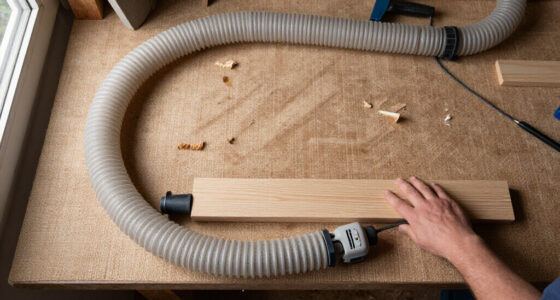
A 2½-inch hose is the sweet spot for small router table collection — big enough to move real volume, small enough to mate with shop vacuum fittings without a pile of adapters. A 1¼- or 1½-inch hose will work for a compact, tightly enclosed cabinet with a small router, but it restricts airflow fast, especially beyond a few feet.
Think of your hose as a highway and every fitting as a toll booth. Each one slows traffic. Here’s my routing checklist, in priority order:
- Use the shortest practical hose. Five feet beats fifteen, every time.
- Eliminate sharp bends. Gentle sweeps; no kinked 90s behind the cabinet.
- Swap corrugated for smooth hose where you can. Those internal ridges create turbulence and drop airflow noticeably.
- Remove unnecessary adapters and sudden diameter reductions. A stepped-down fitting right at the port can undo your whole design.
- Avoid splitters feeding dead branches. Air follows the open path; closed branches still leak.
A concrete example: my table sits on a cart with the vacuum bolted directly below it. The hose runs three feet, one gentle curve, straight into a 2½-inch port with a gasketed fitting. That short, honest run pulls noticeably harder than my old setup across the room, and I didn’t buy a single new machine to get it.
As an affiliate, we earn on qualifying purchases.
Seal the Cabinet Without Cooking Your Router
A router cabinet should be enclosed enough to control dust but never airtight, because routers need cooling air and a fully sealed box will overheat the motor mid-job. I’ve seen melted plastic shroud guards and premature bearing wear from exactly this mistake. The fix is controlled ventilation — intentional openings positioned so incoming air sweeps toward the dust port rather than leaking dust into the room.
Here’s how the airflow logic works: the vacuum pulls air through the cabinet toward the dust port. If the cabinet has gaps, air takes the lazy path through the nearest gap instead of carrying chips to the port. So you seal the lazy paths and leave one deliberate, productive opening. Sealing tape, weatherstripping, and a gasketed door handle that job. My insert plate got a strip of closed-cell foam around its perimeter — thirty cents of material, and it fixed the persistent dust haze around the table top.
Check your router manufacturer’s guidance on enclosure mounting, keep the motor’s cooling vents clear of loose chips, and vacuum out the cabinet when the chip level approaches the router base. A full cabinet isn’t just a cooling problem — packed chips near a spinning collet are a fire consideration too, since fine wood dust is combustible in accumulation.
And design for access from day one. A hinged door, magnetic panel, or quick-release hose coupling means you’ll actually change bits and clear jams instead of working around a system that fights you. The best dust collection in the world fails if you disconnect it out of annoyance.
cyclone separator for dust collection
As an affiliate, we earn on qualifying purchases.
As an affiliate, we earn on qualifying purchases.
Catch the Fine Dust: Filters, Cyclones, and the Air You Can’t See
Chips are the visible nuisance; fine dust is the actual health hazard. The distinction matters more than most woodworkers realize. Particles below about 10 microns — invisible in normal shop light — stay airborne for hours after the cut ends, penetrate deep into the lungs, and are the fraction officially regulated in professional shops. Hardwoods and composite materials like MDF are the worst offenders: MDF in particular produces fine dust that professional exposure limits treat far more strictly than ordinary softwood chips. This is why a system that bags the chips while exhaling fine dust through its exhaust is only doing the cosmetic half of the job — it’s cleaning your floor, not your air.
Your defense has three layers, and understanding why each exists helps you prioritize:
- Filtration: a fine-dust or HEPA-rated filter, properly seated with no bypass around the seal. The reasoning here is simple: a vacuum works by moving air, and whatever the filter doesn’t catch goes straight back into the room you’re standing in. A filter leaking at the gasket is worse than a cheap filter doing its job, because the bypass stream carries exactly the particle sizes the filter grade was chosen for.
- A cyclone separator: drops most chips and coarser debris into a bucket before they ever reach the filter, using centrifugal flow rather than a disposable barrier. Compact units run $30–60 and are, dollar for dollar, the best upgrade in small-shop dust collection. The implication is bigger than convenience: a filter that isn’t being blasted with debris stays cleaner, which means airflow stays consistent through a long session, which means capture at the bit doesn’t fade halfway through a raised-panel run. It also keeps big chips from punching holes in expensive fine filters — protecting the single most important component in your system.
- A respirator: yes, still. Source capture reduces exposure; it doesn’t eliminate it, and here’s why: any capture hood works by entraining dust into moving air, but air at the edge of the capture zone moves slowly, and the finest particles are exactly the ones most likely to drift out of it. Add stir-up during setup, cleanup, and filter changes — when dust that settled all week re-enters the air — and a fitted respirator is cheap insurance, not paranoia. Wear an N95 minimum, and step up when routing MDF or other composites.
The classic tell that your filter is the problem: strong suction for ten minutes, then steadily weaker. That’s filter loading — the filter clogs, static pressure climbs, and airflow at the tool falls even though the motor is running exactly the same. It’s a gradual failure, which is why so many woodworkers blame their vacuum instead of their maintenance schedule. Clean the filter when suction drops rather than waiting for a scheduled date; frequent light cleaning beats heroic rescue efforts on a clogged cartridge, and it extends filter life too, since deeply embedded dust is what forces replacement.
Wiring, Switching, and Static: Finish the System Safely
The most convenient dust collection system is the one that’s already running when the router spins up. A current-sensing automatic switch — the kind that fires the vacuum when it detects the router drawing power — costs about $40 and removes the “forgot to turn on the vac” failure mode completely. Remote switches and a simple wall switch near the table work too. Just make sure an emergency shutoff is within reach from your working position.
On static: flexible plastic hoses build static charge, and in a small hobby system that’s mostly a nuisance — the zap on your knuckles, dust clinging to the hose exterior. Grounding kits and bonded wire can reduce it, but here’s the line I won’t cross: never improvise grounding connections to household electrical systems. Follow the instructions for your specific collector and grounding components, and if anything involves modifying shop wiring, that’s licensed-electrician territory. Same rule for any electrical work on the table itself — kill the power at the breaker before you open a box, and wear eye and hearing protection at the router every single time.
A few non-negotiables that dust collection doesn’t replace:
- Disconnect power before changing bits or servicing anything.
- Use push blocks, featherboards, and guards; keep hands away from the bit.
- Keep dust containers away from ignition sources and empty them before they’re overfilled.
- Don’t route composites or coated materials without controls suited to their dust.
Three Builds from Budget to Dedicated — Pick Your Tier
You can build a dust collection system for a small router table at three realistic budgets, and the honest answer for most garage shops is the middle one. Start entry-level, upgrade where your work actually demands it.
| Tier | Components | Strengths | Limits |
|---|---|---|---|
| Entry (~$100–150) | Shop vacuum, 2½-inch hose, enclosed cabinet, lower dust port, fine filter bag | Cheap, compact, handles falling chips well | Little above-table capture; filter loads fast |
| Improved dual-port (~$200–350) | Lower port + overhead hood or fence port, Y-connector or blast gates, stronger vac or compact collector, cyclone separator | Captures chips and airborne dust; suction stays consistent | Needs enough airflow for both ports together |
| Dedicated system ($600+) | 2HP-class collector, ducting, blast gates, whole-shop layout | Best airflow, lowest filter loading, scales to other machines | Overkill for one compact table used occasionally |
One warning on the dual-port tier: adding an overhead hood without checking your airflow capacity splits a fixed CFM budget two ways. If the vacuum can’t feed both ports, use a blast gate or selector to send air to whichever port is doing the real work — usually the lower one for through cuts, the hood for edge profiling. And note the modern conveniences that have trickled down: sealed-vacuum designs, automatic filter cleaning, clear cyclone buckets (so you can see when to empty), and even 3D-printed custom dust ports for awkward router plates. A poorly designed printed adapter can restrict flow, though — print for fit, not just for fun.
Why Your System Collects Chips but Not Suction: The Fix List
When suction fades or fine dust escapes, the cause is almost always one of a handful of fixable issues — and nearly all of them cost nothing to repair. Run this list before you spend a dollar on new equipment:
- Find and seal leaks. Check the hose-to-port connection, the access door, and around the router insert plate.
- Clean or replace the filter. The single most common cause of weak suction.
- Shorten the hose and straighten the routing. Remove elbows, corrugated sections, and reducers.
- Check port placement. A lower port on the far side of the cabinet from where chips fall does half a job.
- Empty the collection container. A full bag or bucket chokes a cyclone and hides the problem.
- Verify the collector can overcome static pressure. If you’re running two ports on a small vac, gate one closed.
The best low-cost improvement in this entire article: seal leaks and improve hose routing before buying a bigger collector. A well-sealed enclosure with a short, right-sized hose routinely beats simply upgrading the machine. I’d estimate seven out of ten “my vacuum is weak” complaints in small shops trace back to a fifty-cent gasket problem, not an undersized motor.
Frequently Asked Questions
Is a shop vacuum powerful enough for a small router table?
Usually, yes — if the hose is short (under about 6 feet), 2½ inches in diameter, and the lower cabinet is well sealed. A larger dust collector becomes necessary when you add an overhead hood, run long hoses, or feed multiple ports at once, since those all demand more airflow than a compact vac can maintain.
Should I collect dust above or below the router table?
Both. Below-table collection handles the chips that fall into the cabinet, while an overhead hood or fence port captures the airborne dust the bit throws along the cut. If you can only start with one, enclose the base and port the cabinet — that’s where most material ends up — then add the hood later.
How do I keep my router from overheating in an enclosed cabinet?
Never make the cabinet airtight. Leave controlled ventilation openings positioned so incoming air flows toward the dust port, keep the router’s cooling vents clear of loose chips, and check the manufacturer’s mounting guidance. Vacuum out the enclosure regularly so debris can’t block cooling paths.
Do I need a cyclone separator with my shop vacuum?
Not strictly, but it’s the best cheap upgrade in small-shop dust collection. A compact cyclone ($30–60) captures most chips and coarse debris in a bucket before they reach the vacuum’s filter, which preserves suction, cuts filter cleaning dramatically, and lets you see at a glance when to empty.
Why is my system collecting chips but not fine dust?
The usual suspects: a leaking cabinet pulling air through gaps instead of the port, an overloaded filter, a hose that’s too long or too restrictive, or a collector that can’t overcome the system’s static pressure. Seal the leaks, clean the filter, shorten the run, and confirm you have a fine-dust or HEPA-rated filter seated properly — a basic filter can pass the finest (and most harmful) particles straight through.
Do I still need to wear a respirator if I have good dust collection?
Often, yes. Source capture greatly reduces exposure but rarely eliminates fine airborne particles, especially during setup, cleanup, and filter maintenance when settled dust gets stirred back up. Wear at minimum an N95, and use a fitted respirator when routing MDF or other composites that produce especially fine dust.
Conclusion
If you take one thing from this: design beats displacement. Seal the lazy air paths, run a short 2½-inch hose, keep the cabinet enclosed-but-ventilated, and capture above and below the table. Do that, and the modest vacuum you already own will handle a compact router table better than a mismatched collector ever could.
Start this weekend with the free fixes — gasket the insert plate, weatherstrip the door, kill two elbows from the hose run — then measure your results before buying anything. Your lungs, your bits, and the finish on the project sitting on that shelf will all notice the difference.
Fall Picks
fall essentials
As an affiliate, we earn on qualifying purchases.