
If you’re shopping for benchtop thickness planers, the biggest tradeoff you’ll face is between price and cut quality: budget two-blade machines get boards flat, while premium three-blade and spiral-head models leave surfaces that need almost no sanding. The DEWALT DW735X stands out as the best overall pick thanks to its two-speed gearbox, fan-assisted chip evacuation, and convertible stand that makes it the most complete package here. The WEN PL1326 spiral cutterhead is the strongest challenger for finish quality, while the VEVOR 13-Inch Spiral brings spiral cutting to a tighter budget. Budget shoppers and beginners can get solid results from the WEN PL1252 or the standard VEVOR 13-inch models, as long as they accept more snipe and more cleanup work. Keep reading for the full breakdown, including who each machine suits and who should skip it.

Get business pricing on tools and workshop supplies
- Business-only prices and quantity discounts
- Tax-exempt purchasing
- Multiple users, one account, clear invoices
Complete the kit


Key Takeaways
- Cutterhead type was the single biggest differentiator in this lineup: spiral-head models (WEN PL1326, VEVOR 13-Inch Spiral) and three-knife heads (DW734, DW735X, VEVOR Three-Blade) produced visibly smoother surfaces than the two-blade budget machines.
- VEVOR dominates the budget end with six of the fourteen picks, and while they share similar frames, the two-speed and three-blade versions meaningfully outperform the basic two-blade units — the differences within the VEVOR range matter more than the brand badge.
- The DEWALT DW735X earned the top spot largely on its two-speed gearbox (96 CPI finishing pass) and integrated fan-assisted chip ejection, features no other model in this comparison combines.
- The WEN PL1252 and Triton TPT125 sacrifice cutting width at 12.5 inches, which is fine for hobby projects but becomes a real limitation for wider glued panels.
- Snipe control varied more than any spec sheet suggests: models with rigid cast-metal tables and adjustable infeed/outfeed rollers (the DEWALTs and the spiral VEVOR) held board ends noticeably flatter than the lightweight budget units.




More Details on Our Top Picks
CRAFTSMAN 15-Amp Benchtop Planer with Two-Knife Solid Steel Cutter Head (CMEW320)
Craftsman’s CMEW320 keeps things simple where it counts: a 15-amp motor, a ball-bearing-mounted solid steel cutter head, and reversible double-edged knives that stretch your blade budget by flipping instead of replacing. Compared with the WEN PL1252, it gives up a little capacity in exchange for a quicker blade-change design, which matters a lot for first-timers who will inevitably nick a knife on hidden metal or grit. This option makes the most sense for someone buying their first planer who wants clean results without paying for features like dual feed speeds. The tradeoff is real, though — there’s no included stand or extension tables, and dust management depends entirely on hooking up your own vacuum, so budget for a hose and shop vac before the first cut.
Pros:- 15-amp motor handles both hard and soft woods without bogging down
- Reversible, double-edged high-carbon steel knives double usable blade life
- Ball-bearing-mounted cutter head runs smoothly for the price class
- Quick-change knife design simplifies blade swaps for beginners
Cons:- No stand, extension tables, or dust collection hardware included
- Two-knife head leaves a more visible finish than three-knife rivals like the DEWALT DW735X
Best for: First-time woodworkers and hobbyists who want a no-frills planer for occasional furniture and DIY projects
Not ideal for: Buyers without a shop vacuum or dust extractor, since the vacuum port is the only dust management on offer
- Motor:15 Amp
- Type:Benchtop planer
- Cutter head:Two-knife, quick-change solid steel
- Knives:Reversible, double-edged high-carbon steel
- Dust collection:Vacuum port
- Model:CMEW320
Our verdict“A sensible entry point for hobbyists who already own dust collection gear and want reliable planing without premium features.”
WEN PL1252 15-Amp 12.5-Inch Two-Blade Benchtop Thickness Planer
The WEN PL1252 is the classic budget-workhorse formula: respectable specs, 12.5 inches of width capacity, and a 1/8-inch depth of cut per pass that lets you flatten rough lumber quickly. Compared with the Craftsman CMEW320, it publishes more complete performance numbers — 20,000 cuts per minute at a 26 ft/min feed rate — so you know exactly what to expect from the stock. It’s also lighter on features than the VEVOR 13-inch with stand, which bundles a floor stand and extension plates, so you’re trading convenience for a lower cost of entry. The narrower 12.5-inch capacity means full-width shelving boards will need a pass on the table saw first. Still, for a garage woodworker planing the occasional batch of boards, this model covers the fundamentals without asking much in return.
Pros:- Handles boards up to 6 inches thick and 12.5 inches wide
- Aggressive 1/8-inch depth per pass speeds up stock removal
- Two reversible SK5 blades included out of the box
- Published feed rate of 26 ft/min gives predictable results
Cons:- 12.5-inch width capacity excludes wider boards
- No stand or infeed/outfeed support included for long stock
Best for: Garage and basement hobbyists who mill their own lumber occasionally and want capable performance at a low cost
Not ideal for: Woodworkers regularly planing wide 13-inch stock, since the 12.5-inch capacity falls just short
- Model:PL1252
- Motor:15 A
- Maximum board thickness:6 in
- Maximum board width:12.5 in
- Blades:Two reversible 12.5-inch SK5 blades (BP122K)
- Cuts per minute:20,000
- Feed rate:26 ft/min
- Depth per pass:0–1/8 in
Our verdict“The pragmatic choice for occasional planing where capacity demands are modest and every dollar counts.”
VEVOR 13-Inch Benchtop Thickness Planer with Stand
VEVOR’s 13-inch planer with stand stands out in this lineup for what comes in the box: a detachable heavy-duty stand, foldable extension plates, and a full 13 inches of cutting width. While the WEN PL1252 and Craftsman CMEW320 both assume you have a bench and support rollers ready, this package works as a self-contained station out of the box — a real advantage if your shop is a shared garage space. Automatic feeding and return rollers help move longer workpieces through, and overcurrent protection adds a safety layer that budget planers often skip. The tradeoffs: HSS blades dull faster than carbide, the 6 m/min feed speed is single-rate only, and it’s loud enough that hearing protection is non-negotiable. Dust collection gear also isn’t included despite the exhaust port.
Pros:- 13-inch cutting width handles wider stock than 12.5-inch rivals
- Heavy-duty stand and foldable extension plates included
- Automatic feeding and return rollers ease long-board handling
- Overcurrent protection guards against motor damage
Cons:- Dust collection equipment not included despite the exhaust port
- Loud operation requires hearing protection
- HSS blades wear faster than carbide alternatives
Best for: DIYers setting up a first workshop who want a planer, stand, and board support in one purchase
Not ideal for: Anyone in a noise-sensitive space like an attached garage or shared building, given the loud single-speed operation
- Type:Benchtop thickness planer
- Cutting width:13 in (330 mm)
- Cutting thickness:0.2–6.3 in (6–160 mm)
- Motor:15 A, 1800 W
- Blade speed:8000 rpm
- Feed speed:6 m/min (236 in/min)
- Blades:2 double cutter HSS blades
- Dust exhaust interface:1.8 in inner / 2 in outer diameter
- Included components:Planer, stand, accessories, 2 blades
Our verdict“The most complete out-of-box workshop package for budget buyers who can tolerate the noise and supply their own dust extraction.”
DEWALT 13-Inch Two-Speed Thickness Planer (DW735X)
The DEWALT DW735X earns the top spot because it solves the problems the rest of this lineup doesn’t fully address. Its three-knife cutterhead produces a smoother finish per pass than the two-blade Craftsman, WEN, or VEVOR models, and the two-speed gearbox lets you choose between faster stock removal and a finer 96 CPI finish cut. Fan-assisted chip ejection means it manages its own debris even before you connect a vacuum — something no other planer here can claim — and the automatic carriage lock plus depth stop make repeatable thicknessing genuinely practical. Compared with the VEVOR 13-inch with stand, you lose the bundled stand but gain a spare knife set and infeed/outfeed tables in the box. It’s heavier on the wallet, and likely on the bench too, but for anyone planing regularly, the finish quality alone justifies the step up.
Pros:- Three-knife cutterhead delivers smoother finishes and longer knife life than two-blade rivals
- Two feed speeds (96 or 179 CPI) balance speed against surface quality
- Fan-assisted chip ejection keeps the cutterhead clear without external extraction
- Includes infeed/outfeed tables and an extra knife set
Cons:- Premium price compared with the rest of the lineup
- Heavier and bulkier than basic benchtop models without a rolling stand
Best for: Serious hobbyists and small professional shops that plane lumber weekly and need finish-quality results
Not ideal for: Casual DIYers with a handful of boards a year, who would be paying for capability they’ll rarely use
- Model:DW735X
- Planing width:13 inches
- Motor:15 amp, 20,000 rpm
- Cutterhead speed:10,000 rpm
- Cutterhead:Three knives
- Feed speeds:96 or 179 CPI
- Base:19-3/4-inch cast aluminum
- Included accessories:Infeed and outfeed tables, extra set of knives
- Warranty:3-year limited
Our verdict“The planer to buy if you can stretch the budget — it out-finishes and out-features every two-blade option here.”
VEVOR 13-Inch Two-Blade Benchtop Thickness Planer
This VEVOR 13-inch two-blade planer is the pick when board length, not finish quality, drives your decision. Its 35 inches of total table support with extensions out-supports everything else in this batch, which means less snipe and less wrestling with long workpieces — a genuine advantage over the WEN PL1252, which offers no infeed/outfeed support at all. The 2000-watt motor spins at a fast 23,500 rpm, and the built-in 20-amp overload protector cuts power before the motor cooks itself during aggressive cuts. Compared with its sibling VEVOR with stand, you trade the floor stand for longer table support, making this the better fit for bench-mounted setups. The catch is single-speed feeding and a two-knife head, so the surface finish won’t rival the DEWALT DW735X — expect a light sanding pass afterward on visible surfaces.
Pros:- 35 inches of total table support reduces snipe on long boards
- 13-inch width and 6-inch thickness capacity covers most stock
- 20-amp overload protector prevents motor burnout on heavy cuts
- Powerful 2000-watt motor maintains speed under load
Cons:- Single-speed feed with no finish-quality option
- Requires a vacuum cleaner for dust collection
- Two-knife head leaves a rougher finish than three-knife models
Best for: Woodworkers who regularly plane long stock like table aprons, shelving, and trim on a fixed bench
Not ideal for: Finish-focused builders who want glass-smooth surfaces straight off the machine without sanding
- Type:Benchtop thickness planer
- Planing width:13 in
- Maximum board thickness:6 in
- Cutter head:Two knives, quick-change solid steel
- Motor:15 A, 2000 W
- Motor speed:23,500 rpm
- Table support length:35 in total with extensions
- Overload protection:20 A over-current protector
- Dust collection:Vacuum port
Our verdict“The right choice if long-board support and motor protection matter more to you than a ready-to-finish surface.”
VEVOR 13-Inch Two-Blade Benchtop Thickness Planer
VEVOR’s two-blade 13-inch planer is the most affordable way into full-width thickness planing in this roundup, and it covers the fundamentals well. The dual rollers do real work here: they keep boards feeding steadily and cut down on the vibration that produces chatter marks, which cheaper single-roller machines often struggle with. Compared with the Triton TPT125, you give up fine 1/16-inch depth adjustment and settle for coarser 1/8-inch increments, so dialing in a precise final pass takes more patience. The 28.2-inch table is decent for boards, though the three-blade VEVOR with its 35-inch extensions offers better support for long stock. Where this model earns its place is price-to-capacity: a 13-inch width and 1800W motor for less money than anything comparable here.
Pros:- Dual rollers feed boards steadily and reduce vibration
- Full 13-inch planing width at a budget price
- Accepts both 2-inch and 4-inch dust hoses
- 28.2-inch worktable handles reasonably long boards
Cons:- Single-speed operation with no feed-rate adjustment
- 1/8-inch depth increments limit precision finishing
- Two HSS blades won’t match the finish of three-knife or spiral cutterheads
Best for: Hobbyists and garage woodworkers who want full 13-inch planing capacity at the lowest possible cost
Not ideal for: Anyone doing precision furniture work — the 1/8-inch depth increments make fine finish passes hard to control
- Worktable width:13 inches
- Worktable length:28.2 inches
- Motor power:1800W
- Motor speed:Up to 23,500 RPM
- Cutting rate:Up to 16,000 CPM
- Blades:Two HSS blades
- Depth adjustment:1/8-inch increments
- Dust hose compatibility:2-inch and 4-inch hoses
Our verdict“A sensible low-cost entry into thickness planing for occasional projects where finish precision isn’t the priority.”
VEVOR 13-Inch Two-Speed Three-Blade Benchtop Thickness Planer
Stepping up from the two-blade VEVOR gets you the two features that matter most at this price: two feed speeds (24 ft/min for fast stock removal, 15 ft/min for smoother finishing) and a three-knife cutter head that leaves a noticeably cleaner surface than a two-blade setup. The included table extensions stretch total support to 35 inches, which helps keep long boards flat and reduces snipe — something the smaller Triton TPT125 can’t match. The 2000W motor and 20A over-current protection round out a package that competes with pricier machines on paper. The tradeoff against the DEWALT DW734 is build refinement rather than capability: dust collection depends on hooking up your own vacuum, and the 6-inch thickness ceiling caps what you can feed through it.
Pros:- Two feed speeds let you choose between fast removal and fine finishing
- Three-knife solid steel cutter head produces consistent results
- 35 inches of total table support with extensions reduces snipe
- 20A over-current protection and vacuum port included
Cons:- Maximum board thickness limited to 6 inches
- Dust collection requires you to supply your own vacuum
- Fit and finish lag behind premium brands like DEWALT
Best for: Intermediate woodworkers who want feed-speed control and a three-knife finish without paying premium-brand prices
Not ideal for: Those wanting a refined out-of-box experience — you’ll need to supply a vacuum and accept a noisier, rougher machine than the DEWALT alternatives
- Maximum planing width:13 in
- Maximum planing thickness:6 in
- Total table length with extensions:35 in
- Cutter head:Three knives, solid steel
- Feed speeds:24 ft/min and 15 ft/min
- Motor power:2000 W
- Over-current protection:20 A
- Dust collection:Vacuum port
Our verdict“The smart middle ground in this lineup — three-blade cutting and dual feed speeds for buyers who outgrew basic two-blade machines.”
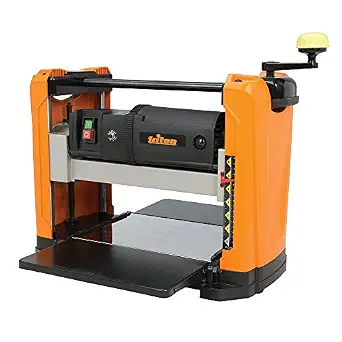
Triton TPT125 High-Performance Benchtop Planer, 12.5-Inch Cutting Width
The Triton TPT125 stands out in this roundup for control rather than raw power. Its depth crank uses 1/16-inch increments with clearly marked scales — twice as fine as either VEVOR’s 1/8-inch steps — which makes final passes on figured or expensive stock far less nerve-wracking. At 17,500 cuts per minute, the cutter head delivers a smooth finish, and the four-post column keeps the head tracking straight through a cut the way the DEWALT DW734 does. The slightly narrower 12.5-inch width means boards over a foot wide need an extra rip-and-glue pass, but honestly most shop lumber falls under that anyway. It’s a smaller ecosystem than DEWALT’s, so replacement knives and accessories take more hunting, and you’re paying a brand premium over VEVOR for comparable capacity.
Pros:- 17,500 cuts per minute for a smooth finish
- Fine 1/16-inch depth increments with clearly marked scales
- Four-post column design keeps the cutter head stable
- Dust chute mounts on either side for flexible shop layouts
Cons:- 12.5-inch width is narrower than the 13-inch VEVOR models
- Smaller accessory and knife ecosystem than DEWALT or VEVOR
- 5.9-inch maximum workpiece height limits thick stock
Best for: Detail-oriented woodworkers who value precise, repeatable depth settings for fine furniture work
Not ideal for: Budget-focused buyers or those regularly planing full 13-inch boards — VEVOR’s machines offer more width for less money
- Cutting width:12.5 in (317 mm)
- Workpiece height range:1/8–5.9 in
- Cuts per minute:17,500
- Depth adjustment increments:1/16 in (1.6 mm)
- Column design:Four-post
- Dust chute:Mountable on either side
Our verdict“Choose this when depth precision and cut quality matter more than maximum width or lowest price.”
DEWALT 15-Amp Benchtop Planer, 12-1/2-Inch, 3-Knife Cutter (DW734)
The DEWALT DW734 is the machine other planers in this roundup are measured against. Its three-knife cutter head produces 96 cuts per inch, one of the finest finishes available on a benchtop machine, and the reversible disposable knives flip over when dull — doubling usable life and eliminating sharpening entirely. The four-column carriage lock is a genuine snipe-reducer that most budget models lack, and the 33-1/2-inch material support handles long boards without extra stands. Compared with the VEVOR two-speed three-blade model, the DW734 gives up adjustable feed speed but gains superior build quality, serviceability, and a parts network that will still exist in a decade. The honest tradeoffs: disposable knives are an ongoing expense versus the sharpenable blades on spiral-head machines like the VEVOR spiral or WEN PL1326, and you lose half an inch of width versus the 13-inch VEVORs.
Pros:- 96 cuts per inch delivers one of the finest finishes in its class
- Reversible disposable knives double usable life and simplify changes
- Four-column carriage lock reduces snipe on long boards
- Extensive parts availability and long-term serviceability
Cons:- Disposable knives create ongoing replacement costs
- 12-1/2-inch width trails the 13-inch VEVOR models
- No feed-speed adjustment unlike the two-speed competitors
Best for: Serious hobbyists and small professional shops who want proven durability and finish quality with easy maintenance
Not ideal for: Buyers who hate consumable costs — disposable knives add up, and a spiral-head planer avoids sharpening and replacement cycles
- Model:DW734
- Power:15 amp, corded
- Motor speed:20,000 rpm
- Cutter-head speed:10,000 rpm
- Planing width:12-1/2 inches
- Cutter head:Three knives, reversible disposable
- Cuts per inch:96
- Material support:33-1/2 inches
Our verdict“The safe long-term buy — pay more upfront for a machine with the durability and finish quality to justify it.”
VEVOR 13-Inch Spiral Benchtop Thickness Planer
A spiral cutterhead with 24 alloy inserts is normally a premium feature — it’s what separates high-end planers from budget ones — and this VEVOR brings it to the value tier. The practical payoff is twofold: individual inserts can be rotated rather than replaced when one edge dulls, and the shearing cut pattern produces far fewer tear-outs on figured hardwood than the straight-blade VEVOR two-blade model. Unlike the WEN PL1326, VEVOR’s other spiral competitor in this space, this machine accepts both 2-inch and 4-inch dust hoses, which makes shop dust hookup simpler. The catch is the 8,000 CPM cutting rate — well below the 16,000 CPM of the two-blade VEVOR — which means slower, more deliberate passes, and single-speed operation gives you no way to tune feed for tricky stock.
Pros:- 24-insert spiral cutterhead resists tear-out on difficult grain
- Individual inserts rotate rather than needing full replacement
- Dual-roller feed keeps boards moving steadily through the cut
- Fits both 2-inch and 4-inch dust hoses
Cons:- 8,000 CPM cutting rate is half the straight-blade VEVOR’s output
- Single-speed operation limits flexibility on tricky stock
- 1/8-inch depth increments are coarse for fine finishing
Best for: Woodworkers planing figured or tear-out-prone hardwoods who want insert-cutter performance at a value price
Not ideal for: Anyone processing large volumes of rough lumber — the lower cutting rate makes dimensioning work noticeably slower
- Planing width:13 inches
- Worktable length:28.2 inches
- Maximum board height:6 inches
- Motor power:2000W
- Motor speed:23,500 RPM
- Cutting rate:Up to 8,000 CPM
- Cutterhead:Spiral-style, 24 alloy blade inserts
- Depth adjustment:1/8-inch increments
- Dust hose compatibility:2-inch and 4-inch
Our verdict“The cheapest route to insert-cutter planing — accept slower feed and coarser adjustments to get tear-out-resistant results on a budget.”
VEVOR 13-Inch Three-Blade Benchtop Thickness Planer
This option stands out for its 28.2-inch worktable, which is longer than most benchtop planers in this lineup and gives long stock far more support at the infeed and outfeed ends — the main driver of snipe. Where the WOODERS 13-inch planer asks you to buy or improvise table extensions, this one arrives with that stability built in. The three HSS blades and dual-roller feed system produce cleaner cuts than the two-blade VEVOR models elsewhere in this roundup, and the 2-inch/4-inch dust hose compatibility means it pairs with most shop vacuums or collectors without adapters. The tradeoff is capacity: a 6-inch maximum planing height rules out thick reclaimed beams, and unlike the WEN PL1326, blades are straight knives rather than rotatable inserts, so a nick means sharpening or replacing the whole set.
Pros:- 28.2-inch worktable supports long boards and helps reduce snipe
- Three HSS blades cut smoother than two-blade equivalents
- Dual-roller feed keeps boards moving steadily through hardwood
- Accepts both 2-inch and 4-inch dust hoses for flexible chip extraction
Cons:- Maximum planing height is limited to 6 inches
- Dust hoses are not included, so extraction setup costs extra
Best for: Hobbyist woodworkers milling long boards who want extra table support and decent dust hookup without a spiral-head price
Not ideal for: Anyone planing thick rough-sawn stock over 6 inches, or buyers who want a dust hose included in the box
Our verdict“A sensible pick if long boards are your norm and you value feed stability over premium cutterhead design.”
WEN PL1326 13-Inch Spiral Benchtop Thickness Planer
The PL1326 earns its place on one feature: a spiral cutterhead with 26 staggered, rotatable HSS blades. Compared with the straight-knife VEVOR three-blade model, the staggered layout shears wood progressively instead of slicing across the full width at once, which translates to fewer mill marks, less tearout on figured grain, and far easier maintenance — a nicked blade just gets rotated to a fresh edge rather than replaced. The material removal gauge and depth stop make repeatable thicknessing straightforward, and the height-adjustable infeed/outfeed tables help tame snipe, something the cheaper WEN PL1252 doesn’t address as directly. The main compromise is aggression: 1/8 inch per pass is the removal ceiling, so hogging through thick rough stock takes more passes and more patience than a heavier straight-knife machine.
Pros:- Spiral cutterhead with 26 rotatable blades delivers a smoother finish and easier blade maintenance
- Material removal gauge and depth stop support accurate, repeatable thicknessing
- Height-adjustable infeed and outfeed tables help minimize snipe
- Handles boards up to 13 inches wide and 6 inches thick
Cons:- Maximum material removal is capped at 1/8 inch per pass
- Feed rate is fixed at 26 feet per minute with no slow-speed option for tricky grain
Best for: Woodworkers prioritizing a glass-smooth finish on figured or delicate woods with minimal sanding afterward
Not ideal for: Those who mainly flatten large volumes of rough lumber fast — the 1/8-inch-per-pass limit slows heavy stock removal
Our verdict“The best choice here when surface quality matters more than raw removal speed.”
VEVOR 13-Inch Two-Speed Benchtop Thickness Planer
What separates this model from the otherwise similar VEVOR three-blade planer above is the two feed speeds. A slower feed means more cuts per inch, which matters when you’re finishing highly figured maple or want to reduce tearout on the final pass — the same reasoning behind the pricier DEWALT DW735X’s two-speed design, delivered here at a much lower tier. Like its sibling, it pairs a 2000W motor with three HSS blades and dual rollers for steady feeding, and accepts both 2-inch and 4-inch dust hoses. The honest drawback is vagueness in the spec sheet: actual feed speed values and the maximum cut depth per pass aren’t stated, so you’re trusting feel rather than numbers when dialing in passes. Buyers who want documented, exact cutting parameters should lean toward the WEN PL1326 instead.
Pros:- Two feed speeds let you slow down for cleaner finishing passes
- Dual rollers reduce vibration and keep boards feeding steadily
- Three HSS blades produce smooth, splinter-free cuts
- Fits both 2-inch and 4-inch dust hose setups
Cons:- Actual feed speed values are not specified by the seller
- Maximum cut depth per pass is not documented
- Same 6-inch height ceiling as other VEVOR models in this roundup
Best for: Budget-minded hobbyists who want a slow-feed finishing pass for figured woods without paying two-speed DEWALT prices
Not ideal for: Detail-oriented buyers who need documented feed rates and cut-depth limits before making a purchase
Our verdict“A value play for feed-speed flexibility, if you can live with an under-specified data sheet.”
WOODERS 13-Inch Benchtop Thickness Planer, 15A, 2000W
Where competitors nickel-and-dime you on accessories, this WOODERS unit arrives as a near-complete kit: two extra planer blades, a dust collector, and a lifting handle in the box. That’s a real edge over the VEVOR three-blade model, which doesn’t even include a hose, and it softens the long-term cost of blade wear — a genuine concern with dual-edge HSS knives. The 6.3-inch workpiece height range edges past the 6-inch ceiling shared by both VEVOR units here, and overload protection adds a safety net when you push dense hardwood through the 10,000 RPM cutterhead. The tradeoffs are physical and evidentiary: it’s a heavy, bench-space-hungry machine, and its anti-snipe and ergonomic claims come from the seller rather than independent validation — the height-adjustable tables on the WEN PL1326 are a more concrete snipe countermeasure.
Pros:- Includes two spare blades, a dust collector, and a lifting handle out of the box
- 6.3-inch workpiece height slightly exceeds the 6-inch ceiling of most rivals here
- Overload protection guards the motor during aggressive hardwood passes
- 15-amp, 2000W all-copper motor with 10,000 RPM cutterhead handles demanding stock
Cons:- Heavy-duty footprint takes up substantial bench space
- Anti-snipe and ergonomic claims are unverified seller statements
Best for: First-time planer buyers who want blades, dust collection, and handling gear included so they can start milling immediately
Not ideal for: Small workshops with limited bench footprint, or skeptics who want verified snipe performance rather than seller claims
Our verdict“The most turn-ready bundle in this batch — ideal if upfront completeness matters more than compact storage.”

How We Picked
I evaluated these fourteen planers against the criteria that actually determine day-to-day satisfaction: cut quality per pass (cutterhead type, knife count, cuts per inch, and feed speed flexibility), snipe control (table rigidity, roller adjustment, and overall mass), capacity and power (cutting width, max depth of cut, and whether the 15-amp motor bogs down on hardwood), and usability (depth-of-cut scales, knife changes, chip evacuation, and dust collection compatibility). Because most of these machines live in home shops, I also weighed footprint, weight, and whether a stand or mobile base is included.
Ranking logic followed value within tiers rather than price alone. The DW735X topped the list because it’s the only model combining a two-speed gearbox with serious dust handling and a convertible stand. Spiral-head machines ranked next on finish quality, three-knife DEWALT-adjacent machines filled the mid-tier, and the basic two-blade units (WEN PL1252, CRAFTSMAN CMEW320, standard VEVORs) were ranked by build quality and included extras. Where two products looked identical on paper — a recurring theme among the VEVOR variants — I separated them by the details that show up in use: blade quality, table support, and stated cuts per inch.
Factors to Consider When Choosing Benchtop Thickness Planers
Before settling on a specific model, it helps to understand what actually separates a planer you’ll keep for a decade from one you’ll outgrow in a year. These are the factors I’d weigh — and the mistakes I’d avoid — when choosing a benchtop thickness planer.Cutterhead Type: Where Your Money Goes Furthest
The cutterhead is the component that most directly determines finish quality, and it’s where the price tiers in this category come from. Straight-knife heads with two blades are the cheapest to manufacture and leave more visible knife marks that you’ll spend time sanding out. Three-knife heads raise the cuts-per-inch count and produce a smoother board in a single pass, which saves both time and stock. Spiral (helical) cutterheads with indexed carbide inserts are the upgrade path: they cut with a shearing action that tears out far less on figured hardwood, and when one insert chips, you rotate it 90 degrees instead of replacing an entire knife. The common mistake is buying a two-blade machine when your projects involve visible, finished surfaces — the money saved gets repaid in sandpaper and frustration. If you’re already leaning toward a straight-knife model, check whether upgrade cutterheads exist for it later.
Snipe: The Problem Nobody Advertises
Snipe — the deeper cut at the beginning or end of a board — is the most common complaint among benchtop planer owners, and spec sheets say almost nothing about it. It’s caused by board ends flexing as they enter and exit the machine, and it’s worsened by flimsy tables, worn infeed/outfeed rollers, and lightweight chassis that flex under load. Heavier machines with rigid cast-metal bed extensions hold boards flatter, and adjustable rollers let you tune the pressure as the machine wears in. If you buy a lighter planer, plan a workaround: lift the board slightly as it feeds, or sacrificial scrap to the ends of precious stock. Factoring snipe control into your buying decision matters more than a tenth of an inch of maximum cut depth, because snipe wastes your best lumber.
Cutting Width and What You Actually Build
Almost every serious benchtop planer offers 12.5 to 13 inches of cutting width, and the difference sounds trivial until it isn’t. A glued-up tabletop panel, a wide shelf, or a live-edge slab often lands just past 12.5 inches, which permanently excludes the narrower machines like the WEN PL1252 and Triton TPT125. Thirteen-inch capacity gives you a margin of safety, but note that none of these benchtop units handle rough-sawn slabs over 6 inches thick. The honest mistake I see is buyers paying for 13 inches when every board they plane is under 10 — and the opposite: hobbyists buying 12.5-inch machines, then discovering their first panel project doesn’t fit. Measure the widest stock you realistically expect to flatten before you choose.
Chip Evacuation and Dust Collection
A thickness planer moves an enormous volume of shavings, and without proper evacuation, chips get re-cut into the wood surface and pack into the cutterhead housing. Some machines — the DEWALT DW735X being the clearest example — include an integrated fan that ejects chips with enough force to fill a bag or feed a shop vacuum. Others rely on passive chutes that clog unless connected to a dust extractor with real airflow. Whatever you buy, budget for dust collection: a shop vac with a 2.5-inch hose is the bare minimum, and a dust collector is better. Ignoring chip management doesn’t just make a mess; it degrades every board you run and shortens knife life.
Two-Speed Gearboxes and Feed Rates
A few models here offer two feed speeds, and it’s a feature that’s easy to dismiss until you understand what it does. The slower setting feeds the board less distance per knife revolution, which multiplies your cuts per inch and produces a finish-ready surface in one pass. The faster setting is for dimensioning rough stock quickly when finish doesn’t matter yet. For occasional hobbyists, a single-speed machine is perfectly usable — you’ll just sand more. For anyone planing quantities of hardwood or producing visible surfaces, the two-speed gearbox pays for itself in time and sandpaper. It’s one of the few premium features that has a measurable, repeatable output difference rather than a marketing one.
Budget Machines: What You Give Up and What You Don’t
The entry-level tier of this market has improved dramatically, and a sub-$400 planer today can genuinely dimension lumber accurately. What you give up is consistency and refinement: softer bed components, less precise depth scales, knives that dull faster, and customer support that varies widely. What you don’t give up is the core function — a 15-amp motor spinning sharp knives will plane a board flat regardless of the badge on the housing. My guidance for budget buyers is to prioritize the frame and table rigidity over electronics and included accessories, since a wobbly chassis can’t be fixed but a cheap stand or fence can be replaced. And whatever you buy, buy a set of replacement knives at the same time, because the included set is rarely the best one the machine will ever run.
Frequently Asked Questions
Is a spiral cutterhead worth the extra cost over a straight-knife planer?
It depends on the wood you plane and how much sanding you’re willing to do. A spiral head shears wood at an angle, which dramatically reduces tear-out on figured grain, maple, and other difficult species, and its carbide inserts last far longer than high-speed steel knives. If your projects involve visible finished surfaces or hardwoods, the upgrade typically pays for itself in sandpaper, time, and saved lumber. If you mostly dimension construction pine or soft stock that will be painted, a three-knife straight head gets you close enough that the spiral premium is harder to justify. Also remember that when a straight knife chips or dulls, you replace the whole set and re-align it — with a spiral head, you rotate a single indexed insert in minutes.
How much snipe should I expect from a benchtop planer, and can I eliminate it?
You can minimize snipe but rarely eliminate it completely on any benchtop machine. Heavier, more rigid models hold boards more consistently, while lightweight units flex more and let board ends dive as they pass the rollers. Practical mitigation matters more than brand choice: support long boards with roller stands at the same height as the bed, keep infeed and outfeed rollers properly adjusted, and lift up slightly on the board as it enters and exits. Many woodworkers also leave boards an inch or two long and trim the sniped ends after planing. If a planer produces deep snipe through the middle of a board or snipe that worsens over time, the rollers or cutterhead bearings need attention.
Is 12.5-inch cutting width enough, or do I need 13 inches?
The honest answer is that most hobby projects never exceed 12.5 inches, but the exception tends to arrive right after you buy the narrower machine. Glued-up panels, wide tabletops, and live-edge pieces frequently land between 12.5 and 13 inches, and there’s no workaround — the board simply won’t fit. If you build furniture, cabinets, or anything from glued panels, spend the small premium for 13-inch capacity. If you plane individual boards for small projects, cutting boards, or trim work, 12.5 inches covers you and often comes with a lower price and lighter weight. Measure your typical stock honestly before deciding.
Do I need a planer with a stand included, or should I buy separately?
An included stand saves you the hassle of matching heights and often integrates better — the DEWALT DW735X’s convertible stand doubles as a mobile base with its own feed-table extensions, which is genuinely useful. A separate or shop-built stand gives you flexibility on height, storage underneath, and mobility, and a sturdy outfeed table you build yourself often beats a stock stand for snipe control. The one mistake to avoid is setting a benchtop planer on a wobbly workbench: the machine needs solid support, and vibration translates directly into surface marks. Whether included or separate, plan for roller stands on both sides once you feed anything over four feet long.
Why do several VEVOR 13-inch planers look identical — which one should I pick?
The differences between VEVOR’s 13-inch variants come down to cutterhead configuration, feed speed, and included accessories, and they matter more than the similar housings suggest. The basic two-blade single-speed version is the entry point and fine for softwood dimensioning. The two-speed versions add a finishing feed rate that produces a smoother board in one pass. The three-blade and spiral-head versions are the ones to shortlist if cut quality matters to you, since they close most of the gap to the premium brands at a lower price. Check the stated cuts per inch, whether a stand is included, and knife availability before choosing between them — those details, not the model numbers, define the real differences.
Conclusion
The right benchtop planer depends less on which machine is objectively best and more on what you plane and how often. For the best overall package, the DEWALT DW735X remains the machine to beat — its two-speed gearbox, fan-assisted chip ejection, and convertible stand make it the most complete workshop tool in this lineup, and the one that best justifies its premium. If finish quality is your priority but you want value, the WEN PL1326 spiral cutterhead is the smart middle path, while the VEVOR 13-Inch Spiral is the best way to get a spiral head on a tight budget.
Best value overall goes to the DEWALT DW734, which pairs three-knife cut quality with proven durability. Beginners and casual hobbyists are well served by the WEN PL1252 or the standard VEVOR 13-inch two-blade — inexpensive, simple, and adequate for learning. For occasional dimensioning on a strict budget, the CRAFTSMAN CMEW320 and Triton TPT125 get the job done. Whatever you choose, invest in dust collection and roller stands alongside it: those two accessories improve results more than stepping up a price tier.
Fall yard work Picks
leaf blowers
As an affiliate, we earn on qualifying purchases.