For most small-to-midsize shops, I’d start with the WEN DC1300: its 1,300 CFM rating and 50-gallon bag suit connected dust collection across several stationary machines. The VEVOR 1.5 HP Vortex Cone is a strong alternative for buyers who want a vortex-style collector, while the POWERTEC DC5371 offers a wall-mounted setup that saves floor space. The main tradeoffs are airflow and collection capacity versus footprint, filtration needs, and how much ductwork your shop can support. Air-filtration units such as the WEN 3410 serve a different purpose from machine-connected collectors, so matching the type to your dust problem matters. Read on for the full breakdown of all 13 options and how I’d choose between them.

Get business pricing on tools and workshop supplies
- Business-only prices and quantity discounts
- Tax-exempt purchasing
- Multiple users, one account, clear invoices
Complete the kit



Key Takeaways
The WEN DC1300 leads on capacity in this lineup, with a 1,300 CFM rating and 50-gallon bag; its size makes more sense in a shop with room to move and store it.
Air cleaners and machine collectors are not interchangeable. The WEN 3410 and hanging DEWALT unit filter circulating shop air, while the other collector-style models connect to tools or ducting.
Wall mounting changes the space tradeoff, not the airflow requirement. The VEVOR 1 HP wall-mount and POWERTEC DC5371 are rated at 560 CFM, so their compact footprint does not make them equivalent to higher-airflow models.
Filtration claims vary across the collection. Several models specify 2.5-micron filtration, while the POWERTEC DC1081 and wall-mount DC5371 list 1-micron bags; buyers should check the full filtration setup rather than relying on the collector name alone.
Portable and compact options favor flexibility over central collection. The DYNAVEX 12-gallon extractor and WEN DC3401 are easier to place near a tool than a large bag collector, but their smaller collection capacity calls for more frequent emptying.
| VEVOR Wall-Mount Dust Collector, 1 HP, 560 CFM, 2.5-Micron Filtration |  | Best Wall-Mount Value | Motor: 1 HP induction motor | Airflow: 560 CFM | Filtration: 2.5 microns | VIEW LATEST PRICE | See Our Full Breakdown |
| VEVOR 1.5 HP Vortex Cone Dust Collector, 1100 CFM, 2.5-Micron Filtration |  | Best for Higher Airflow | Motor: 1.5 HP induction motor | Motor speed: 3400 RPM | Airflow: 1100 CFM | VIEW LATEST PRICE | See Our Full Breakdown |
| Abestorm DecDust 780S Tabletop Dust Collector with Timer |  | Best for Airborne Workshop Dust | Airflow settings: 580 CFM and 780 CFM | Filter: MERV-13; specified to last up to 6 months | Timer: Up to 120 minutes | VIEW LATEST PRICE | See Our Full Breakdown |
| WEN 3410 3-Speed Remote-Controlled Air Filtration System, 300/350/400 CFM, Black | 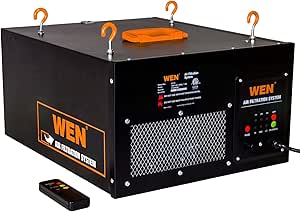 | Best for Quiet, Remote-Controlled Air Cleaning | Airflow: 300 / 350 / 400 CFM | Filters: 5-micron pre-filter and 1-micron filter | Coverage area: Up to 400 sq ft | VIEW LATEST PRICE | See Our Full Breakdown |
| DYNAVEX 10-Amp Portable Woodworking Dust Extractor with 12-Gallon Tank |  | Best for Tool-Linked HEPA Extraction | Motor: 1.5 HP | Airflow: 142 CFM | Tank capacity: 12 gallons | VIEW LATEST PRICE | See Our Full Breakdown |
| DEWALT DWXAF101 Hanging Air Filtration System for Woodworking |  | Best for Fine Airborne Dust | Filtration: Two-stage cotton pre-filter and H11 HEPA filter | Particle capture: Over 95% of particles as small as 0.3 microns | Operating modes: High, medium, low, and automatic | VIEW LATEST PRICE | See Our Full Breakdown |
| VEVOR 1 HP Vortex Cone Dust Collector, 800 CFM, 2.5-Micron Filtration, 16-Gallon Bag |  | Best Mid-Size Vortex-Cone Collector | Airflow: 800 CFM | Motor: 1 HP induction motor, 3400 RPM | Filtration: 2.5 microns | VIEW LATEST PRICE | See Our Full Breakdown |
| WEN DC1300 1,300 CFM Woodworking Dust Collector with 50-Gallon Bag and Mobile Base |  | Best for High-Volume Chip Collection | Airflow: Up to 1,300 CFM | Motor: 14 amps | Collection bag: 50 gallons | VIEW LATEST PRICE | See Our Full Breakdown |
| WEN DC3401 Woodworking Dust Collector, 5.7-Amp, 12-Gallon |  | Best Compact Collector | Airflow: Up to 660 CFM | Motor: 5.7-amp brushed motor | Impeller: 6-inch nylon | VIEW LATEST PRICE | See Our Full Breakdown |
| POWERTEC 1 HP Dust Collector with 1-Micron Filtration and Mobile Base (DC1081) |  | Best for Finer Bag Filtration | Motor power: 1 HP | Voltage: 120/240 V | Motor speed: 3450 RPM | VIEW LATEST PRICE | See Our Full Breakdown |
| WEN DC3474 15-Gallon Woodworking Dust Collector |  | Best Flexible Placement | Motor: 7.4-amp induction motor | Impeller: 9 inches | Airflow: Up to 600 CFM | VIEW LATEST PRICE | See Our Full Breakdown |
| POWERTEC 1 HP Wall-Mount Dust Collector, 560 CFM, with 1-Micron Filter Bag (DC5371) |  | Best for Fine Bag Filtration | Motor power: 1 HP | Voltage and current: 120V/240V; 12A at 120V or 6A at 240V | Motor speed: 3450 RPM | VIEW LATEST PRICE | See Our Full Breakdown |
| POWERTEC DC5372 1 HP Portable Dust Collector, 560 CFM, with 1-Micron Filter Bag |  | Best Portable 1-Micron Option | Motor power: 1 HP | Voltage and current: 120V/240V; 12A at 120V or 6A at 240V | Motor speed: 3450 RPM | VIEW LATEST PRICE | See Our Full Breakdown |
| woodworking dust collector | Airflow | Weight | Motor |
|---|---|---|---|
| VEVOR Wall-Mount Dust Collecto | 560 CFM | 24 lb | 1 HP induction motor |
| VEVOR 1.5 HP Vortex Cone Dust | 1100 CFM | 68.1 lb | 1.5 HP induction motor |
| Abestorm DecDust 780S Tabletop | — | 19.96 lb | — |
| WEN 3410 3-Speed Remote-Contro | 300 / 350 / 400 CFM | 31 lb | — |
| DYNAVEX 10-Amp Portable Woodwo | 142 CFM | 29.5 lb | 1.5 HP |
| DEWALT DWXAF101 Hanging Air Fi | — | — | — |
| VEVOR 1 HP Vortex Cone Dust Co | 800 CFM | 57.3 pounds | 1 HP induction motor, 3400 RPM |
| WEN DC1300 1,300 CFM Woodworki | Up to 1,300 CFM | — | 14 amps |
| WEN DC3401 Woodworking Dust Co | Up to 660 CFM | 17 pounds | 5.7-amp brushed motor |
| POWERTEC 1 HP Dust Collector w | — | 55 pounds | — |
| WEN DC3474 15-Gallon Woodworki | Up to 600 CFM | — | 7.4-amp induction motor |
| POWERTEC 1 HP Wall-Mount Dust | 560 CFM | — | — |
| POWERTEC DC5372 1 HP Portable | 560 CFM | 43.6 pounds | — |
More Details on Our Top Picks
VEVOR Wall-Mount Dust Collector, 1 HP, 560 CFM, 2.5-Micron Filtration
For a small shop that needs direct collection at a stationary machine, this VEVOR combines 560 CFM with a 21-gallon bag in a wall-mounted format. The bottom zipper makes emptying easier without removing the bag, while its 2.5-micron filtration is suited to capturing fine dust along with larger chips. Compared with the VEVOR 1.5 HP Vortex Cone, this model has lower airflow and a smaller footprint; that makes it a more manageable choice for a modest setup, not a match for several machines running together. Its 1 HP motor and overload protection add practical shop utility, but noise can reach 90 dB. I’d skip it for high-demand production or for anyone expecting quiet operation.
Pros:- 560 CFM airflow suits collection at a single stationary woodworking machine.
- 21-gallon bag reduces how often the collector needs emptying.
- Bottom zipper allows debris removal without detaching the bag.
- Overload-resistant motor adds protection during routine shop use.
Cons:- Airflow is lower than the 1100 CFM VEVOR 1.5 HP Vortex Cone.
- Noise can reach 90 dB.
- Wall-mounted design is less convenient to reposition around the shop.
Best for: Small-shop woodworkers who want a wall-mounted collector for one machine or occasional medium-sized projects.
Not ideal for: Woodworkers connecting several machines or seeking quiet operation; 560 CFM and noise levels up to 90 dB may not fit those needs.
- Motor:1 HP induction motor
- Airflow:560 CFM
- Filtration:2.5 microns
- Collection bag:21 gallons (80 L)
- Noise level:≤ 90 dB
- Voltage:120 V
- Weight:24 lb
- Dimensions:40.94 × 13.78 × 15.75 in
Our verdict“Choose this VEVOR for a small shop needing a fixed, 560 CFM collector with a large bag, but not for multi-machine demand or low-noise work.”
VEVOR 1.5 HP Vortex Cone Dust Collector, 1100 CFM, 2.5-Micron Filtration
The standout here is 1100 CFM airflow, which gives this floor-standing VEVOR more capacity for chip and dust collection than the 560 CFM VEVOR wall-mount model. Its 1.5 HP induction motor and large bags suit a shop with more demanding stationary-tool connections, while clip-style bag access simplifies removal when cleanup is due. The tradeoff is scale: at 75.59 inches tall and 68.1 pounds, it takes more floor space and is less suited to a compact garage than either the wall-mount VEVOR or the portable DYNAVEX extractor. The listed bag capacities also conflict—the title cites 35 gallons, while the description cites 42—so I would verify the supplied configuration before buying. It can run under 90 dB, but that still may be loud in a small shop.
Pros:- 1100 CFM airflow exceeds the 560 CFM VEVOR wall-mount collector.
- 1.5 HP induction motor supports higher-demand dust collection.
- 2.5-micron filtration captures fine dust as well as coarser debris.
- Clip-style bag access helps with removal and emptying.
Cons:- Tall, heavy construction takes substantial shop space and is difficult to reposition.
- Bag capacity is listed inconsistently as 35 or 42 gallons.
- Noise under 90 dB may still be disruptive in a compact workspace.
Best for: Woodworkers with a dedicated shop who want substantially more airflow than a compact wall-mount collector can provide.
Not ideal for: Garage woodworkers short on floor space, or buyers who need a clearly confirmed bag capacity before choosing.
- Motor:1.5 HP induction motor
- Motor speed:3400 RPM
- Airflow:1100 CFM
- Filtration:2.5 microns
- Bag capacity:Listed as 35 gallons in the title and 42 gallons in the description
- Voltage:120 V
- Weight:68.1 lb
- Dimensions:36.22 × 29.13 × 75.59 in
Our verdict“Pick this VEVOR when airflow matters more than a compact footprint, after confirming which bag capacity comes with the unit.”
Abestorm DecDust 780S Tabletop Dust Collector with Timer
This tabletop unit addresses a different problem from the VEVOR collectors: it is designed to filter airborne shop dust, not pull chips through a machine hose. Its two settings—580 and 780 CFM—let a woodworker adjust air movement, and the MERV-13 filter is specified to last up to six months. A timer running for up to 120 minutes can keep air circulating after a sanding session without requiring a manual shutoff. Compared with the WEN 3410, the Abestorm offers a higher top airflow figure, while the WEN provides a stated 1-micron filter and a remote control. Neither should be treated as a substitute for source collection at a saw or router. The Abestorm also needs a corded 115 V outlet, and filter replacement remains part of ongoing upkeep.
Pros:- Two airflow settings provide 580 or 780 CFM for airborne dust circulation.
- MERV-13 filter is specified to last up to six months.
- Timer can run for up to 120 minutes after work is done.
- Metal housing, handle, and cord wrap support portability and storage.
Cons:- Does not connect directly to woodworking machines for source capture.
- Filter requires replacement after its stated service life.
- Requires a corded 115 V power source.
Best for: Woodworkers who want a portable air-filtration unit to reduce suspended dust after sanding or other dusty work.
Not ideal for: Buyers seeking direct dust extraction from a saw, sander, or router; this is an air cleaner rather than a machine-connected collector.
- Airflow settings:580 CFM and 780 CFM
- Filter:MERV-13; specified to last up to 6 months
- Timer:Up to 120 minutes
- Voltage:115 V
- Current:0.9 A
- Wattage:100 W
- Weight:19.96 lb
- Dimensions:14.57 × 9.45 × 11.87 in
Our verdict“Choose the Abestorm as a portable air cleaner for lingering airborne dust, not as a replacement for a machine-connected collector.”
WEN 3410 3-Speed Remote-Controlled Air Filtration System, 300/350/400 CFM, Black
The WEN 3410 is an overhead air-filtration system, not a collector for chips at a machine. Its three airflow settings top out at 400 CFM, below the Abestorm DecDust 780S’s 780 CFM, but the WEN’s 50–60 dB operating noise and RF remote make it a more convenient fit for smaller shops where a louder air cleaner would be intrusive. The 5-micron pre-filter and 1-micron filter capture airborne particles as room air passes through; the stated coverage is up to 400 square feet. A programmable shutoff timer adds useful hands-off operation. The compromises are its limited coverage and replacement-filter upkeep. I’d choose the Abestorm for higher stated airflow, while this WEN suits buyers who value quieter operation and remote control over maximum circulation.
Pros:- Three speeds provide 300, 350, or 400 CFM airflow.
- 5-micron pre-filter and 1-micron filter capture airborne dust.
- RF remote works from up to 26 feet without direct line of sight.
- Noise level of 50–60 dB is lower than the dust collectors listed here.
Cons:- Coverage is limited to rooms up to 400 square feet.
- Filters require replacement.
- Lower maximum airflow than the Abestorm DecDust 780S.
Best for: Small-shop woodworkers who want quieter room-air filtration, remote operation, and a timer for post-work cleanup.
Not ideal for: Owners of larger workshops or anyone needing direct collection at a machine; its stated coverage is up to 400 square feet and it is an air filtration system.
- Airflow:300 / 350 / 400 CFM
- Filters:5-micron pre-filter and 1-micron filter
- Coverage area:Up to 400 sq ft
- Noise level:50–60 dB
- Remote range:Up to 26 ft
- Timer:Programmable automatic shutoff
- Weight:31 lb
- Power requirements:120 V, 60 Hz, 1 A
Our verdict“Choose the WEN 3410 for quieter, remotely controlled air cleaning in a smaller workshop, not for tool-side dust extraction.”
DYNAVEX 10-Amp Portable Woodworking Dust Extractor with 12-Gallon Tank
For woodworkers who move between tools, the DYNAVEX stands apart from the larger VEVOR collectors through its portable, tool-linked setup. Its auto-start socket switches extraction on with a compatible connected tool, while the supplied hose, adaptors, and clamps help connect to different machines. The 0.5-micron HEPA filter offers finer stated filtration than the 2.5-micron bags on the VEVOR models. Airflow is only 142 CFM, though, so this extractor is better suited to close-coupled tool collection than the higher-volume airflow needs of a stationary collector. The 12-gallon steel tank limits frequent emptying, but the connected tool must stay within 550 W, with continuous use limited to one hour. Wheels also require installation. Compared with the Abestorm and WEN air cleaners, this unit captures dust at the tool rather than filtering room air.
Pros:- 0.5-micron HEPA filter provides finer stated filtration than the VEVOR collectors’ 2.5-micron filters.
- Auto-start socket synchronizes extraction with a compatible connected tool.
- 12-gallon steel tank holds dust and debris between emptying sessions.
- Included hose, adaptors, and clamps support connections to multiple tools.
Cons:- 142 CFM airflow is far below the VEVOR collectors’ stated airflow.
- Connected tools are limited to 550 W, with continuous use capped at one hour.
- Wheels require installation.
Best for: Woodworkers who use compatible portable saws, sanders, or routers and want tool-triggered extraction with HEPA filtration.
Not ideal for: Shops seeking high-volume collection across multiple stationary machines, or users whose connected tools exceed 550 W or require continuous operation beyond one hour.
- Motor:1.5 HP
- Airflow:142 CFM
- Tank capacity:12 gallons
- Filter:0.5-micron HEPA
- Current:10 A
- Voltage:120 V
- Weight:29.5 lb
- Hose:4 in × 6.5 ft
- Linked tool limit:550 W maximum; continuous use up to 1 hour
Our verdict“Choose the DYNAVEX for portable, tool-linked HEPA extraction from compatible equipment, not for high-airflow collection across a stationary shop.”
DEWALT DWXAF101 Hanging Air Filtration System for Woodworking
The DEWALT DWXAF101 fills a different role from the WEN DC1300 or POWERTEC DC1081: it filters suspended shop air rather than collecting chips through a hose at the machine. Its H11 HEPA and washable pre-filter capture over 95% of particles as small as 0.3 microns, giving it a finer stated particle target than the bag collectors here. Ceiling mounting keeps floor space open, while the remote, automatic mode, and timer let you run it without reaching overhead. The tradeoff is that it does not replace source collection; dust can spread before the unit pulls it in. Installation also requires suitable ceiling space, and its 64 dB noise level may be noticeable. I’d choose it as a supplement for fine airborne dust, not as a standalone collector for a saw or planer.
Pros:- Two-stage filtration captures over 95% of particles as small as 0.3 microns.
- Washable pre-filter and replacement indicator simplify filter upkeep.
- Remote control, automatic mode, and timer settings support hands-off operation.
- Ceiling mounting preserves floor space.
Cons:- Does not collect chips at the source or replace a hose-connected dust collector.
- Requires ceiling installation and available mounting clearance.
- The stated 64 dB noise level may be noticeable during shop work.
Best for: Woodworkers who already collect chips at their machines and want ceiling-mounted filtration for lingering fine airborne dust.
Not ideal for: Anyone seeking a single machine-side collector for sawdust and chips, or workshops without suitable ceiling mounting space.
- Filtration:Two-stage cotton pre-filter and H11 HEPA filter
- Particle capture:Over 95% of particles as small as 0.3 microns
- Operating modes:High, medium, low, and automatic
- Timer settings:1, 2, 4, and 8 hours
- Power:AC, 105 watts
- Noise level:64 dB
- Dimensions:10.2 × 15.9 × 20 inches
- Weight and mounting:20.9 pounds; ceiling-mounted with included hooks and chains
- Warranty:3 years
Our verdict“Choose the DEWALT for fine airborne dust control alongside a machine collector, not as a replacement for one.”
VEVOR 1 HP Vortex Cone Dust Collector, 800 CFM, 2.5-Micron Filtration, 16-Gallon Bag
The VEVOR DC100 is a wheeled, 1 HP collector for shops that need more airflow than the compact WEN DC3401 but don’t need the WEN DC1300’s larger 50-gallon bag and stated 1,300 CFM. Its 800 CFM airflow and 16-gallon collection bag suit routine machine-side pickup while keeping the footprint smaller than a large-capacity setup. Clip-style holders also make bag removal tool-free, a practical advantage when clearing collected debris. The main compromise is filtration: its 2.5-micron rating is less fine than the POWERTEC DC1081’s 1-micron bag, so buyers prioritizing finer bag filtration may prefer that model. Noise is another concern, with operation rated up to 90 dB. I’d shortlist this for a mobile shop collector, but not for a quiet workspace or the finest dust capture.
Pros:- 800 CFM airflow provides more stated capacity than the compact WEN DC3401.
- 16-gallon collection bag supports longer runs than smaller bags.
- Clip-style holders allow tool-free bag removal.
- Casters make it easier to move between machines.
Cons:- 2.5-micron filtration is less fine than the POWERTEC DC1081’s 1-micron bag.
- Rated noise of up to 90 dB may be disruptive.
- The 16-gallon bag can still need emptying during high-volume work.
Best for: Small-to-midsize shop owners who want a wheeled 1 HP collector with more bag capacity than a compact unit.
Not ideal for: Woodworkers prioritizing finer bag filtration, quiet operation, or long high-volume sessions without emptying.
- Airflow:800 CFM
- Motor:1 HP induction motor, 3400 RPM
- Filtration:2.5 microns
- Collection bag:16 gallons (60 L)
- Noise level:Up to 90 dB
- Weight:57.3 pounds
- Dimensions:30.71 × 22.83 × 60.24 inches
- Power source:AC
Our verdict“Pick the VEVOR DC100 for mobile 800 CFM collection and a moderate-capacity bag, provided its noise and 2.5-micron filtration fit your shop.”
WEN DC1300 1,300 CFM Woodworking Dust Collector with 50-Gallon Bag and Mobile Base
For a shop where collection capacity matters more than a compact footprint, the WEN DC1300 is the strongest match in this group. Its stated 1,300 CFM airflow exceeds the 800 CFM VEVOR DC100 and POWERTEC DC1081, while the 50-gallon bag means less frequent emptying than either model’s smaller collection setup. Two 4-inch inlets also allow connections to up to two tools, which can help organize a multi-machine area. That does not make it a fine-dust air cleaner: the supplied product data gives no filtration micron rating, unlike the POWERTEC’s 1-micron bag or the VEVOR’s 2.5-micron rating. It is also a larger, indoor-use unit with a single speed. I’d favor it for substantial chip and sawdust volume, not for buyers whose first priority is fine-particle filtration.
Pros:- Up to 1,300 CFM is the highest stated airflow among these five products.
- 50-gallon bag reduces how often collection needs to be emptied.
- Two 4-inch inlets support connections to up to two tools.
- Four swivel casters make the unit movable around the shop.
Cons:- Its larger bag and mobile base take more workshop space than the compact WEN DC3401.
- The supplied product data does not state a filtration micron rating.
- Single-speed operation offers less airflow adjustment than the DEWALT air filtration system’s multiple modes.
Best for: Woodworkers with multiple machines or high chip volume who want a large collection bag and wheeled mobility.
Not ideal for: Small shops short on floor space or buyers choosing primarily by a specified fine-particle filtration rating.
- Airflow:Up to 1,300 CFM
- Motor:14 amps
- Collection bag:50 gallons
- Inlets:Two 4-inch inlets
- Impeller:10-inch steel; up to 3,450 RPM
- Mobility:Mobile base with four swivel casters
- Power source:AC
- Warranty:Two years
Our verdict“Choose the WEN DC1300 for high-volume chip collection and fewer bag changes, but look elsewhere if fine-dust filtration is your main requirement.”
WEN DC3401 Woodworking Dust Collector, 5.7-Amp, 12-Gallon
The WEN DC3401 favors a small footprint and easy repositioning over the airflow and capacity of the larger VEVOR DC100 and WEN DC1300. It moves up to 660 CFM, has a standard 4-inch port, and weighs 17 pounds, making it a practical fit for a one-machine shop or a collector that needs to move between tools. Its 12-gallon bag is smaller than the VEVOR’s 16-gallon bag and far below the DC1300’s 50 gallons, so frequent emptying is part of the bargain. The stated 5-micron bag rating is also coarser than the POWERTEC DC1081’s 1-micron filtration. A built-in wall mount gives space-constrained owners another setup option, though the brushed motor’s carbon brushes need routine attention. This is the compact, lower-capacity choice—not the one for heavy production.
Pros:- 17-pound weight and compact dimensions suit limited workshop space.
- Up to 660 CFM and a 4-inch port support common single-machine setups.
- Four lockable swivel casters help with positioning and stability.
- Built-in wall mount offers an alternative to using floor space.
Cons:- Its 12-gallon capacity is smaller than the VEVOR DC100’s 16-gallon bag and WEN DC1300’s 50-gallon bag.
- The 5-micron bag is less fine than the POWERTEC DC1081’s 1-micron bag.
- The brushed motor requires routine carbon-brush maintenance.
Best for: Hobbyist woodworkers with one primary machine who need a lightweight collector that can roll around or mount on a wall.
Not ideal for: Shops running several machines or producing high debris volumes, and buyers seeking finer filtration than a 5-micron bag.
- Airflow:Up to 660 CFM
- Motor:5.7-amp brushed motor
- Impeller:6-inch nylon
- Dust port:4 inches
- Collection bag:12 gallons; 5-micron zippered bag
- Dimensions:34.25 × 13 × 14.2 inches
- Weight:17 pounds
- Mounting:Mobile base or built-in wall mount
- Warranty:Two years
Our verdict“The WEN DC3401 makes sense for a space-limited, single-machine shop that values compact mobility over capacity and finer filtration.”
POWERTEC 1 HP Dust Collector with 1-Micron Filtration and Mobile Base (DC1081)
The POWERTEC DC1081 is the clearest pick here for buyers who want a stated fine-particle rating in a conventional wheeled collector. Its 1-micron filter bag is finer by the listed rating than the VEVOR DC100’s 2.5-micron filtration and the WEN DC3401’s 5-micron bag. Airflow is 800 CFM, matching the VEVOR’s stated output but sitting below the WEN DC1300’s 1,300 CFM, so it is a more targeted choice than a high-volume collector. A 4-inch intake, quick-release clamps, and wheeled steel base support use at individual machines and movement around the shop. The tradeoffs are a single speed and assembly; the product data also gives no collection-bag capacity. I’d choose it for filtration priority, while heavy chip volume points toward the larger WEN DC1300.
Pros:- 1-micron filter bag has a finer stated rating than the VEVOR DC100’s 2.5-micron filtration.
- 800 CFM airflow supports machine-side sawdust and chip collection.
- Quick-release clamps simplify collection-bag removal.
- Wheeled steel base and handle support movement around the workshop.
Cons:- Its 800 CFM is below the WEN DC1300’s stated 1,300 CFM.
- The supplied product data does not state collection-bag capacity.
- Assembly is required, and single-speed operation limits adjustment.
Best for: Woodworkers who want a portable, single-machine collector with a finer stated bag rating than the VEVOR DC100 or WEN DC3401.
Not ideal for: High-volume shops seeking the WEN DC1300’s stated airflow and 50-gallon capacity, or buyers who want a specified bag capacity.
- Motor power:1 HP
- Voltage:120/240 V
- Motor speed:3450 RPM
- Air suction capacity:800 CFM
- Filtration:1 micron
- Intake port:4 inches
- Power:AC, single phase, 60 Hz
- Weight:55 pounds
- Base dimensions:15-1/4 × 25-1/2 inches
Our verdict“Choose the POWERTEC DC1081 when a 1-micron bag rating matters more than maximum airflow or a stated large collection capacity.”
WEN DC3474 15-Gallon Woodworking Dust Collector
The WEN DC3474 is a flexible choice for a small shop that needs a dedicated collector without committing to one location. Its 600 CFM airflow is slightly higher than the 560 CFM POWERTEC DC5371 and DC5372, while the 15-gallon bag gives it room for routine tool cleanup. Swivel casters and a carrying handle make repositioning straightforward; the optional wall mount offers another way to reclaim floor space. That mounting option has a catch: installing it means removing the wheels, so switching between mounted and mobile use is less convenient. The 5-micron bag also captures less fine dust than the POWERTEC models’ 1-micron bags. I’d choose this WEN for flexible placement and airflow, not for finer bag filtration or a connection smaller than 4 inches.
Pros:- Up to 600 CFM airflow, more than the 560 CFM POWERTEC DC5371 and DC5372
- 15-gallon zippered collection bag
- Swivel casters and carrying handle support repositioning
- Optional wall mounting adds another placement choice
Cons:- The 5-micron bag is less fine than the POWERTEC models’ 1-micron bags
- Requires a compatible 4-inch tool connection
- Wall mounting requires removing the wheels
Best for: Small-shop woodworkers who want a wheeled collector that can also be mounted when floor space is needed.
Not ideal for: Woodworkers prioritizing finer bag filtration or using machines without a 4-inch dust connection.
- Motor:7.4-amp induction motor
- Impeller:9 inches
- Airflow:Up to 600 CFM
- Dust port:4 inches
- Collection bag:15 gallons, 5-micron zippered bag
- Mobility:Four 2-inch swivel casters and carrying handle
- Mounting:Optional built-in wall mount
- Dimensions and weight:43.3 x 17.7 x 20.1 inches; 41.1 pounds
- Warranty:Two years
Our verdict“Choose the DC3474 if you want flexible mobile or wall placement and higher listed airflow than the POWERTEC 560 CFM models.”
POWERTEC 1 HP Wall-Mount Dust Collector, 560 CFM, with 1-Micron Filter Bag (DC5371)
The POWERTEC DC5371 suits a shop where bag filtration and a fixed installation matter more than maximum listed airflow. Its reusable 1-micron cloth bag captures finer particles by its stated rating than the 5-micron bag on the WEN DC3474, though the WEN lists 600 CFM compared with this unit’s 560 CFM. A viewing window helps track dust buildup, and the bottom zipper simplifies emptying. The included bracket and hardware support wall, workbench, or floor mounting, giving it more mounting choices than a wall-only setup. The tradeoff is a 4-inch inlet that limits compatibility and has a protective grate that may need regular cleaning. I’d favor this model over the portable POWERTEC DC5372 when keeping the collector in one place and clearing floor space are priorities.
Pros:- Reusable 1-micron cloth filter bag
- Viewing window and bottom zipper make bag checks and emptying easier
- Wall, workbench, or floor mounting options with included hardware
- Vortex Base is designed to guide airflow and reduce turbulence
Cons:- Listed airflow is 560 CFM, below the WEN DC3474’s 600 CFM
- Protective inlet grate may collect debris and need regular cleaning
- 4-inch inlet limits compatibility with other connection sizes
Best for: Woodworkers with a compatible 4-inch tool port who want finer-rated bag filtration and a collector mounted off the floor.
Not ideal for: Shops that move the collector between machines often or need an inlet size other than 4 inches.
- Motor power:1 HP
- Voltage and current:120V/240V; 12A at 120V or 6A at 240V
- Motor speed:3450 RPM
- Airflow:560 CFM
- Inlet:4 inches
- Filter:Reusable 1-micron cloth bag with viewing window and bottom zipper
- Mounting options:Wall, workbench, or floor
- Height:44 inches with bag inflated
- Noise level:80 dB
Our verdict“Pick the DC5371 if you want a mountable collector with a reusable 1-micron bag and do not need to move it around the shop.”
POWERTEC DC5372 1 HP Portable Dust Collector, 560 CFM, with 1-Micron Filter Bag
The POWERTEC DC5372 is the better fit for woodworkers who move a collector between machines instead of installing it in a permanent spot. Its casters and 43.6-pound weight support shop-floor repositioning, while its 1-micron reusable bag matches the finer stated filtration of the wall-mount DC5371. Both POWERTEC models list 560 CFM and use a 4-inch inlet, so the choice between them is mainly about mobility: the DC5371 offers wall, workbench, or floor mounting, while the DC5372 is explicitly portable. Compared with the WEN DC3474, this model has a finer-rated bag but lists less airflow. Its inlet grate can catch debris, and AC power confines it to indoor use near an outlet. I’d pick it for a compatible, mobile setup rather than a fixed installation.
Pros:- Casters support moving the unit around the shop
- Reusable 1-micron cloth bag includes a viewing window and bottom zipper
- Vortex Base is designed to reduce turbulence and improve dust removal
- 4-inch inlet connects to compatible woodworking machine ports
Cons:- Listed airflow is 560 CFM, below the WEN DC3474’s 600 CFM
- Protective inlet grate can collect debris and needs checking
- Indoor use and AC power limit where it can operate
Best for: Indoor workshop owners who connect compatible 4-inch machines one at a time and want to roll the collector between them.
Not ideal for: Woodworkers seeking a wall-mounted setup, a non-4-inch connection, or a collector for outdoor use.
- Motor power:1 HP
- Voltage and current:120V/240V; 12A at 120V or 6A at 240V
- Motor speed:3450 RPM
- Airflow:560 CFM
- Inlet:4 inches
- Filter:Reusable 1-micron cloth bag with viewing window and bottom zipper
- Weight:43.6 pounds
- Design:Portable unit with casters
- Intended use:Indoor woodworking, garage, and workshop dust collection
Our verdict“Choose the DC5372 if you need a rollable collector with a 1-micron bag and your machines use 4-inch ports.”
How We Picked
I ranked these woodworking dust collectors by how well their stated design and specifications match common shop needs: connecting to stationary tools, collecting dust near portable tools, filtering air already in the room, or conserving floor space. I compared stated airflow, filtration rating, collection capacity, mounting and mobility, and whether a product’s format suits its likely job. Models with different purposes are not treated as direct substitutes: an ambient air cleaner cannot replace source collection at a saw or sander.
The order favors useful capability for a broad range of workshops, then narrows toward more specialized or space-conscious choices. A higher CFM figure alone does not settle the ranking; duct length, hose diameter, tool ports, and filter condition all affect real collection. I also weighed practical compromises, including bag capacity, installation needs, and how often a smaller unit may need attention. Where the supplied product details do not state a feature, I avoid treating it as confirmed.
Factors to Consider When Choosing Woodworking Dust Collectors
Before choosing a collector, I’d match the machine to the kind of dust problem in the shop, then check whether the rest of the setup can support it. These factors help prevent common mismatches that a headline airflow figure or compact footprint can hide.
1. Decide Whether You Need Source Collection or Air Cleaning
A machine-connected collector captures chips and dust at a tool’s port, while an ambient air cleaner filters particles already circulating in the room. These jobs overlap only partially: a ceiling or hanging unit can reduce airborne dust but will not collect chips from a planer or table saw. Start by listing the tools that produce the most debris and checking whether they have usable dust ports. If your main concern is fine dust lingering after cutting, an air cleaner can complement source collection rather than replace it. Buying the wrong category is a common way to end up with a running machine that does not address the main mess.
2. Match Airflow to the Tool and Duct Route
Airflow ratings are useful for comparing models, but they do not tell the whole story once air has to travel through hoses, fittings, or a duct system. Narrow hoses, long runs, sharp bends, and leaks can reduce collection at the tool. Check the outlet size on both the machine and the collector, then sketch the route before choosing a unit. A collector with a high stated CFM may be a poor match if your setup forces air through restrictive connections. For one nearby tool, a modest portable setup may work better than a larger collector attached to an inefficient network.
3. Treat Filtration as a Whole-System Choice
A filter rating describes a part of the dust-control system, not every particle the workshop setup will capture. The collector’s bag or filter, seals, connections, and the way dust is emptied all affect what escapes back into the room. Compare stated micron ratings, but also check whether replacement filters are available and compatible with your intended use. A finer filter can add resistance or require more attention as dust loads it, so filtration and airflow need to be considered together. If fine dust exposure is a concern, a machine collector should not be assumed to replace appropriate respiratory protection or general shop ventilation.
4. Size the Collection Container for Your Work
Bag or tank capacity affects how often work stops for emptying, especially when machining produces a steady stream of chips. A larger bag is helpful for repeated use across stationary tools, but it takes more space and can be awkward to handle when full. A smaller tank can suit intermittent work or a collector moved between tools, though frequent emptying may become tiresome in a busy shop. Think about the material you process and how much storage room you have for both the collector and replacement bags. Do not choose capacity by itself: the collector still needs enough airflow for the tool and connection.
5. Plan for Placement, Mobility, and Installation
A wheeled base makes it easier to bring a collector to one machine at a time, while a wall-mounted model keeps floor area open but commits you to a fixed location. Before buying, check ceiling height, wall structure, nearby power access, and clearance for changing bags or filters. A fixed collector can make sense when tools rarely move and duct routing is practical; a portable unit offers more flexibility when the shop layout changes. The mistake to avoid is focusing on storage footprint without planning the hose or duct path. A compact collector that cannot reach the tool conveniently may spend more time parked than working.
6. Pay More for Capability You Can Use
A larger collector or more elaborate setup is worthwhile when you have multiple compatible stationary tools, long work sessions, or a plan to add ducting. It is less compelling for occasional use at one portable tool, where mobility and simple storage may matter more than a large bag. Before stepping up, account for the practical costs of the system: ductwork, fittings, filter replacements, and room for the machine. Also check whether your tools have ports that can connect effectively; a powerful collector cannot compensate for a poor-fitting connection. Choose capacity for the workshop you actually have, not a future layout you may never build.
Frequently Asked Questions
Can an air-filtration unit replace a dust collector connected to my tools?
No. An air-filtration unit, such as the WEN 3410 or the hanging DEWALT system, treats air circulating in the room, while a machine-connected collector captures debris at a tool port. The two approaches address different stages of dust control. If your saw or sander produces chips and fine dust at the source, use a compatible collector there first. An air cleaner can add another layer for dust that escapes into the shop, but it is not a substitute for source collection.
Is a 2.5-micron collector enough for a small woodworking shop?
That depends on the tool, the dust produced, and how the collector is connected; the stated micron figure alone cannot describe the whole system. Several VEVOR models in this roundup specify 2.5-micron filtration, while the POWERTEC DC1081 and DC5371 list 1-micron filter bags. Check the filter and bag details, seal quality, and replacement options before choosing. For fine dust concerns, pair effective source capture with suitable shop ventilation and respiratory protection rather than relying on a single rating.
Should I buy a wall-mounted collector or a mobile-base model?
Choose a wall-mounted unit if your tools have stable locations, you can plan a practical hose or duct route, and floor space is scarce. A mobile-base collector is more adaptable when you move between machines or rearrange the shop. Wall mounting can free floor area, but it does not remove the need to reach each tool efficiently. A mobile unit can be easier to position, though it occupies floor space and may require reconnecting hoses. Compare the layout and access for bag changes before settling on either format.
When is a larger bag collector worth choosing over a portable extractor?
A larger bag collector makes more sense when stationary tools produce substantial chips or when you want to collect from more than one machine through a planned hose or duct setup. The WEN DC1300’s 50-gallon bag offers much more capacity than the 12-gallon DYNAVEX tank or 12-gallon WEN DC3401, but the larger unit also needs more room. A portable extractor can be a better fit for intermittent tasks, compact shops, or tools that move around. Consider how often you work and how inconvenient emptying would be before paying for capacity you may not use.
Can one dust collector serve several woodworking machines?
It can, but the result depends on airflow needs, duct layout, and whether you use one tool at a time or several simultaneously. Long runs, narrow ducting, and restrictive fittings can reduce airflow at the active machine. Check each tool’s port and plan the route before assuming that a single collector will cover the whole shop. A simple one-tool-at-a-time arrangement is easier to manage than a multi-branch system, which may need gates and careful balancing. If your tools have different requirements, prioritize the machine that creates the most demanding collection problem.
Conclusion
For a broad range of stationary-shop needs, I’d choose the WEN DC1300 as best overall because its stated 1,300 CFM and 50-gallon bag give it the strongest combination of airflow and capacity in this lineup. The VEVOR 1 HP Wall-Mount is my value-oriented choice for buyers who want a compact, fixed collector and can work within its 560 CFM rating; the POWERTEC DC5371 is a step-up option for those who specifically want a wall-mounted unit with a stated 1-micron bag. For beginners with a small shop, the WEN DC3401 offers a more compact 12-gallon format, while the WEN 3410 suits buyers who need ambient air cleaning rather than tool-port collection. Choose the DYNAVEX 12-gallon extractor for a portable, tank-style setup, or the VEVOR 1.5 HP Vortex Cone when higher stated airflow is the priority. Match the collector to your tools and shop layout before choosing by capacity alone.