
TL;DR
Listen free for 30 days with Audible
Thousands of audiobooks and originals — cancel anytime.
Start your free trialAs an affiliate, we earn on qualifying purchases.
The best hybrid table saws for a home workshop pair a rigid fence and cast-iron table with a 1.5–2 hp induction motor, a quick-release riving knife, roughly 30–36 inches of rip capacity, and effective cabinet dust collection. Compare measured specifications rather than trusting the hybrid label, and budget for wiring, blades, dust control, mobility, and outfeed support.
A friend once rolled a new saw into his one-car garage, bolted on its 52-inch fence rails, and discovered that he could no longer open the side door. The motor had power to spare, but the machine turned his shop into a steel traffic jam. He sold the long rails three months later and fitted a 36-inch system.
That story gets at the real challenge. You are not choosing a motor in isolation; you are choosing a cutting system that must share space with lumber racks, a workbench, dust hoses, electrical outlets, and perhaps the family car. A well-matched hybrid saw feels planted and predictable, humming rather than screaming, while an oversized or poorly designed machine fights your room at every step.
This guide shows you how to compare safety hardware, fence accuracy, usable power, dust collection, rip capacity, and ownership cost. You will also see where a hybrid sits between contractor and cabinet machines, why labels can mislead you, and which specifications matter during real cuts. By the end, you should be able to read a specification sheet and spot the difference between useful engineering and shiny sales copy.
Choose a rigid, repeatable fence before paying for a small increase in motor horsepower.
A 1.5–1.75 hp induction motor suits most furniture and cabinet work; frequent ripping of thick hardwood makes about 2 hp and 240V more useful.
For most garage shops, 30–36 inches of rip capacity saves valuable floor space while still handling common furniture parts.
Pair a 4-inch cabinet port with a proper high-airflow dust collector, and use a shop vacuum for smaller guard ports when appropriate.
Calculate the system price, including wiring, dust collection, blades, mobility, outfeed support, freight, and dado accessories.
How to Choose the Best Hybrid Table Saws for a Home Workshop
A great hybrid saw is not merely a motor with a tabletop. It is a complete cutting system that must deliver accurate guidance, controlled power, effective dust capture, dependable safety hardware, and a footprint your workshop can actually support.
“Hybrid” describes a bridge, not a fixed engineering standard.
Two machines may carry the same label while using very different trunnions, fences, tables, dust paths, and electrical systems. Compare each specification line by line.
Practical power
Commonly uses a 1.5–2 hp belt-driven induction motor, often compatible with ordinary home-shop electrical service.
Mass and control
A cast-iron surface and enclosed or partially enclosed base improve stability, vibration control, and dust capture.
Balanced ownership
Usually costs and weighs less than an industrial cabinet saw while feeling calmer and more planted than a typical contractor saw.
Put control and safety ahead of headline horsepower.
The best machine is predictable during every cut. A rigid fence, aligned blade, effective riving knife, and stable table influence daily results more than a modest increase in motor output.
Control kickback risk
The riving knife should rise, fall, and tilt with the blade while remaining quick to remove when the cut requires it.
- Transparent blade guard
- Anti-kickback pawls
- Large, reachable stop switch
- Reliable height and bevel locks
- Active injury mitigation when available
Demand repeatable guidance
A T-square-style fence should glide smoothly, lock parallel to the blade, stay square, and resist sideways pressure at its far end.
- Positive locking action
- Low deflection under pressure
- Clear measurement cursor
- Adjustable face and rail alignment
- Repeatability across multiple cuts
Check what sits below the table
Accessible adjustment points make routine calibration possible without dismantling half the cabinet.
- Minimal arbor runout
- Flat cast-iron tabletop
- Blade-to-slot adjustment
- Calibratable bevel stops
- Standard-size miter slots
Inspect the entire airflow path
A large port cannot compensate for sharp bends, open gaps, or a poorly shaped blade shroud.
- Shroud close to the blade
- Four-inch cabinet connection
- Guard or overarm extraction
- Short internal airflow route
- Easy cleanout and belt access
| Buying Factor | Contractor Saw | Home-Shop Hybrid | Industrial Cabinet Saw |
|---|---|---|---|
| Enclosed dust path | ~Limited | ✓Expected | ✓Strong |
| Typical motor class | ~Portable to 1.5 hp | ✓1.5–2 hp | ✓3 hp and above |
| Home electrical fit | ✓Usually simple | ✓Often flexible | ~Often 240V |
| Garage mobility | ✓Easier | ✓Mobile base advised | ~Difficult |
| Mass and stability | ~Moderate | ✓Balanced | ✓Maximum |
Choose capacity for the room around the saw.
A 52-inch rail can handle wide sheet cuts, but it may block a door, storage bay, walkway, or parking space. Measure the complete working envelope, including infeed and outfeed clearance.
Relative workshop footprint
Power should follow the workload.
A sharp, task-appropriate blade often improves cutting more than a small horsepower upgrade. Confirm voltage, amperage, conversion support, overload protection, plug type, and dedicated-circuit requirements before purchase.
Measure the cutting zone, not only the cabinet.
Include the rails, mobile base, fence position, hose bends, cord route, control access, lumber path, and a level outfeed surface positioned slightly below the saw.
Electrical work: Have a licensed electrician assess any new 240V circuit, receptacle, grounding, and local code requirements.
Follow the chain from your work to the final system cost.
Buying in the right order prevents an attractive machine from becoming an expensive obstruction. Start with the work, verify the room, then test the engineering.
The purchase price is only the first line.
A complete budget protects you from discovering that the saw needs electrical work, extraction equipment, mobility hardware, or accessories before it can perform safely.
Include every supporting component.
What You Actually Get When a Saw Is Called Hybrid
A hybrid table saw combines features of contractor and cabinet machines, usually pairing a 1.5–2 hp belt-driven induction motor with an enclosed or partially enclosed base. It typically offers more mass and better dust control than a contractor saw while costing and weighing less than a full industrial cabinet saw. The label itself has no tightly fixed technical definition [1].
That loose definition explains why two machines carrying the same label can feel completely different. One may use a heavy cast-iron top, cabinet-mounted trunnions, and a 4-inch dust port; another may place a contractor-style mechanism inside a sheet-metal box. Both count as hybrid products in a catalog, yet only one may hold its alignment after you roll it across a cracked garage floor.
Think of the category as a bridge. It blends the useful traits of contractor and cabinet saws, but each manufacturer decides where that bridge lands. You need to compare the fence, trunnions, table flatness, motor, electrical requirements, and service access one line at a time rather than buying the category name.
For example, suppose you build bookcases from plywood and occasionally rip 8/4 maple. A 1.75 hp saw on 120V may handle nearly every cut with a sharp thin-kerf blade, while its enclosed cabinet keeps the floor cleaner. You gain the calm, low growl and stable iron surface people want from a stationary saw without bringing a 600-pound production machine into a small shop.
Buy the specifications, not the badge. A saw earns its place through alignment, control, and support—not through the word hybrid printed on its carton.
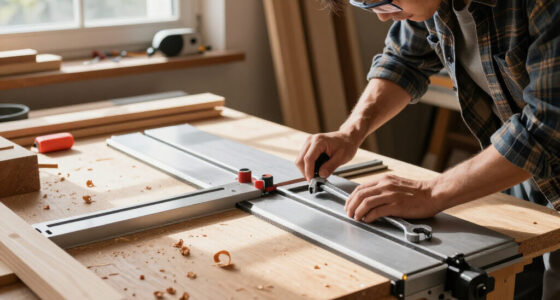
hybrid table saw with adjustable fence
As an affiliate, we earn on qualifying purchases.
As an affiliate, we earn on qualifying purchases.
Choose Enough Power Without Paying for an Electrical Surprise
The best hybrid table saws for a home workshop usually provide 1.5–2 hp, which covers furniture, cabinets, plywood, and ordinary hardwood work. Power near 2 hp gives you more breathing room in thick oak or maple, but voltage, amperage, and circuit demands matter as much as the horsepower number. Check the manual and motor nameplate before purchase [2].
A 1.5–1.75 hp induction motor can make clean, steady cuts when you match the blade to the task. Fit a sharp 24-tooth ripping blade for thick stock, and the saw clears chips like a small snowplow. Push a dull 60-tooth crosscut blade through 2-inch hard maple, and even a stronger motor may bog, heat the wood, and leave brown burn marks.
Many 120V machines need a dedicated circuit, especially when the dust collector starts at the same moment. A motor and collector sharing an overloaded branch can trip the breaker halfway through a long rip, leaving the board stopped beside the blade. If the saw requires 240V, hire a licensed electrician to check the panel, circuit capacity, receptacle, plug, grounding, and local code requirements; switch power off and verify it is dead before touching any electrical enclosure.
Your workload should set the power tier. If you make painted plywood cabinets on weekends, a well-tuned 1.75 hp saw will usually serve you better than a 3 hp cabinet machine squeezed against a wall. If you rip 10-foot lengths of 8/4 white oak every week, the heavier saw, 240V supply, and slower feed rate become practical production tools rather than luxuries.
- Mostly plywood and 3/4-inch stock: favor fence quality, sheet support, and a good 40-tooth combination blade.
- Frequent thick hardwood: favor about 2 hp, 240V capability, and a dedicated ripping blade.
- Mixed home-shop work: choose flexible voltage, motor overload protection, and easy belt access.
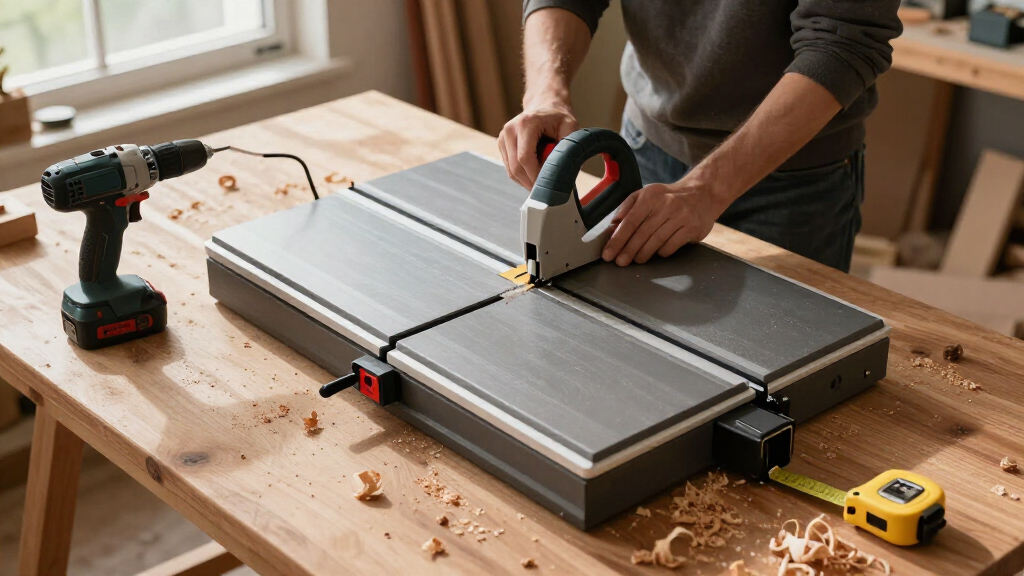
best hybrid cabinet style table saw
As an affiliate, we earn on qualifying purchases.
As an affiliate, we earn on qualifying purchases.
Let the Fence Decide Whether Your Cuts Stay Straight
The best hybrid table saws for a home workshop use a fence that locks parallel to the blade, glides without binding, and resists sideways pressure. Fence behavior matters more than a small horsepower difference because every rip cut references that rail. A crooked or flexible fence produces tapered parts and can steer stock toward the rear teeth.
At a showroom, slide the fence from end to end and lock it at several positions. Press its far end sideways with firm hand pressure; a rigid T-square style fence should not wag like a loose gate. Check whether the cursor is easy to read, the face sits square to the table, and the clamping action feels positive without needing a hard slap.
Accuracy also depends on what sits beneath the tabletop. Look for easy blade-to-miter-slot adjustment, calibratable bevel stops, stable elevation gears, and handwheels with little backlash. A flat cast-iron table gives you a reliable reference surface, though you should protect the bare metal with paste wax or another suitable rust inhibitor when damp winter air rolls into the garage.
Here is a common furniture-shop example. You rip four face-frame stiles at a nominal 1 1/2 inches, then stack them against a machinist square. If the fence shifts by only 0.015 inch between cuts, the stack shows a visible stair step, and your cabinet doors reveal uneven gaps after assembly. A repeatable fence saves more time than correcting every part at the jointer.
Standard miter slots also matter because they accept common featherboards, sled runners, and gauges. The included miter gauge may have some play, but you should be able to tune or replace it without hunting for an odd proprietary size. Routine calibration should involve accessible bolts and stops, not removing half the cabinet while balancing a wrench above the motor.
As an affiliate, we earn on qualifying purchases.
Put These Safety Features Ahead of Extra Horsepower
The safest practical choice includes a riving knife that moves with the blade, a transparent guard, anti-kickback pawls, firm blade locks, and a large stop switch you can hit with your knee. Active injury-mitigation technology adds another layer when available. None of this hardware replaces push sticks, featherboards, eye protection, or hearing protection.
The riving knife deserves close attention because it stays near the rear of the blade through height and bevel changes. When internal tension closes a board’s kerf, the knife helps stop the wood from pinching the spinning teeth and launching backward. Without it, a harmless-looking board can become a wooden spear before you have time to move.
Imagine ripping a bowed 6-foot cherry board. Halfway through the cut, the kerf squeezes shut with a faint click, like a spring trap snapping closed. A correctly sized and aligned riving knife keeps the cut open, while a featherboard holds the stock against the fence and a push block keeps your hand away from the blade.
Check whether you can remove and refit the guard and knife without tools. If changing the setup takes ten minutes and two buried bolts, people tend to leave the protection hanging on a wall. A quick-release mechanism makes the safe configuration the easy configuration, especially when you switch between through-cuts and non-through grooves.
Flesh-detection systems can reduce the severity of blade-contact injuries, though they increase the purchase price and may require a new brake cartridge or blade after activation. Treat that cost as part of the decision, not a reason to ignore the technology. Keep the saw disconnected while changing blades or reaching inside the cabinet, wear proper PPE, and never rely on electronics to compensate for poor hand position.
A riving knife manages the cut you cannot see: the wood closing behind the blade.
As an affiliate, we earn on qualifying purchases.
Match Rip Capacity and Mobility to the Room You Really Have
The best hybrid table saws for a home workshop usually pair 30–36 inches of rip capacity with a mobile base and clear infeed and outfeed paths. That range handles most furniture components without letting long rails swallow a garage. Measure material movement, not merely the cabinet footprint, before you order the machine.
A 52-inch rail system sounds generous until it blocks a doorway or forces you to feed lumber beneath a wall cabinet. Full sheets also need about 8 feet of clear approach and 8 feet beyond the blade, plus side room for your body. In a 12-by-20-foot garage, that material path often matters more than the extra 16 inches printed on the fence scale.
Suppose you build a 34-inch-wide dining tabletop once a year but make 24-inch cabinet parts every month. A 36-inch fence handles the daily work, while a track saw breaks the occasional 4-by-8-foot panel into manageable pieces on foam insulation. That pairing often feels safer and less cramped than wrestling a full sheet across a stationary saw.
A hybrid can weigh several hundred pounds, so choose a mobile base rated for the complete saw and rail configuration. The support points must keep the cabinet from twisting when you raise the casters. Route the power cord and dust hose where a wheel cannot crush them, and leave motor vents open rather than packing offcuts against the cabinet.
Your outfeed surface should sit level and slightly below the saw top so a long board cannot catch on its front edge. A folding table can work in a shared garage, but test it with an 8-foot board before the first cut. You want the board to slide across the surface like a drawer on waxed runners, not seesaw off the back of the blade.
Get Dust Collection That Moves Chips Instead of Making Noise
Good hybrid-saw dust control needs an enclosed base, a close-fitting blade shroud, and a short airflow path to a properly sized port. A 4-inch cabinet connection usually belongs on a dust collector that moves high airflow, while a shop vacuum suits smaller, high-resistance guard ports. Port diameter alone does not prove the system works.
Dust behaves like water in a gutter: tight bends, leaks, and narrow passages slow the stream. A large collector connected through a long, ribbed hose may underperform a modest unit on a short, smooth run. Inspect the cabinet interior for ledges where sawdust can pile into amber drifts around the trunnions and elevation gears.
For a real garage example, connect a shop vacuum to a 4-inch port through a reducer and rip a sheet of MDF. The vacuum may roar, yet fine tan powder still rolls from cabinet gaps because the machine produces static pressure rather than enough volume through the large opening. A proper dust collector with adequate airflow captures far more debris at the cabinet, while a separate vacuum hose can serve the blade guard.
Look for easy access panels so you can clear packed chips without dismantling the saw. Overarm or guard extraction helps catch the pale plume that rises above the blade during trimming and grooving. Even strong collection misses some fine dust, so wear a suitable respirator for dusty materials and keep the shop ventilated.
Do not compare collector ratings by a single advertised CFM number. Hose length, filter loading, blast gates, elbows, and the saw’s internal design change real airflow. A clean filter and a direct 4-inch run often improve capture more than adding a louder machine at the far end of a tangled duct network.
Use This Side-by-Side Check Before You Spend
A contractor saw favors portability and price, a hybrid balances home-shop performance, and a cabinet saw favors continuous heavy work. Your best choice depends on stock thickness, available power, floor space, and production pace. The comparison below gives you a practical starting point based on common category specifications [1].
| Feature | Contractor saw | Hybrid saw | Cabinet saw |
|---|---|---|---|
| Typical motor | 1–2 hp | 1.5–2 hp | 3–5 hp |
| Base | Open or stand-style | Usually enclosed | Fully enclosed |
| Power | Often 120V | 120V or 240V | Usually 240V |
| Dust control | Fair | Good | Usually best |
| Weight | Lower | Moderate | High |
| Best fit | Portable general work | Serious home workshop | Production and thick stock |
A portable jobsite model sits outside this comparison. It uses a compact frame and usually a loud universal motor, trading mass and a broad cast-iron work surface for easy transport. If you carry the saw up stairs or load it into a van every morning, that trade makes sense; if it stays in one garage, a hybrid feels calmer and more stable.
After choosing the general class, score each candidate on the features you will touch every day. A sensible all-around specification includes a rigid fence, cast-iron table, quick-release riving knife, standard miter slots, 30–36-inch capacity, dado approval, and accessible calibration points. Check current regional certification, warranty coverage, replacement-parts supply, and the exact manual because safety systems and configurations continue to change [2].
Do not stop at the sticker price. Add the blade, mobile base, outfeed support, dust collector, hose, dado insert, freight charge, and any electrical work. A $1,700 saw can become a $2,500 shop system quickly, while a slightly costlier package with an integrated base and usable blade may cost less by the time you make the first accurate cut.
Before accepting delivery, ask how the carrier handles a several-hundred-pound crate and what happens if the cast-iron top arrives cracked. Once the saw lands, inspect freight damage, wing flatness, fence alignment, arbor behavior, belt tension, bevel stops, and guard operation before discarding the packaging. That hour of careful checking can save weeks of arguing over a damaged machine.
Frequently Asked Questions
Can a hybrid table saw run on a normal household outlet?
Many 1.5–1.75 hp hybrid saws run on 120V, but they may need a dedicated circuit with the amperage stated in the manual. Some models support conversion to 240V, while others require it from the start. Have a licensed electrician install or verify any new circuit, receptacle, or plug, following local code and permit rules.
Is a hybrid table saw accurate enough for fine furniture?
Yes. A hybrid saw with a flat table, rigid fence, low arbor runout, and accessible alignment controls can produce furniture-grade work. Fit the correct blade and calibrate the blade parallel to the miter slot; the category name matters less than the machine’s ability to hold those settings.
How much rip capacity does a home workshop need?
About 30 inches handles most furniture parts, while 36 inches adds useful room without dominating many garages. Wider rails help with full sheets, but they demand substantial side clearance. In a tight room, a track saw for initial panel breakdown often pairs better with a compact hybrid.
Can you use a dado stack on every hybrid table saw?
No. Use a dado stack only when the manufacturer approves it and specifies the maximum width, blade diameter, and compatible throat plate. Short arbors and regional rules can limit dado use, so check the current manual before buying either the saw or the stack.
What blade should you buy first?
A quality 40-tooth combination blade is a practical first blade for mixed ripping and crosscutting. Add a 24-tooth ripping blade for thick hardwood and a higher-tooth-count crosscut blade when clean plywood edges matter. Match the blade kerf to the riving knife specification so the knife works correctly.
Conclusion
Your smartest move is to choose the saw that stays accurate, guarded, clean, and easy to use inside your real room. Start with the fence and riving knife, verify the electrical supply, then map a full board-length path across the floor. Spend on horsepower only after those pieces fit.
A good hybrid saw should disappear into the work. The fence clicks home, the induction motor settles into a low hum, and a long maple board glides onto the outfeed table without drama. When the machine fits your hands, your circuit, and your garage, you stop thinking about the saw and start thinking about the furniture taking shape.
Fall yard work Picks
leaf blowers
As an affiliate, we earn on qualifying purchases.