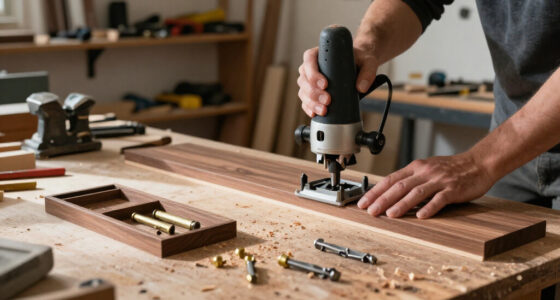

Woodworking spindle sanders smooth inside curves and cutouts more evenly than hand sanding, but the right choice depends on your workspace and how often you sand them. I rank the RIKON 50-300 as the best overall for a dedicated benchtop setup, while the WEN 6510T is a straightforward value pick and the WEN HA5932 suits jobs that call for portability and variable speed. Fixed machines offer a stable work surface; portable and handheld options trade that support for easier movement or access. Read on for the full comparison, buying advice, and recommendations by shop and project type.

Get business pricing on tools and workshop supplies
- Business-only prices and quantity discounts
- Tax-exempt purchasing
- Multiple users, one account, clear invoices
Complete the kit


Key Takeaways
- The RIKON 50-300 leads the benchtop group for buyers prioritizing a dedicated, stable sanding station over portability.
- The WEN 6510T keeps the choice simple for buyers who want a conventional benchtop sander without making variable speed the deciding feature.
- Variable-speed models have a distinct use case: the Woodskil and WEN HA5932 offer more control when wood species, abrasive, or curve size call for adjustments.
- Portable designs change how you work: the WEN HA5932 can move to the workpiece, while a handheld kit reaches projects that cannot be brought to a benchtop machine.
- The JET JBOS-5 sits in a different class of shop commitment with its 1/2 HP motor, while compact and benchtop alternatives take less dedicated space.
| RIKON 50-300 Oscillating Spindle Sander |  | Best for a Stable, Heavy-Duty Bench Setup | Model: 50-300 | Motor: 1/2 HP | Power source: Corded electric | VIEW LATEST PRICE | See Our Full Breakdown |
| WEN 6510T 3.5 Amp Oscillating Spindle Sander |  | Best for Beginners | Model: 6510T | Motor power: 1/2 HP | Amperage: 3.5 A | VIEW LATEST PRICE | See Our Full Breakdown |
| VEVOR Oscillating Benchtop Spindle Sander with 6 Sleeves |  | Best Compact Pick | Model: OSM-1 | Power source: Corded electric | Maximum speed: 2,000 rpm | VIEW LATEST PRICE | See Our Full Breakdown |
| WEN AT6535 3.5-Amp Oscillating Spindle Sander |  | Best for Angled Work | Motor: 3.5 A | Power source: Electric | Maximum rotational speed: 2,000 rpm | VIEW LATEST PRICE | See Our Full Breakdown |
| RIKON Benchtop Oscillating Spindle Sander |  | Best for Large Sleeve Sizes | Model: 50-320 | Motor: 1/2 HP | Power source: Corded electric | VIEW LATEST PRICE | See Our Full Breakdown |
| Woodskil Variable-Speed Oscillating Spindle Sander |  | Best for Speed Control | Motor: 2/3 HP, 4 A | Speed: 1,000–1,800 RPM | Sanding sleeves: 6, ranging from 1/2 to 3 inches | VIEW LATEST PRICE | See Our Full Breakdown |
| Triton TSPS450 Oscillating Spindle Sander |  | Best for Table Support | Motor: 3.5 A (450 W) | No-load speed: 2,000 RPM | Oscillation speed: 58 OPM | VIEW LATEST PRICE | See Our Full Breakdown |
| WEN HA5932 5-Amp Variable-Speed Portable Oscillating Spindle Sander |  | Best Portable Option | Motor: 5 A | Rotational speed: 1,800–3,200 RPM | Oscillation rate: 50–90 oscillations per minute | VIEW LATEST PRICE | See Our Full Breakdown |
| JET JBOS-5 Benchtop Oscillating Spindle Sander, 1/2 HP |  | Best for Bevel Sanding | Motor: 1/2 HP TEFC induction motor | Spindle speed: 1,725 RPM | Oscillation: 1 inch at 30 oscillations per minute | VIEW LATEST PRICE | See Our Full Breakdown |
| Handheld Drum Spindle Sander Kit for Woodworking |  | Best Drill-Powered Add-On | Brand: HANPINYUAN | Model: SCSG-407 | Drum diameters: 1 inch and 1.5 inches | VIEW LATEST PRICE | See Our Full Breakdown |
| woodworking spindle sander | Motor | Power source | Weight | Model |
|---|---|---|---|---|
| RIKON 50-300 Oscillating Spind | 1/2 HP | Corded electric | 76–80 lbs (source listings differ) | 50-300 |
| WEN 6510T 3.5 Amp Oscillating | — | — | 30.2 lbs | 6510T |
| VEVOR Oscillating Benchtop Spi | — | Corded electric | 19.8 lbs | OSM-1 |
| WEN AT6535 3.5-Amp Oscillating | 3.5 A | Electric | 33.2 lbs | — |
| RIKON Benchtop Oscillating Spi | 1/2 HP | Corded electric | — | 50-320 |
| Woodskil Variable-Speed Oscill | 2/3 HP, 4 A | Corded electric | 26 lbs | — |
| Triton TSPS450 Oscillating Spi | 3.5 A (450 W) | Corded electric; listed voltage is inconsistent | — | — |
| WEN HA5932 5-Amp Variable-Spee | 5 A | — | — | — |
| JET JBOS-5 Benchtop Oscillatin | 1/2 HP TEFC induction motor | — | 77 lb | — |
| Handheld Drum Spindle Sander K | — | — | — | SCSG-407 |
More Details on Our Top Picks
RIKON 50-300 Oscillating Spindle Sander
The RIKON 50-300 is the strongest fit here for woodworkers who want a substantial machine that stays planted while shaping curves. Its cast iron tilting table and 76–80 lb weight support steady work, while five spindle diameters and six inserts cover a useful range of curve sizes. Compared with the lighter VEVOR OSM-1, this RIKON trades easier repositioning for a heavier build and a beveling table. Its 15/16-inch stroke is also longer than the 5/8-inch stroke on the WEN 6510T, which may help keep abrasive wear distributed along the sleeve. The tradeoff is substantial: it takes dedicated bench space, and its corded power limits placement. I’d choose it for a stationary shop where stability matters more than mobility.
Pros:- Cast iron tilting table offers a stable surface for angled work.
- Long 15/16-inch oscillation stroke compared with the shorter-stroke WEN models.
- Five spindle diameters and six inserts support a range of curve sizes.
- Five-year warranty.
Cons:- At 76–80 lb, it is much less portable than the 19.8 lb VEVOR OSM-1.
- Corded power restricts placement to areas with an outlet.
Best for: Woodworkers with a permanent shop station who regularly sand varied curve sizes and value a heavy cast iron tilting table.
Not ideal for: Small-shop users who need to move their sander often or store it between projects; its 76–80 lb weight makes that less convenient.
- Model:50-300
- Motor:1/2 HP
- Power source:Corded electric
- Oscillation stroke:15/16 in.
- Oscillation rate:29 times per minute
- Spindle diameters:5 sizes, 1/2–2 in.
- Table inserts:6
- Table material:Cast iron
- Weight:76–80 lbs (source listings differ)
Our verdict“Choose the RIKON 50-300 if you want a heavy, stable sander for a dedicated woodworking station and can spare the space.”
WEN 6510T 3.5 Amp Oscillating Spindle Sander
The WEN 6510T makes a practical first spindle sander because its 30.2 lb body is easier to move and store than the much heavier RIKON 50-300. It arrives with six sleeve sizes, five rubber drums, and onboard storage, so a new user can match the abrasive to a range of curves without sourcing a separate drum set. Its 2,000 rpm rotation and 58 oscillations per minute suit routine edge shaping, while the dust port gives a vacuum a connection point. That port does not collect dust by itself, though, so effective cleanup depends on a separate extractor. Compared with the WEN AT6535, the 6510T has a smaller listed footprint and includes a 3-inch sleeve; the AT6535 instead offers a larger beveling table. I’d favor this model for flexible, general-purpose starter work.
Pros:- Six sleeve sizes, including a 3-inch sleeve, cover a broad range of curve sizes.
- Includes five rubber drums and onboard accessory storage.
- At 30.2 lb, it is easier to move than the RIKON 50-300.
- Dust port allows connection to a separate collection system.
Cons:- Effective dust management requires a separately purchased extractor.
- Corded 120V power limits use to locations with an outlet.
Best for: New woodworkers who want a movable benchtop sander with several sleeve and drum sizes for learning to shape curves.
Not ideal for: Woodworkers who need an angled work surface or expect dust control without owning a vacuum or extractor.
- Model:6510T
- Motor power:1/2 HP
- Amperage:3.5 A
- Voltage:120V AC
- Rotational speed:2,000 rpm
- Oscillation rate:58 OPM
- Stroke length:5/8 in.
- Included accessories:6 sanding sleeves and 5 rubber drums
- Weight:30.2 lbs
Our verdict“The WEN 6510T suits beginners who want an easy-to-move starter machine with a broad accessory set and already have a way to collect dust.”
VEVOR Oscillating Benchtop Spindle Sander with 6 Sleeves
At 19.8 lb, the VEVOR OSM-1 is the easiest model in this group to reposition or tuck away, which makes it a sensible fit for a shared or space-limited shop. It still includes six sleeve sizes and six table inserts, and its 12.5 × 11.5-inch cast aluminum table gives small and medium parts room to sit flat. The 2,000 rpm speed and 0.59-inch stroke support curved and contoured work; a dust port can connect to a vacuum. Compared with the WEN 6510T, the VEVOR is lighter, but its listed data does not specify the same motor horsepower or a collection of rubber drums. Its specified abrasive is 80 grit, so buyers seeking other grits will need to source them separately. This is the compact choice when portability outranks a heavier build.
Pros:- At 19.8 lb, it is lighter than the WEN 6510T and RIKON 50-320.
- Six sleeve sizes and six table inserts accommodate different curve diameters.
- Cast aluminum table measures 12.5 × 11.5 in.
- Dust port supports connection to a vacuum hose.
Cons:- Only 80-grit abrasive is specified, limiting the included grit choice.
- Corded electric power still requires access to an outlet.
Best for: Hobby woodworkers with limited bench space who want a lightweight machine and multiple sleeve sizes for occasional curve sanding.
Not ideal for: Buyers who want a documented horsepower rating, included rubber drums, or multiple abrasive grits out of the box.
- Model:OSM-1
- Power source:Corded electric
- Maximum speed:2,000 rpm
- Amperage:3.75 A
- Stroke length:0.59 in. (15 mm)
- Worktable dimensions:12.5 × 11.5 in.
- Sleeve sizes:1/2, 3/4, 1, 1-1/2, 2, and 3 in.
- Table inserts:6
- Weight:19.8 lbs
Our verdict“Pick the VEVOR OSM-1 if portability and a small footprint matter more to your shop than a heavier-duty build or a wider included grit selection.”
WEN AT6535 3.5-Amp Oscillating Spindle Sander
The WEN AT6535 earns its place for projects where a part needs to meet the sanding surface at an angle. Its 14.5-inch square table bevels from 0 to 45 degrees, giving it a more useful setup for bevel work than the listed tables on the WEN 6510T or VEVOR OSM-1. Five sleeve sizes cover common curves, and the 58 oscillations per minute help keep sanding action moving along the sleeve. Onboard storage reduces the chance of misplacing accessories, while the dust port gives a collection system a hookup. Its 33.2 lb weight is more manageable than the RIKON 50-300, though it is heavier than the VEVOR. This WEN includes five 80-grit sleeves rather than the 6510T’s six sizes and five drums, so its accessory range is narrower.
Pros:- 14.5 × 14.5-inch table bevels up to 45 degrees for angled workpieces.
- Five sleeve sizes handle common curve profiles.
- Onboard storage keeps accessories organized.
- Dust port allows connection to a dust collection system.
Cons:- At 33.2 lb, it is heavier than the VEVOR OSM-1 for users who need frequent portability.
- Includes five 80-grit sleeves, fewer listed accessories than the WEN 6510T.
Best for: Woodworkers who routinely sand bevels or angled edges and want a broad, tilting table on a benchtop machine.
Not ideal for: Buyers who prioritize the widest included sleeve and drum selection or the lightest machine for frequent relocation.
- Motor:3.5 A
- Power source:Electric
- Maximum rotational speed:2,000 rpm
- Oscillation rate:58 times per minute
- Stroke:5/8 in.
- Sanding sleeve sizes:1/2, 3/4, 1, 1-1/2, and 2 in.
- Table size:14.5 × 14.5 in.
- Table bevel:0 to 45 degrees
- Weight:33.2 lbs
Our verdict“Choose the WEN AT6535 if beveling capability and a larger tilting table matter more than a lighter body or the broadest included accessory kit.”
RIKON Benchtop Oscillating Spindle Sander
The RIKON 50-320 is the pick here for woodworkers who need to sand larger inside curves: its listed spindle range reaches 3 inches, matching the largest sleeve in this batch alongside the WEN 6510T and VEVOR OSM-1. It combines that range with a 1/2 HP motor, a cast metal 12-5/8 × 12-inch work surface, onboard storage, and a dust port. The 5/8-inch stroke and 58 oscillations per minute are closer to the WEN models’ setup than the longer-stroke RIKON 50-300. Compared with the VEVOR OSM-1, this RIKON lists a 1/2 HP motor and five spindles, while the VEVOR is notably lighter at 19.8 lb. The RIKON’s listed details do not include its weight, and its included abrasive is 80 grit, so portability and finishing options are less clear.
Pros:- Spindle diameters extend up to 3 in. for larger curves.
- Includes five spindles and six table inserts.
- Cast metal work surface measures 12-5/8 × 12 in.
- Onboard storage and a dust port support a tidier setup.
Cons:- Only 80-grit abrasives are specified in the included set.
- Weight is not provided, making portability harder to judge than for the VEVOR OSM-1.
Best for: Woodworkers shaping larger interior curves who want a benchtop machine with spindle sizes up to 3 inches and onboard storage.
Not ideal for: Buyers who need a known lightweight machine for frequent moving or want multiple grits included for finishing work.
- Model:50-320
- Motor:1/2 HP
- Power source:Corded electric
- Amperage:4 A
- Work surface:12-5/8 × 12 in.
- Oscillation stroke:5/8 in.
- Oscillation rate:58 times per minute
- Spindle diameters:1/2 to 3 in.
- Included:5 spindles, 6 table inserts, and 4-1/2-inch-long 80-grit abrasives
Our verdict“The RIKON 50-320 is best for curve work that needs sleeves up to 3 inches, provided portability and included grit variety are secondary concerns.”
Woodskil Variable-Speed Oscillating Spindle Sander
The Woodskil OSM-1V gives small-shop woodworkers a way to adjust sanding speed across different curves and contours. Its 1,000–1,800 RPM range offers more control over the sanding pace than the fixed-speed Triton TSPS450, while six sleeves cover diameters from 1/2 to 3 inches. A vacuum can connect to the dust port, which is useful when sanding produces fine debris. At 26 pounds, it is easier to reposition than the 77-pound JET JBOS-5. The tradeoff is a relatively modest 2/3 HP motor, and the cord restricts where it can run. I’d choose it for varied, occasional shop work where speed adjustment and a manageable footprint matter more than a heavy cast-iron base.
Pros:- Adjustable 1,000–1,800 RPM speed suits different sanding tasks
- Six sleeves cover sizes from 1/2 to 3 inches
- Dust port allows connection to a vacuum
- At 26 pounds, it is easier to move than the JET JBOS-5
Cons:- Corded power limits where the sander can be placed
- The 2/3 HP motor may be less suited to sustained heavy stock removal
- The supplied information does not specify a warranty duration
Best for: Woodworkers who sand varied curves and want variable speed in a compact, repositionable benchtop machine
Not ideal for: Shops that need a heavy, highly stable sander for frequent large workpieces or cord-free placement
- Motor:2/3 HP, 4 A
- Speed:1,000–1,800 RPM
- Sanding sleeves:6, ranging from 1/2 to 3 inches
- Power source:Corded electric
- Dust collection:Dust port for vacuum connection
- Weight:26 lbs
Our verdict“Choose the Woodskil if you want adjustable speed and six sleeve sizes in a compact corded sander for varied shop tasks.”
Triton TSPS450 Oscillating Spindle Sander
The Triton TSPS450 is a sensible pick when supporting the workpiece matters as much as reaching a curve: its 11.5 x 14.5-inch cast-iron table provides a broad, steady surface. Rotating and oscillating action is designed to help limit burning and band marks on irregular edges, and the included six sleeves, matching drums, and table inserts make it ready for a range of shapes. Compared with the variable-speed Woodskil OSM-1V, the Triton runs at a listed fixed 2,000 RPM, so there is less room to tune the sanding pace. Its onboard accessory storage helps keep parts together, though it remains a corded machine. The supplied voltage information conflicts—110 volts in the specs and 230V AC in the description—so buyers should check compatibility before choosing it.
Pros:- Large cast-iron table supports workpieces during sanding
- Rotating and oscillating action is designed for contours and irregular shapes
- Includes six sleeves, matching rubber drums, and table inserts
- Onboard storage keeps sanding accessories close at hand
Cons:- Fixed listed speed offers less adjustment than the Woodskil OSM-1V
- Corded design requires access to an outlet
- Voltage information conflicts between the listed specs and description
Best for: Woodworkers who want a substantial cast-iron support table for sanding curves and irregular edges at a fixed speed
Not ideal for: Buyers who need adjustable speed, cordless placement, or a clearly confirmed voltage for their workshop
- Motor:3.5 A (450 W)
- No-load speed:2,000 RPM
- Oscillation speed:58 OPM
- Table size:11.5 x 14.5 inches
- Sleeve range:1/2 to 3 inches
- Included accessories:6 sanding sleeves, matching rubber drums, and table inserts
- Power source:Corded electric; listed voltage is inconsistent
Our verdict“Pick the Triton if a broad cast-iron table and included accessories matter more than variable speed, after confirming its voltage.”
WEN HA5932 5-Amp Variable-Speed Portable Oscillating Spindle Sander
The WEN HA5932 takes a different approach from benchtop machines: use it handheld for sanding curves and edges, or clamp it to a workbench for stationary work. Its 1,800–3,200 RPM variable speed and 50–90 oscillations per minute give buyers more speed adjustment than the fixed-speed Triton TSPS450. Four spindle diameters—1/2, 3/4, 1, and 1-1/2 inches—cover common curves, though the JET JBOS-5 includes five spindle sizes and reaches a 2-inch diameter. The WEN’s 1-1/2-inch dust port supports connection to dust collection, and the included guide can help keep edge work aligned. Its portability brings less built-in table support than a dedicated benchtop unit, and its four spindle sizes may limit larger-radius work.
Pros:- Portable design can be used handheld or clamped to a workbench
- Variable rotational and oscillation speeds allow adjustment for different tasks
- Includes four spindle diameters, rubber drums, sleeves, and a straight-edge guide
- 1-1/2-inch dust port can connect to dust collection
Cons:- Only four spindle diameters are listed, with a maximum of 1-1/2 inches
- Supplied sanding sleeves are all 80 grit
- Handheld setup offers less workpiece support than the Triton TSPS450’s cast-iron table
Best for: Woodworkers with limited bench space who want one tool for handheld curve sanding and occasional clamped, stationary work
Not ideal for: Shops that routinely sand large arcs or need the stable cast-iron table of a dedicated benchtop sander
- Motor:5 A
- Rotational speed:1,800–3,200 RPM
- Oscillation rate:50–90 oscillations per minute
- Stroke:1/4 inch
- Spindle diameters:1/2, 3/4, 1, and 1-1/2 inches
- Dust port:1-1/2 inches
- Warranty:2 years
Our verdict“Choose the WEN HA5932 if portability and variable speed are more useful to you than a full-size benchtop table or wider spindle range.”
JET JBOS-5 Benchtop Oscillating Spindle Sander, 1/2 HP
The JET JBOS-5 suits woodworkers who need to sand bevels as well as curves: its 14-1/2-inch cast-iron table tilts up to 45 degrees, giving angled work a solid support surface. Five included spindle sizes, from 1/4 to 2 inches, cover a broader range than the four listed for the portable WEN HA5932, and the 1-inch oscillation helps move the sleeve against more of the workpiece. A 2-inch dust port provides a direct connection point for dust collection. Those capabilities come with a 77-pound machine that is far less convenient to move than the 26-pound Woodskil OSM-1V. The listed 1,725 RPM is fixed-speed, and the optional 3-inch spindle is separate. This is a focused shop tool for supported, angled sanding rather than a portable pick.
Pros:- Tilting cast-iron table supports bevel sanding from 0 to 45 degrees
- Five included spindle sizes cover diameters from 1/4 to 2 inches
- Oscillation helps reduce friction heat, burnishing, and sleeve wear
- Includes table inserts and a 2-inch dust port
Cons:- At 77 pounds, it is difficult to reposition compared with the Woodskil OSM-1V
- The 1,725 RPM spindle speed is listed as fixed
- The 3-inch spindle and 4-inch dust hose reducer are sold separately
Best for: Woodworkers who regularly sand bevels and want a heavy cast-iron table with multiple spindle sizes
Not ideal for: People who need to move their sander frequently or want variable speed and an included 3-inch spindle
- Motor:1/2 HP TEFC induction motor
- Spindle speed:1,725 RPM
- Oscillation:1 inch at 30 oscillations per minute
- Table:14-1/2 x 14-1/2-inch cast iron; tilts 0–45 degrees
- Included spindles:1/4 x 6, 1/2 x 6, 5/8 x 6, 1-1/2 x 5-1/2, and 2 x 5-1/2 inches
- Dust port:2-inch O.D.
- Weight:77 lb
- Warranty:5 years
Our verdict“Choose the JET JBOS-5 if bevel sanding and a stable, wide spindle range justify keeping a heavy machine in your shop.”
Handheld Drum Spindle Sander Kit for Woodworking
The HANPINYUAN SCSG-407 is an accessory kit for woodworkers who already own a compatible electric drill and need to sand a few curved edges without dedicating bench space to a spindle sander. It supplies two drum diameters and eight sleeves in 80- and 120-grit, giving more grit choice than the single 80-grit sleeve type listed with the Woodskil OSM-1V. That compact setup weighs 1.8 pounds, but it does not include its own motor or a work table: the drill must provide the power, and the operator must guide the tool. Compared with the benchtop JET JBOS-5, it is far easier to store but offers fewer drum sizes and no listed oscillating mechanism. I’d reserve it for occasional contour touch-ups rather than repeatable, supported sanding across many parts.
Pros:- Uses a standard electric drill as its power source
- Includes two drum diameters and eight sanding sleeves
- 80- and 120-grit sleeves offer more grit choice than the Woodskil’s listed 80 grit
- At 1.8 pounds, the kit is easy to store
Cons:- Requires a separate compatible electric drill
- No oscillating action or support table is listed
- Only two drum diameters are included
Best for: Woodworkers who already own an electric drill and need a compact kit for occasional curve sanding or contour touch-ups
Not ideal for: Buyers seeking a dedicated oscillating sander, stable table support, or repeatable control across production work
- Brand:HANPINYUAN
- Model:SCSG-407
- Drum diameters:1 inch and 1.5 inches
- Drum and sleeve length:4.5 inches
- Grit options:80 and 120
- Included components:1 handheld sander, 2 rubber drums, 8 sanding sleeves, and 1 wrench
- Item weight:1.8 pounds
Our verdict“Pick this kit for occasional contour sanding when you already have a drill and do not need the control of a dedicated spindle sander.”

How We Picked
I compared these ten options around the jobs spindle sanders handle: smoothing concave curves, refining cutouts, and keeping abrasive contact consistent along an edge. The ranking weighs motor and speed details alongside practical factors such as workpiece support, portability, available sleeves, and whether the tool makes sense as a permanent shop fixture. Those factors matter together: power alone does not help much if the sander does not fit the workspace or the shape of the work.
Dedicated benchtop models rank ahead for repeatable shop work when they offer a useful balance of stability, usability, and build. I gave variable-speed and portable designs distinct places for buyers who need control or mobility, rather than treating those features as universal upgrades. The handheld kit serves a narrower access-focused role, while the JET’s larger motor makes it a premium direction for buyers who can support a more substantial station. Product details supplied for this roundup do not establish comparative test results, so the ranking reflects feature fit and tradeoffs, not claims of measured sanding performance.
| woodworking spindle sander | Power source |
|---|---|
| RIKON 50-300 Oscillating Spind | Corded electric |
| WEN 6510T 3.5 Amp Oscillating | — |
| VEVOR Oscillating Benchtop Spi | Corded electric |
| WEN AT6535 3.5-Amp Oscillating | Electric |
| RIKON Benchtop Oscillating Spi | Corded electric |
| Woodskil Variable-Speed Oscill | Corded electric |
| Triton TSPS450 Oscillating Spi | Corded electric; listed voltage is inconsistent |
| WEN HA5932 5-Amp Variable-Spee | — |
| JET JBOS-5 Benchtop Oscillatin | — |
| Handheld Drum Spindle Sander K | — |
Factors to Consider When Choosing Woodworking Spindle Sanders
Choosing a spindle sander starts with the work you make and the space available for the machine. These broader decisions can prevent a mismatch that no list of included accessories can fix.
Choose a fixed station or a tool that moves
A benchtop sander gives the workpiece a defined support surface, which helps when you are guiding several small parts through the same curve. That stability comes with a footprint and a place in your shop layout. Portable sanders let you bring the tool to larger or awkward work, but you need a safe, steady way to support the workpiece and control the tool. A handheld kit can reach inside work too large or inconvenient to place on a benchtop machine. Think about the largest piece you expect to sand before buying, not only the size of your usual offcuts. A common mistake is choosing for storage convenience, then finding the work itself is hard to hold securely.
Match the sanding sleeves to your curves
Spindle diameter sets the tightest inside radius the tool can sand without changing the shape. Smaller spindles reach tighter curves, while larger ones make more contact across broad arcs and can reduce the number of passes. Check which sleeve sizes a machine supports and which are included; a broad sleeve assortment is useful only if those sizes match your templates and projects. Also account for abrasive availability, since a less common size can complicate routine replacement. If your work ranges from tight cutouts to broad curves, prioritize a useful range of compatible sleeves over one especially large spindle. Avoid forcing a curve onto a spindle that is too large, because the sanding can alter the intended profile.
Decide whether variable speed will earn its place
Variable speed gives you a way to adjust sanding action for different wood, abrasive grits, and delicate edges. It can help when you want more control near a thin section or when a project uses materials that react differently to heat and abrasion. That control adds value only if you expect to change settings and can use them consistently. For repeated work in similar hardwoods, a fixed-speed machine may be simpler and entirely adequate. Do not assume a speed dial automatically prevents burning or rounding; feed pressure, grit, and keeping the work moving still matter. Pay for speed adjustment when your projects vary enough to use it, rather than treating it as a must-have on every shop machine.
Look beyond motor power to the work surface
Motor power matters most when the machine must maintain sanding action through regular or demanding use, but it is only one part of the buying decision. The table or base needs to support the pieces you plan to sand, and the layout should let you guide them without awkward reaches. A larger motor may come with a larger, heavier machine that claims valuable bench space. For occasional small projects, ease of setup and a useful sleeve range may affect your work more than a higher power figure. Before choosing a heavier model, measure the intended station and consider how you will secure and position it. Match the machine’s scale to your workload instead of using horsepower as a stand-in for overall fit.
Plan for dust and abrasive upkeep
Spindle sanding creates fine dust close to the work surface, so dust collection and cleanup should be part of the setup decision. Check whether the design supports a dust collection connection and whether your existing hose and collector can connect without awkward adapters. Even with collection, expect to clear dust from the table and around the spindle, where buildup can interfere with a clean, controlled pass. Sleeves also wear at different rates depending on material, pressure, and how often you sand. Keeping replacement abrasives available helps prevent a worn sleeve from turning into a poor finish or a longer job. A low-friction maintenance routine can make a modestly equipped machine a better daily fit than a more elaborate model you avoid setting up.
Frequently Asked Questions
Should I buy a benchtop spindle sander or a portable model?
Choose benchtop when you usually bring small or medium workpieces to the tool and want a supported surface for repeatable passes. Portable makes more sense when your pieces are too large or awkward to carry to a stationary station, provided you can still secure the work safely. A handheld kit can address access problems that neither format solves well, though it offers a different workholding experience. Compare the workpieces you make most often, not the tool formats in the abstract. If both types of jobs are common, the footprint and setup time of a fixed machine may decide the question.
Is variable speed worth choosing for a spindle sander?
Variable speed is useful when you switch among wood types, sleeve grits, or delicate details and want to adjust the sanding action. It has less practical value if you mostly repeat the same operation on similar stock at a consistent pace. Speed control does not replace light, steady feeding or suitable abrasive selection, so it should not be treated as a shortcut to better results. Consider whether your projects give you a reason to change speed regularly. If not, a simpler fixed-speed machine can be easier to operate and maintain.
What sleeve sizes should I look for?
Start with the tightest inside radius in your templates, then check whether the sander accepts a spindle small enough to reach it. Include the broad curves you make as well, since a very small sleeve may take longer to sand those edges evenly. The included sleeves may not cover every useful diameter, so verify both the compatible range and how readily replacement abrasives are available. A collection of sizes that does not fit your actual patterns adds little value. If your projects vary widely, prioritize a machine with a practical range of compatible spindles.
Can a spindle sander replace sanding curves by hand?
A spindle sander is well suited to smoothing concave curves and cutouts, but it does not replace every hand-sanding task. Tight corners, delicate final adjustments, and edges that need to retain a precise profile may still call for hand work. Machine sanding can remove material quickly, so a light touch and frequent checks help keep curves true. For a project that has only one small curved edge, hand sanding may be simpler than setting up a machine. The sander earns its space most readily when curved edges recur across your work.
How much motor power do I need for shop use?
Think about how frequently you will sand, how much material you need to remove, and whether the work is mostly small parts or larger pieces. A stronger motor can suit sustained shop use, but power alone does not tell you whether the machine’s work surface, spindle range, or footprint fits your projects. Occasional light sanding may not justify a larger, heavier station. For regular production, consider motor capacity alongside the machine’s support and dust collection setup. Choose based on your actual workload rather than a power figure in isolation.
Conclusion
For most woodworkers setting up a dedicated station, I recommend the RIKON 50-300 as the best overall choice. The WEN 6510T is the best value direction for a straightforward benchtop tool, while the Woodskil is a better fit for buyers who want variable speed in a fixed setup. Beginners can start with the WEN 6510T’s simpler approach if its benchtop format suits their shop. For a premium shop machine with a 1/2 HP motor, consider the JET JBOS-5; for work that calls for mobility, look at the WEN HA5932, and choose the handheld kit when access is the deciding need. Match that role to your workpiece size and available space, then check compatible sleeve sizes before settling on a model.
Fall yard work Picks

Halloween Inflatable Haunted House Maze – 20×20 ft with Removable Roof and Blower
As an affiliate, we earn on qualifying purchases.