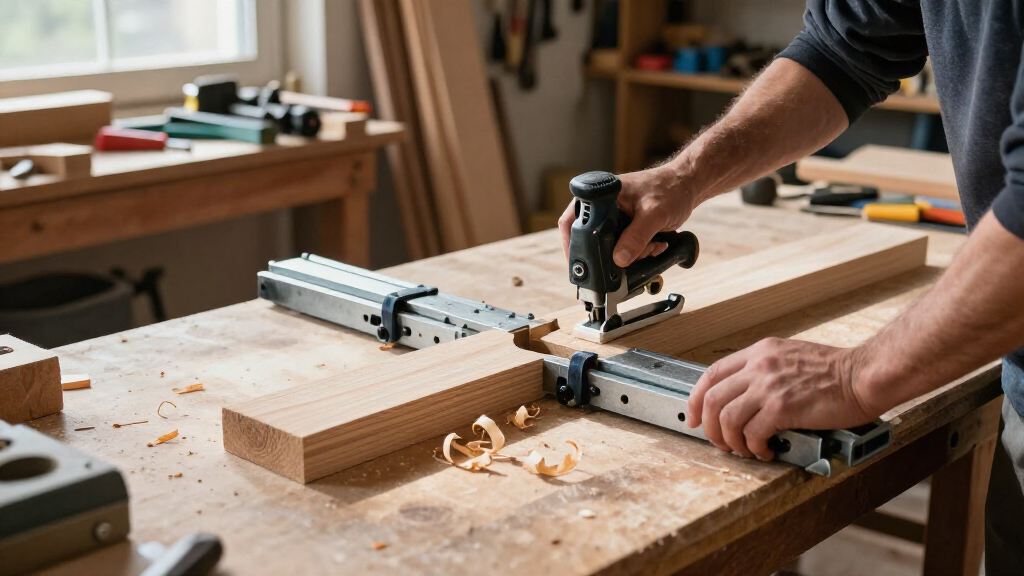

The Kreg MortiseMate Loose Tenon Jig is my best overall pick for woodworkers who want a dedicated loose-tenon approach, while the General Tools Mortise and Tenon Jig is a more traditional option and the Woodpeckers MJ-24 stands out for plunge-router work. The main choice is between router jigs, table-saw tenoning jigs, and drill-press attachments, since each makes a different part of the joint easier. Fit matters too: several router models are designed around narrow 64–65 mm trimmers, while others are intended for plunge routers. I weigh joint-making method, compatibility, adjustment, and setup demands to show where each tool fits and what it gives up. Read on for the full comparison and recommendations by shop setup and experience.

Get business pricing on tools and workshop supplies
- Business-only prices and quantity discounts
- Tax-exempt purchasing
- Multiple users, one account, clear invoices
Complete the kit


Key Takeaways
- The Kreg MortiseMate ranks first because its loose-tenon approach offers a focused route to repeatable joinery without requiring a dedicated tenoning setup.
- Router compatibility divides the compact options: several jigs specify 64–65 mm trimmers, so measuring the tool body and checking the mounting method should come before buying.
- The Woodpeckers MJ-24 and plunge-router models favor control, while small-trimmer jigs trade broader compatibility for a compact setup.
- Table-saw tenoning jigs address a different half of the joint-making problem and make the most sense for shops already set up to cut tenons on a saw.
- The drill-press attachment is the dedicated mortise route; its chisels add capability, but it does not provide the same all-in-one routing workflow as paired mortise-and-tenon jigs.
| 65mm Router Mortise and Tenon Jig with 12 Invisible Connectors |  | Best for Concealed Fastener Joints | Router compatibility: 65mm trim routers | Board thickness: 13–35mm | Material: Aluminum | VIEW LATEST PRICE | See Our Full Breakdown |
| Kreg MortiseMate Loose Tenon Jig |  | Best for Drill-Powered Mortising | Power source: Manual | Compatible tool: Drill | Workpiece thickness range: 1/2–1 1/2 inches | VIEW LATEST PRICE | See Our Full Breakdown |
| TECHTONGDA Table Saw Tenon Jig with Adjustable Clamps |  | Best for Table Saw Tenons | T-slot width: 19.05mm | T-slot depth: 9.525mm | Guide rod size: 265 × 19 × 9.5mm | VIEW LATEST PRICE | See Our Full Breakdown |
| Adjustable Mortise and Tenon Jig for Woodworking, 55 mm Slotting Length, Fits 64–65 mm Trimmers |  | Best for Three-Axis Router Adjustment | Material: Aluminum alloy | Maximum grooving length: 55mm | Applicable sheet thickness: 16–20mm | VIEW LATEST PRICE | See Our Full Breakdown |
| Drill Press Mortising Attachment Set with Four Chisels |  | Best for Drill Press Conversion | Brand: BMTURNING | Model: BMT-DPA65 | Material: Iron | VIEW LATEST PRICE | See Our Full Breakdown |
| General Tools Mortise and Tenon Jig |  | Best for Simple, Repeatable Joints | Model: 870 | Material: Plastic (listed specification; description says aluminum) | Weight: 1 lb | VIEW LATEST PRICE | See Our Full Breakdown |
| Trend Mortise and Tenon Jig |  | Best for Angled Joinery | Part number: MT/JIG | Weight: 6.89 lb | Dimensions: 13.7 × 9 × 5.5 in | VIEW LATEST PRICE | See Our Full Breakdown |
| Adjustable Mortise and Tenon Router Jig for Woodworking | | Best 2-in-1 Setup | Manufacturer: Eoweiot | Router compatibility: 64–65 mm outer diameter | Weight: Conflicting listings: 4.4 lb and 2.2 lb | VIEW LATEST PRICE | See Our Full Breakdown |
| YUCHENGTECH 2-in-1 Router Slotting Jig for Invisible Fasteners |  | Best for Invisible-Fastener Slots | Material: Aluminum alloy | Router compatibility: 65 mm diameter; two-plug routers | Board thickness: 15–40 mm | VIEW LATEST PRICE | See Our Full Breakdown |
| O’SKOOL Mortise and Tenon Jig for Plunge Router |  | Best for Defined Joint Sizes | Model: RTA009 | Compatible tool: Plunge router | Joint length: 3/4–3 1/8 in | VIEW LATEST PRICE | See Our Full Breakdown |
| Adjustable Tenoning Jig for Table Saws |  | Best for Angled Table Saw Tenons | Applicable T-slot: 19.05 mm (0.75 in) wide × 9.525 mm (0.375 in) deep | Slot center-to-saw blade distance: 95–170 mm (3.74–6.69 in) | Guide rod dimensions: 265 × 19 × 9.5 mm (10.4 × 0.7 × 0.4 in) | VIEW LATEST PRICE | See Our Full Breakdown |
| Mortise and Tenon Jig for Woodworking Routers |  | Best for Adjustable Router Mortises | Material: Metal | Router compatibility: Routers with 64–65 mm outside diameter | Guide: Three-axis guide rail | VIEW LATEST PRICE | See Our Full Breakdown |
| YUCHENGTECH 2-in-1 Mortising Jig for 65 mm Routers |  | Best for Adjustable Slotting | Brand: YUCHENGTECH | Model: YWQ-164 | Router compatibility: 65 mm diameter routers | VIEW LATEST PRICE | See Our Full Breakdown |
| Woodpeckers MJ-24 Mortising Jig for Plunge Routers |  | Best for Repeatable Furniture Mortises | Manufacturer: Woodpeckers | Part number: MJ-24 | Maximum mortise length: 3-1/2 inches | VIEW LATEST PRICE | See Our Full Breakdown |
| woodworking mortise and tenon jig | Material |
|---|---|
| 65mm Router Mortise and Tenon | Aluminum |
| Kreg MortiseMate Loose Tenon J | Metal |
| TECHTONGDA Table Saw Tenon Jig | — |
| Adjustable Mortise and Tenon J | Aluminum alloy |
| Drill Press Mortising Attachme | Iron |
| General Tools Mortise and Teno | Plastic (listed specification; description says aluminum) |
| Trend Mortise and Tenon Jig | — |
| Adjustable Mortise and Tenon R | — |
| YUCHENGTECH 2-in-1 Router Slot | Aluminum alloy |
| O’SKOOL Mortise and Tenon Jig | — |
| Adjustable Tenoning Jig for Ta | — |
| Mortise and Tenon Jig for Wood | Metal |
| YUCHENGTECH 2-in-1 Mortising J | — |
| Woodpeckers MJ-24 Mortising Ji | — |
More Details on Our Top Picks
65mm Router Mortise and Tenon Jig with 12 Invisible Connectors
For cabinet and shelf builders who want hidden connectors, this jig pairs a 65mm trim router with an 11mm bit and includes 12 full-through and half-through connectors. Its transparent base helps keep the work visible as you guide the cut, while adjustment for 13–35mm boards covers a useful range of furniture stock. Compared with the Kreg MortiseMate, which cuts mortises with a drill and steps down in measured increments, this set is centered on making concealed connector joints with a compatible trim router. That focus makes it a more targeted choice, rather than a broad loose-tenon setup. The tradeoff is fit: it is designed for 65mm trim routers, so buyers with a different router size cannot assume compatibility. I would choose it for repeat cabinet or shelf connections, and skip it for general mortising across varied shop setups.
Pros:- Includes 12 full-through and half-through invisible connectors
- 11mm router bit is included
- Adjusts for boards 13–35mm thick
- Transparent base helps keep the cut area visible
Cons:- Designed specifically for 65mm trim routers
- Its concealed-connector focus is less suited to general loose-tenon work
Best for: Cabinet and shelf makers who own a compatible 65mm trim router and want concealed connector joints.
Not ideal for: Woodworkers with routers outside the 65mm trim-router fit or those seeking a general-purpose mortising jig.
- Router compatibility:65mm trim routers
- Board thickness:13–35mm
- Material:Aluminum
- Router bit:11mm
- Included connectors:6 full-through and 6 half-through
- Power source:Hand powered
- Item weight:1.46 pounds
Our verdict“Choose this set if concealed cabinet and shelf joints are your priority and your trim router matches its 65mm fit.”
Kreg MortiseMate Loose Tenon Jig
The MortiseMate suits woodworkers who want controlled mortise cuts without routing: it uses a drill, clamps the workpiece, and lowers the cutter in 1/16-inch increments. That indexing gives the cut a measured progression, while laser-etched marks and micro-adjustment screws help set up repeatable joints. Its 1/2 to 1 1/2 inch workpiece range is broader than the 13–35mm board range listed for the 65mm Router Mortise and Tenon Jig, though the two use different cutting approaches and are not direct substitutes. The Kreg’s main advantage is its manual, drill-based operation; the cost of that approach is reliance on a compatible drill and a narrower thickness ceiling than some furniture stock may require. I’d favor it for shops that already use a drill for joinery and value incremental depth control, but skip it if you need a router-based jig or work with thicker pieces.
Pros:- Auto-indexing lowers the cutter in 1/16-inch increments
- Trigger-style clamps help secure workpieces
- Micro-adjustments and laser-etched markings support repeatable setup
- Cuts mortises using a drill
Cons:- Requires a compatible drill for operation
- Workpiece thickness is limited to 1/2–1 1/2 inches
Best for: Furniture makers who have a drill and want incremental, adjustable mortise cuts in stock from 1/2 to 1 1/2 inches thick.
Not ideal for: Woodworkers who need to cut thicker workpieces or prefer a router-based mortise-and-tenon system.
- Power source:Manual
- Compatible tool:Drill
- Workpiece thickness range:1/2–1 1/2 inches
- Maximum workpiece thickness:1.5 inches
- Indexing increment:1/16 inch
- Material:Metal
- Included component:Carbide-tipped mortising cutter
- Model number:KLTJ100
Our verdict“Pick the MortiseMate if you want drill-powered mortising with incremental depth control and your stock fits its thickness range.”
TECHTONGDA Table Saw Tenon Jig with Adjustable Clamps
This is the table-saw specialist in the group: adjustable clamps hold the workpiece for tenon cuts, and angle adjustments support varied sawing setups. That makes it a different kind of option from the Kreg MortiseMate, which cuts mortises with a drill; the TECHTONGDA helps form the tenon side of a joint and depends on a compatible table saw. Its stated 19.05mm T-slot width and 95–170mm slot-center-to-blade distance give buyers concrete measurements to check before purchase. The maximum grip is 82.5mm, and the metal construction weighs 8.7kg, so it is a substantial jig rather than a compact add-on. Its versatility is useful only if your saw matches the mounting geometry. I’d choose it for table-saw owners making tenons at varied angles, but skip it if your saw’s slot or blade spacing falls outside the listed fit.
Pros:- Adjustable clamps secure workpieces for tenon cuts
- Rear pallet adjusts from 0–45 degrees
- Backing angle adjusts from 0–15 degrees
- Metal construction provides a substantial workholding platform
Cons:- Requires a 19.05mm T-slot and compatible slot-to-blade spacing
- Its 8.7kg weight makes it a substantial shop accessory
- The package contains one tenon jig, not a complete mortise-and-tenon system
Best for: Table-saw owners who make tenons at varied angles and can confirm their saw matches the jig’s T-slot and blade spacing.
Not ideal for: Woodworkers without a compatible table saw or anyone looking for a jig that cuts mortises.
- T-slot width:19.05mm
- T-slot depth:9.525mm
- Guide rod size:265 × 19 × 9.5mm
- Slot-center-to-blade distance:95–170mm
- Maximum grip:82.5mm
- Rear pallet angle adjustment:0–45 degrees
- Backing angle adjustment:0–15 degrees
- Net weight:8.7kg
Our verdict“Choose this jig if your table saw fits its mounting dimensions and you need adjustable support for cutting tenons.”
Adjustable Mortise and Tenon Jig for Woodworking, 55 mm Slotting Length, Fits 64–65 mm Trimmers
Three-axis guide-rail adjustment is the defining advantage here, giving trimmer users control over alignment as they set slot length and width. The listed 55mm maximum grooving length and 16–20mm sheet range point toward a more specific stock window than the 65mm Router Mortise and Tenon Jig, which lists boards from 13–35mm thick and includes invisible connectors. This jig instead focuses on guided slotting with a transparent dust shield and an alloy cutter. It fits trimmers with a 64–65mm body diameter, but the trimmer itself is not included, so the advertised compatibility does not make it a ready-to-use kit. Product text also gives conflicting weight figures, 4.4lb and 2.2lb, which makes its handling weight uncertain. I’d consider it for owners of a matching trimmer who need adjustment flexibility, but skip it if you need a complete tool bundle.
Pros:- Three-axis guide rail supports alignment adjustments
- Fits trimmers with 64–65mm body diameters
- Includes an alloy cutter and accessories
- Transparent dust shield helps maintain visibility
Cons:- Trimmer is not included
- Applicable sheet thickness is limited to 16–20mm
- Product text lists conflicting weights of 4.4lb and 2.2lb
Best for: Owners of 64–65mm trimmers who work with 16–20mm sheet stock and want adjustable slot alignment.
Not ideal for: Buyers without a compatible trimmer or those who need an included router and a clearly stated product weight.
- Material:Aluminum alloy
- Maximum grooving length:55mm
- Applicable sheet thickness:16–20mm
- Compatible trimmer body diameter:64–65mm
- Guide rail:Three-axis adjustment
- Included:Mortise and tenon jig, alloy cutter, and accessories
- Trimmer included:No
- Weight stated in product text:4.4lb and 2.2lb (conflicting figures)
Our verdict“This is a fit for trimmer owners who value three-axis slot adjustment and can work within its stated stock range.”
Drill Press Mortising Attachment Set with Four Chisels
This attachment set is for a shop that already has a compatible bench drill press and wants to add mortising and grooving capability. Four chisel sizes, from 1/4 to 5/8 inch, give it a wider range of mortise widths than the single 11mm router bit included with the 65mm Router Mortise and Tenon Jig. Reducer rings accommodate several collar diameters, but they do not remove the need to check the press dimensions: the listed minimum chuck-to-workbench distance is 15.7 inches. Unlike the Kreg MortiseMate, this set relies on a drill press attachment rather than a hand-held drill jig, tying it to a fixed machine and its setup. I’d pick it for a drill-press owner who wants multiple chisel sizes in one stored set. Skip it if your press dimensions do not match or you need a portable joinery jig.
Pros:- Includes four chisel sizes from 1/4 to 5/8 inch
- Converts a compatible drill press for mortising and grooving
- Reducer rings support several collar diameters
- Includes a storage case
Cons:- Installation depends on drill press dimensions
- Requires at least 15.7 inches of chuck-to-workbench distance
- Ties mortising work to a compatible stationary press
Best for: Bench drill press owners who want multiple mortising chisel sizes and can verify the machine’s installation dimensions.
Not ideal for: Woodworkers without a compatible drill press or those who need a portable, self-contained mortising jig.
- Brand:BMTURNING
- Model:BMT-DPA65
- Material:Iron
- Included chisel sizes:1/4, 3/8, 1/2, and 5/8 inch
- Collar diameter:65mm
- Reducer ring sizes:60mm, 55mm, 52.5mm, and 40mm
- Minimum chuck-to-workbench distance:15.7 inches
- Cutting diameter:6.5cm
Our verdict“Choose this set if your bench drill press fits its dimensions and you want four chisel sizes for shop-based mortising.”
General Tools Mortise and Tenon Jig
The General Tools 870 earns this role for a straightforward setup that cuts matching mortises and tenons with one jig. Its bushings cover 1/4-, 3/8-, and 1/2-inch joints, giving furniture and frame builders a few common sizes without changing to a different system. Compared with the angle-adjustable Trend Mortise and Tenon Jig, this model is less suited to angled work, but its simpler joint-width choices may be easier to manage for standard square assemblies. It can mount to a bench or to a board held in a vise, which gives small-shop users options for securing the work. The main tradeoff is that it requires a plunge router, and the supplied bit does not remove that added tool requirement.
Pros:- Cuts matching mortise and tenon joints with the same jig
- Includes bushings for 1/4-, 3/8-, and 1/2-inch joint widths
- Can mount to a workbench or a board secured in a vise
- Includes a 1/4-inch router bit and bushing kit
Cons:- Requires a plunge router, which is not included
- The listed joint length range is limited to 1–3 inches
- Does not offer the compound-angle adjustment described for the Trend jig
Best for: Furniture and frame builders who want to make standard-width joints with a plunge router and can mount the jig to a bench or vise-held board.
Not ideal for: Woodworkers who need compound-angle joints or do not own a plunge router.
- Model:870
- Material:Plastic (listed specification; description says aluminum)
- Weight:1 lb
- Dimensions:15 × 4 × 4.2 in
- Joint widths:1/4, 3/8, and 1/2 in
- Joint length range:1–3 in
- Included components:1/4-inch router bit, bushing kit, and wrench
- Warranty:1 year parts
Our verdict“Choose the General Tools 870 for common straight joints and flexible mounting, provided you already have a plunge router.”
Trend Mortise and Tenon Jig
For projects that call for more than square shoulders, the Trend MT/JIG stands apart with compound-angle adjustment from -10° to 45°. It handles stock from 1/2 to 1 7/8 inches thick and up to 3 1/2 inches wide, so it can accommodate substantial parts that fall beyond the General Tools 870’s stated 1–3-inch joint length setup. The included US-style screw-on guide bush also supports router-guided work, while doweling adds another use for the fixture. Those adjustments make it more adaptable, but they bring a compatibility constraint: the guide bush is not suited to UK or other non-US routers, and a plunge router is still required. For square joints in a few standard widths, the O’SKOOL RTA009 is a more plainly specified alternative.
Pros:- Adjusts for compound angles from -10° to 45°
- Handles stock 1/2 to 1 7/8 inches thick
- Accepts material up to 3 1/2 inches wide
- Supports doweling as well as mortise-and-tenon work
Cons:- US-style guide bush is not compatible with UK or non-US routers
- Plunge router is not included
- The supplied components list only one guide bush
Best for: Experienced furniture makers who need angled mortise-and-tenon joints, work with thicker stock, and have a compatible US-style plunge router.
Not ideal for: Owners of UK or non-US routers, or woodworkers making only standard square joints who do not need the angle range.
- Part number:MT/JIG
- Weight:6.89 lb
- Dimensions:13.7 × 9 × 5.5 in
- Material thickness range:1/2–1 7/8 in
- Material width:Up to 3 1/2 in
- Angle range:-10° to 45°
- Guide bush:US-style screw-on
- Warranty:1 year for material and workmanship defects
Our verdict“Pick the Trend when angled joinery and thicker stock matter more than broad router compatibility.”
Adjustable Mortise and Tenon Router Jig for Woodworking
This Eoweiot 2-in-1 jig combines adjustable guides for slotting and trimming, a useful pairing for buyers who want one setup to cover more than a fixed joint pattern. Its 3-axis guide is intended to help position cuts, and the kit includes an alloy cutter, pilot drill bit, fasteners, wrenches, and a right-angle ruler. That gives it a broader accessory bundle than the General Tools 870, whose listed kit centers on a router bit and bushings. The fit is narrow, though: the jig is specified for routers with a 64–65 mm outer diameter, and neither the router nor trimmer is included. Product information also gives two different weights, so buyers cannot rely on that figure when judging portability. This is a more flexible setup in concept, with more fit and documentation uncertainty.
Pros:- Adjustable 3-axis guide supports positioning cuts
- Designed for both slotting and trimming tasks
- Fits routers with a 64–65 mm outer diameter
- Includes cutter, pilot drill bit, fasteners, wrenches, and a right-angle ruler
Cons:- Router and trimmer are not included
- Compatibility is limited to a 64–65 mm router body
- Listed weight conflicts between 4.4 lb and 2.2 lb
Best for: Woodworkers who want adjustable slotting and trimming guides and already own a router that measures 64–65 mm in outer diameter.
Not ideal for: Buyers who need confirmed weight information, broad router compatibility, or a complete tool kit including the router and trimmer.
- Manufacturer:Eoweiot
- Router compatibility:64–65 mm outer diameter
- Weight:Conflicting listings: 4.4 lb and 2.2 lb
- Color:Silver
- Included components:Alloy cutter, pilot drill bit, 6 two-in-1 fasteners, 2 wrenches, and carpenter’s right-angle ruler
- Router and trimmer:Not included
Our verdict“Consider the Eoweiot if its measured router fit is confirmed and you want slotting and trimming guides in one kit.”
YUCHENGTECH 2-in-1 Router Slotting Jig for Invisible Fasteners
The YUCHENGTECH slotting jig is the specialist choice here: its adjustments target slots for invisible fasteners and furniture joinery, rather than the standard mortise-and-tenon dimensions offered by the O’SKOOL RTA009. CNC-machined aluminum alloy and controls for slot depth, width, length, and height give users a defined range of positioning adjustments. It is specified for 65 mm, two-plug routers and boards 15–40 mm thick, which makes fit checking central to the decision. The limitations are substantial for a general joinery buyer: it does not fit cordless or irregularly shaped routers and cannot make square cuts. At 5.5 pounds, it is also a dedicated fixture rather than a light accessory to move between varied tasks. Choose it for its fastener-slot focus, not as a universal mortise jig.
Pros:- Adjusts slot depth, width, length, and height
- CNC-machined aluminum-alloy construction
- Designed specifically for invisible-fastener slots and furniture joinery
- Includes a stated 1-year warranty
Cons:- Only fits 65 mm two-plug routers
- Not compatible with cordless or irregularly shaped routers
- Cannot make square cuts
Best for: Cabinet and furniture builders making invisible-fastener slots in 15–40 mm boards with a compatible 65 mm two-plug router.
Not ideal for: Woodworkers seeking square mortises, using cordless or irregularly shaped routers, or needing a general-purpose jig for conventional joints.
- Material:Aluminum alloy
- Router compatibility:65 mm diameter; two-plug routers
- Board thickness:15–40 mm
- Forward and backward stroke:0–20 mm
- Left and right stroke:0–40 mm
- Weight:5.5 lb
- Dimensions:15.7 × 9.8 in
- Warranty:1 year
Our verdict“Choose this YUCHENGTECH model for invisible-fastener slots when your router and board dimensions match its limits.”
O’SKOOL Mortise and Tenon Jig for Plunge Router
The O’SKOOL RTA009 suits buyers who want clear limits for their joint sizes and stock before setting up. It covers 1/4-, 3/8-, and 1/2-inch widths, with lengths from 3/4 to 3 1/8 inches, a slightly longer stated reach than the General Tools 870’s 1–3-inch range. Its stock limits are also spelled out: 1/2–1 1/2 inches thick and wider than 2 inches. The kit includes a 1/4-inch bit, guides, mounting hardware, sandpaper, and a hex wrench, so setup accessories are more fully enumerated than on the Trend jig. That convenience depends on owning a compatible plunge router, and the stock restrictions can rule out wider or thicker work. It makes the most sense for repeatable joints within those stated dimensions.
Pros:- Supports three joint widths: 1/4, 3/8, and 1/2 inch
- Joint lengths extend from 3/4 to 3 1/8 inches
- Includes a router bit, guides, mounting hardware, and setup accessories
- Backed by a 1-year warranty
Cons:- Requires a plunge router, which is not included
- Limited to stock 1/2–1 1/2 inches thick
- Stock must be wider than 2 inches
Best for: Woodworkers with a plunge router who make repeated furniture joints in stock 1/2–1 1/2 inches thick and wider than 2 inches.
Not ideal for: Builders working with stock outside the listed thickness or width limits, or anyone without a plunge router.
- Model:RTA009
- Compatible tool:Plunge router
- Joint length:3/4–3 1/8 in
- Joint widths:1/4, 3/8, or 1/2 in
- Compatible stock thickness:1/2–1 1/2 in
- Minimum stock width:Wider than 2 in
- Included router bit:1/4 in
- Weight:2.1 kg
- Warranty:1 year
Our verdict“Choose the O’SKOOL for repeatable, specified joint sizes if your stock fits its limits and you own a plunge router.”
Adjustable Tenoning Jig for Table Saws
This jig is the table-saw specialist in this group: it handles straight, angled, and mitered tenons, while the Woodpeckers MJ-24 is built around routing repeatable mortises. Fine adjustment and oversized feed handles give the operator more control over the workpiece during a cut, which suits joinery that needs consistent positioning. Its 82.5 mm clamping capacity also accommodates substantial stock. The tradeoff is fit: the jig requires a 19.05 mm by 9.525 mm T-slot and a slot-to-blade distance within its stated range, so measurements are essential before buying. At 8.7 kg, it is also a heavy accessory to move or store. Choose it for compatible saws and tenon work; skip it if you need a router-based mortising setup.
Pros:- Fine adjustment supports repeatable positioning.
- Oversized feed handles help control the workpiece.
- Designed for straight, angled, and mitered tenons.
- Clamps stock up to 82.5 mm thick.
Cons:- Requires a specific T-slot width and depth.
- Compatible slot-to-blade distance is limited to 95–170 mm.
- Net weight of 8.7 kg makes it cumbersome to move.
Best for: Table-saw owners who make angled or mitered tenons and can confirm their saw’s slot dimensions and blade distance.
Not ideal for: Woodworkers with nonmatching T-slots or limited storage who want a light, portable jig.
- Applicable T-slot:19.05 mm (0.75 in) wide × 9.525 mm (0.375 in) deep
- Slot center-to-saw blade distance:95–170 mm (3.74–6.69 in)
- Guide rod dimensions:265 × 19 × 9.5 mm (10.4 × 0.7 × 0.4 in)
- Maximum clamping capacity:82.5 mm (3.25 in)
- Net weight:8.7 kg (19.2 lbs)
- Gross weight:10.2 kg (22.5 lbs)
- Package dimensions:36 × 36 × 27 cm (14.2 × 14.2 × 10.6 in)
- Package contents:1 tenoning jig for table saws
Our verdict“Choose this jig for varied table-saw tenons if your saw matches its dimensions and you can accommodate its weight.”
Mortise and Tenon Jig for Woodworking Routers
For router users who want to position mortises along three axes, this metal jig offers a more adjustable approach than the YUCHENGTECH 2-in-1 Mortising Jig, which specifies forward/backward and left/right strokes. Its three-axis guide rail adjusts cutting length and width, while the transparent shield preserves a view of the work area during routing. Non-slip and auxiliary handles add control, and the kit includes an end mill, pilot bit, fasteners, and wrenches to get the jig ready for setup. The main constraint is router fit: it accepts routers with a 64–65 mm outside diameter, and the router itself is not included. Buyers should also confirm that their planned joinery suits a router-cut mortise rather than the table-saw tenons made with the Adjustable Tenoning Jig for Table Saws.
Pros:- Three-axis guide adjusts mortise cutting length and width.
- Transparent dust shield helps maintain visibility.
- Non-slip and auxiliary handles support controlled positioning.
- Includes an alloy end mill, pilot drill bit, fasteners, and wrenches.
Cons:- Router or trimmer is not included.
- Limited to routers with a 64–65 mm outside diameter.
Best for: Router owners with a 64–65 mm body who want adjustable mortise placement and included cutting accessories.
Not ideal for: Woodworkers whose router has a different body diameter or who need a complete kit with the router included.
- Material:Metal
- Router compatibility:Routers with 64–65 mm outside diameter
- Guide:Three-axis guide rail
- Dimensions:4.33 × 12.2 × 11.02 inches
- Item weight:4.84 pounds
- Included accessories:Alloy end mill, pilot drill bit, 6 fasteners, 2 wrenches
- Router or trimmer included:No
Our verdict“Pick this jig if your router fits and you value three-axis mortise adjustment with basic accessories included.”
YUCHENGTECH 2-in-1 Mortising Jig for 65 mm Routers
The YUCHENGTECH is a compact choice for router owners making slots for invisible fasteners or mortise-and-tenon joints. Its two-direction adjustment provides 0–20 mm of forward/backward travel and 0–50 mm left/right, while the stated board-thickness range of 15–50 mm covers a useful spread of stock. That makes its movement limits easy to assess against a project before setup. Compared with the Mortise and Tenon Jig for Woodworking Routers, this model gives specific stroke ranges but does not claim a three-axis guide. Its key limitation is the inability to make square slots, which rules it out for joinery that depends on square-ended openings. It also fits only 65 mm routers, and the router is sold separately.
Pros:- Supports board thicknesses from 15 to 50 mm.
- Offers forward/backward and left/right stroke adjustment.
- Designed for slots used with invisible fasteners and mortise-and-tenon joints.
- Works with various brands of 65 mm routers.
Cons:- Cannot make square slots.
- Router is not included.
- Compatibility is limited to 65 mm diameter routers.
Best for: Woodworkers with a 65 mm router making adjustable slots in boards 15–50 mm thick, including for invisible fasteners.
Not ideal for: Joiners who need square slots or owners of routers outside the specified 65 mm diameter.
- Brand:YUCHENGTECH
- Model:YWQ-164
- Router compatibility:65 mm diameter routers
- Forward and backward stroke:0–20 mm
- Left and right stroke:0–50 mm
- Processable board thickness:15–50 mm
- Weight:2.8 pounds
- Size:7 × 11 inches
- Set name:2 in 1
Our verdict“Choose it for adjustable slotting in compatible routers if square slots are not part of your joinery plans.”
Woodpeckers MJ-24 Mortising Jig for Plunge Routers
For repeated mortises in furniture or cabinet work, the MJ-24 puts the emphasis on controlled, consistent travel. Adjustable stops set the mortise length, and laser-engraved stainless-steel scales make settings readable for repeated setups. Its phenolic work surface and powder-coated steel base form a substantial work platform. The jig cuts mortises up to 3-1/2 inches long and works with plunge routers using standard guide bushings. Compared with the Mortise and Tenon Jig for Woodworking Routers, it specifies a maximum mortise length and guide-bushing compatibility rather than a 64–65 mm router body fit. That focus may suit a dedicated plunge-router station, but it also means this is not a table-saw tenon jig or a router-free solution. Buyers need a compatible plunge router and should check whether its capacity matches their work.
Pros:- Adjustable travel stops support repeatable mortise lengths.
- Laser-engraved stainless-steel scales help set and reproduce positions.
- Accepts plunge routers with standard guide bushings.
- Phenolic work surface and powder-coated steel base provide a substantial platform.
Cons:- Requires a compatible plunge router, which is not included in the described product data.
- Maximum mortise length is 3-1/2 inches.
- Does not serve as a table-saw tenoning jig.
Best for: Furniture and cabinet makers who batch repeatable mortises with a plunge router and standard guide bushings.
Not ideal for: Woodworkers without a compatible plunge router or those who need a jig for table-saw tenons.
- Manufacturer:Woodpeckers
- Part number:MJ-24
- Maximum mortise length:3-1/2 inches
- Router compatibility:Plunge routers with standard guide bushings
- Work surface:Phenolic
- Base:Powder-coated steel
- Scales:Laser-engraved stainless steel
- Country of manufacture:United States
Our verdict“Choose the MJ-24 for repeatable routed mortises up to 3-1/2 inches when you already have a compatible plunge router.”
How We Picked
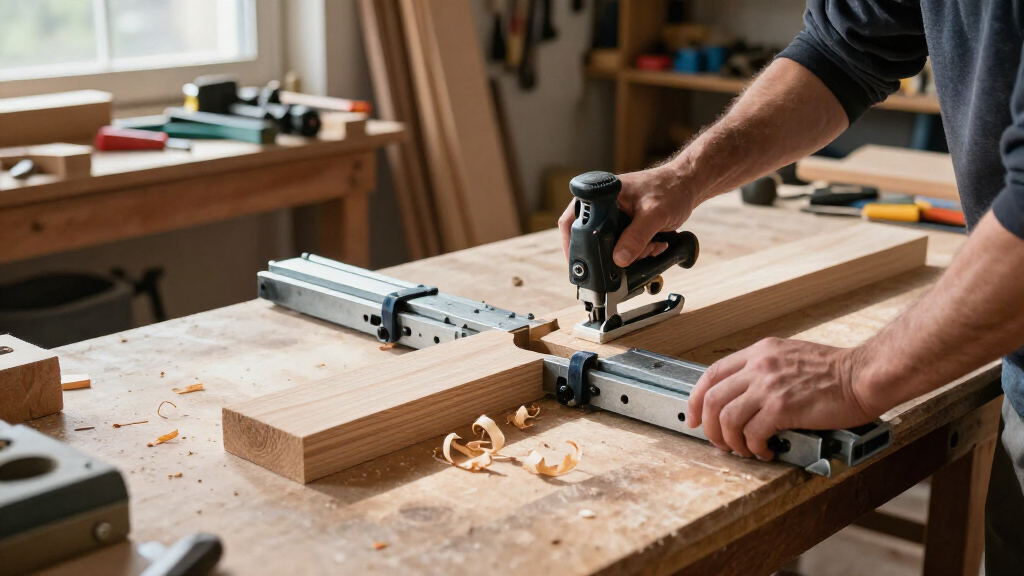
I ranked these tools by how directly they help a woodworker make accurate, repeatable mortise-and-tenon joints. My main criteria were the joint-making method, compatibility with common shop tools, adjustment range, workpiece holding, and how much setup a buyer must handle before cutting. I also considered whether each product supports both sides of the joint or focuses on mortises, tenons, or invisible fasteners, since those are different jobs despite sharing the search category.
The ranking gives the strongest positions to options with a clear, useful workflow and a defined audience, then places more specialized or compatibility-dependent tools lower. A table-saw tenoning jig can be the right choice for an established saw workflow, but it is less versatile for someone seeking a compact router solution. Likewise, a jig that fits only a narrow trimmer size may suit its intended setup but deserves more caution than one suited to a broader plunge-router workflow. Product names alone do not establish accuracy or build quality, so buyers should confirm included components, fit details, and instructions before committing.
| woodworking mortise and tenon jig | Material |
|---|---|
| 65mm Router Mortise and Tenon | Aluminum |
| Kreg MortiseMate Loose Tenon J | Metal |
| TECHTONGDA Table Saw Tenon Jig | — |
| Adjustable Mortise and Tenon J | Aluminum alloy |
| Drill Press Mortising Attachme | Iron |
| General Tools Mortise and Teno | Plastic (listed specification; description says aluminum) |
| Trend Mortise and Tenon Jig | — |
| Adjustable Mortise and Tenon R | — |
| YUCHENGTECH 2-in-1 Router Slot | Aluminum alloy |
| O’SKOOL Mortise and Tenon Jig | — |
| Adjustable Tenoning Jig for Ta | — |
| Mortise and Tenon Jig for Wood | Metal |
| YUCHENGTECH 2-in-1 Mortising J | — |
| Woodpeckers MJ-24 Mortising Ji | — |
Factors to Consider When Choosing Woodworking Mortise And Tenon Jigs
Choosing a jig starts with the joints and tools already in your shop. These products use different methods, so the most useful comparison is not simply which one has the most adjustments. Think about the whole process: how you will cut each half of the joint, hold the stock, repeat the settings, and maintain alignment over multiple pieces.
Choose the joint-making method before the jig
Mortise-and-tenon jigs do not all perform the same operation. Some guide a router for mortises, some help form tenons, and loose-tenon systems use a separate floating tenon to join the parts. A table-saw tenoning jig only addresses tenon cuts, so you still need a reliable way to make the mortises. Before buying, sketch the steps for one joint and identify which tool performs each cut. A common mistake is assuming a product with “mortise and tenon” in its name handles both halves in one setup. Paying for a dedicated system makes sense when it replaces several difficult operations, but a focused jig may be the better fit when you already have the other half covered.
Verify router fit and mounting details
Compact router jigs often specify a narrow body diameter, such as 64–65 mm, while plunge-router models rely on a different base and support arrangement. Measure the router body or base where the jig actually clamps; the motor diameter alone may not tell you whether it will fit. Check how the router is secured, what cutters are supported, and whether the jig requires a particular base plate. Buyers can lose time by ordering around a brand name or nominal size without checking the mounting geometry. If you own more than one router, compare the jig’s usable fit against all of them before choosing. Broader compatibility can be worth more than extra adjustment if it lets you use the tool you already know.
Plan for stock size, clamping, and support
A jig can guide a cutter accurately and still produce poor joints if the workpiece shifts or lacks support. Consider the width, thickness, and length of typical stock, along with where clamps can reach without obstructing the tool. Long rails and narrow parts often need auxiliary support or a repeatable stop, even when the jig includes adjustable clamps. Buyers should also think about whether the jig can register from an edge, a face, or a marked centerline, since those references affect setup speed and consistency. A common mistake is judging capacity from the cutter opening alone while ignoring how the stock is held. For recurring furniture work, a stable clamping method may matter more than a wider adjustment range.
Look at repeatability across a batch
One accurate joint is easier to make than a dozen matching joints. For a batch, prioritize positive stops, clear scale markings, paired setup references, and a way to preserve settings between cuts. If the jig depends on visual alignment or repeated measurement, expect setup to take longer and errors to accumulate as parts multiply. Think through how you will mark mating pieces and keep the mortise centered on the same reference. A test cut in scrap is useful for checking fit before machining the project stock, especially when changing cutter diameter or material thickness. Buyers making one-off repairs may accept more manual setup, while production of chairs or cabinet doors rewards a jig that resets predictably.
Match the jig to your shop’s existing machines
A table-saw tenoning jig is most practical when the saw has suitable capacity, a sound fence, and room to support the work. Router-based tools can take less dedicated floor space, but they still need a secure bench area and compatible accessories. A drill-press mortising attachment uses a machine many shops already own, though the chisels and setup call for their own care and technique. Do not compare these options as if they were interchangeable: each asks you to rely on a different machine and skill set. Consider dust collection, storage, and how often the jig will be mounted or removed. The least expensive workflow for a buyer may be the one that uses existing equipment safely and consistently.
Decide when extra build and adjustment are worthwhile
More adjustment can help with unusual stock, but it also adds setup choices that may slow simple work. A specialized jig can be a stronger match when the same joint type appears repeatedly, while a simpler model may serve occasional projects without occupying much shop space. Evaluate the parts that affect alignment and wear, such as the fence, clamps, guide surfaces, and replaceable or consumable components. Look for clear instructions and available cutter or chisel sizes so the tool remains useful after the first project. Avoid paying for flexibility that does not match your planned joints. Spend more when a stable setup, broader work range, or durable construction will directly improve the work you do most often.
Frequently Asked Questions
Can one jig cut both the mortise and the tenon?
Some systems are designed to support both operations, but many products in this roundup focus on one side or use a particular joint method. A router mortising jig may cut the cavity while leaving you to form a matching tenon separately. A table-saw tenoning jig helps shape the tenon but does not make the mortise. Loose-tenon systems use a separate tenon, changing how both pieces are prepared. Check the included tooling and instructions for the exact operations before assuming the product name describes a complete workflow.
Will a 65 mm router jig fit my compact router?
Only if the clamping area and mounting arrangement match your router; the stated size is not a guarantee across every compact model. Measure the router at the point where the jig secures it and compare that dimension with the product’s fit range. Also check whether the jig registers on the motor body, router base, or a supplied adapter. A close fit can still be unusable if the handles, depth adjustment, or base interfere with the guide. When details are unclear, treat compatibility as unconfirmed rather than relying on the word “universal.”
Should I choose a loose-tenon jig or a traditional mortise-and-tenon setup?
A loose-tenon system can simplify stock preparation because you cut matching mortises and add a separate tenon, which may suit repeatable frame joinery. A traditional integral tenon keeps the tenon on one workpiece, a useful choice when that construction method matters to the design or shop routine. The right choice depends on your stock, available cutters, and comfort making the separate tenons. Compare the full sequence, including how the tenon is sized and fitted, rather than focusing only on the mortise jig. For a first project, make a sample joint from scrap to confirm the method produces the shoulder and fit you want.
Is a drill-press mortising attachment a good choice if I already own a router?
It can be, if you prefer the drill press for chopping square-sided mortises and are willing to set up the attachment and chisels correctly. The router may offer a faster guided workflow for some stock and joint sizes, while the drill-press attachment centers the process on its included chisel set. Owning a router does not automatically make the router jig the better choice; stability, workpiece support, and the shape of the required mortise matter. Check the attachment’s compatibility with your drill press and the chisel sizes supplied. If your projects call for varied mortise widths, confirm that the available tooling covers them before choosing.
What should I check before using a table-saw tenoning jig on project stock?
Confirm that the jig fits your saw and fence arrangement, holds the workpiece securely, and supports the stock through the full cut. Read the saw and jig instructions for the permitted setup, blade position, and workpiece dimensions. Make a test cut in scrap and check the tenon against the mortise before machining a full set of parts. Plan how you will produce the mortise, since a tenoning jig handles the tenon operation only. If the workpiece is long, narrow, or awkward to hold, address support and clamping before cutting.
Conclusion
For the best overall balance, I recommend the Kreg MortiseMate Loose Tenon Jig for buyers who want a defined loose-tenon workflow. The best value direction is a compatible compact-router jig, especially for a shop that already owns a matching 64–65 mm trimmer and only needs guided slotting. For a premium plunge-router setup, the Woodpeckers MJ-24 is the specialist pick; buyers who prioritize a traditional route can look at the General Tools or Trend options. Beginners should choose the method that matches their existing machine and practice on scrap before moving to project parts. For specific needs, select the table-saw jig for tenon cuts, the drill-press attachment for chisel-cut mortises, or an invisible-fastener model when concealed connectors are the goal.
Fall yard work Picks

Halloween Inflatable Haunted House Maze – 20×20 ft with Removable Roof and Blower
As an affiliate, we earn on qualifying purchases.