
TL;DR

Get business pricing on tools and workshop supplies
- Business-only prices and quantity discounts
- Tax-exempt purchasing
- Multiple users, one account, clear invoices
Hunker published a roundup of 22 ways to cover or decorate old glass jars without relying on paint. The ideas include tinted decoupage, clothespins, clay, jewelry and dried foliage; the article also advises cleaning jars first and taking care with projects involving heat or tools.
Hunker has published 22 ideas for covering or decorating old glass jars without paint, suggesting materials such as decoupage, twine, clothespins, clay and dried foliage. The roundup presents jars as potential home accents as well as storage, and offers alternatives for people who want to reuse containers with common craft supplies.
The ideas range from surface treatments to changes in how a jar is used. One method mixes Mod Podge, water and food coloring to tint glass with a vintage-inspired look; another uses Mod Podge and orange food coloring to make Halloween lanterns. The report also describes covering jars with clothespin halves, shaping clay around the glass, and draping jars with decorative chains or jewelry.
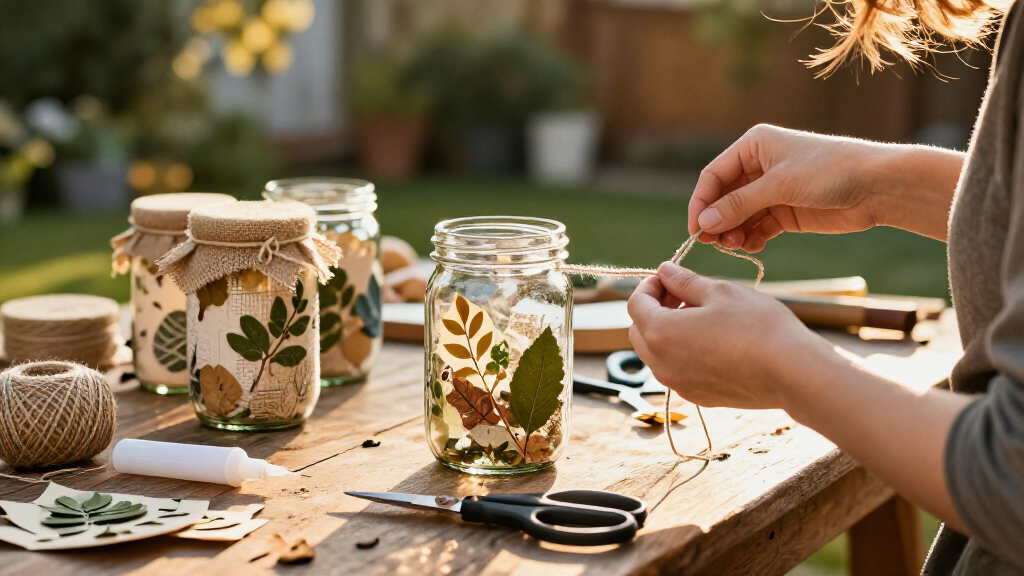
Other projects turn jars into functional or display pieces. A jar can sit in an adjustable clamp fixed to a board to hold flowers, or be paired with a lid fitted with a knob to make a countertop canister. The roundup also includes a festive jar-based Christmas tree sculpture, and a method for attaching dried foliage. Some suggestions leave the glass visible, while others cover much of the exterior.
Before starting, Hunker recommends soaking jars in warm water and dish soap to remove food residue and labels. It suggests adding vinegar for stubborn stickers and scrubbing remaining adhesive with a hard-bristled brush. The report’s clay instructions call for careful attention to temperature: it says traditional clay may be baked in short intervals at 275 degrees Fahrenheit, while warning that glass can weaken above 300 degrees. These are project instructions from the source, not a guarantee that every jar or oven setup is suitable.
Reuse Ideas Beyond Paint
The roundup matters mainly as a practical reuse guide: it gives readers multiple ways to adapt household jars rather than discard them or buy new decorative containers. Several suggestions, including jewelry displays, flower holders and canisters, combine appearance with a use around the home.
Hunker describes many projects as budget-friendly and achievable with common materials, but the cost and difficulty will depend on what a reader already owns and which design they choose. Some ideas need little more than twine or embellishments; others involve adhesives, drilling, heating or mounting hardware. Readers should match the project to their tools and experience, and follow product instructions when using glue or other craft materials.
Popular right now

Roborock F25 Ultra Steam Wet Dry Vacuum Mop

De'Longhi Magnifica Evo Fully Automatic Espresso Machine with Manual Milk Frother, Silver

Samsung 85-Inch QN70H Neo QLED 4K Smart TV (2026)
As an affiliate, we earn on qualifying purchases.
How the Jar Projects Work
The report frames paint as the familiar option for decorating glass, then offers alternatives that either cover the jar or change its color using other materials. Examples include fabric-like coverings and clothespins on the outside, as well as tinted decoupage that dries onto the glass. Several projects are reversible or allow the container to retain a practical role.
Hunker’s examples also draw on demonstrations attributed to creators on YouTube and TikTok, including projects involving clothespins, chains, holiday decorations and jar-lid knobs. The source gives a list of 22 ideas, but the supplied material ends partway through its discussion of dried foliage, so it does not provide the full set of instructions or details for every project.
““old jars aren’t trash””
— Hunker
Project Details and Safety Limits
The supplied source material does not include the complete description of all 22 ideas, and it gives no publication date. It also does not specify whether each decorative finish is waterproof, food-safe or suitable for repeated washing. Readers should not assume a decorated jar is safe for food storage simply because the original container held food; check the materials’ labels and keep finishes away from food-contact surfaces unless their instructions explicitly allow that use.
Some projects involve drilling lids or boards, adhesives, or heating clay and glass. The excerpt does not explain the appropriate protective equipment, glass type, ventilation or tool setup for every method. Results may vary by jar and materials, and the source does not independently establish that every project works with all containers.
Choosing and Preparing a Jar
The next step for readers is to select a project based on the jar’s intended use and the materials available. Clean the container and remove its label before decorating, then review instructions for the specific adhesive, clay, coloring or hardware being used. For projects involving heat or drilling, follow product and tool guidance, protect the work area, and do not leave a heated project unattended.
Hunker’s article is a set of DIY suggestions rather than a scheduled product launch or policy change, so no further milestone is stated. The practical follow-up is to consult the full instructions for the chosen idea, especially where the excerpt does not include complete steps.
Key Questions
What is the news about old glass jars?
Hunker published a roundup of 22 paint-free decorating ideas for old glass jars, using craft supplies and household materials.
What materials can decorate a jar without paint?
The source mentions Mod Podge, food coloring, twine, clothespins, clay, chains, jewelry and dried foliage, among other craft materials.
How does Hunker recommend preparing jars?
It advises soaking jars in warm water and dish soap, adding vinegar for stubborn labels, and scrubbing away residue before decorating.
Can decorated jars be used for food storage?
The roundup includes canister ideas, but the supplied material does not establish that every finish is food-safe or washable. Check material labels and keep decorative coatings away from food-contact surfaces unless approved for that use.
Are all 22 project instructions included in the source excerpt?
No. The supplied material stops during the dried-foliage section, so it does not provide the full instructions for all 22 ideas.
Source: rss