Choosing among cordless finish nailers comes down to more than freeing yourself from a compressor. Nail gauge and angle affect which trim jobs a tool suits, while weight, battery compatibility, and controls influence how comfortable it is to use through a full installation. I rank the DEWALT DCN650B first for its 15-gauge angled format and broad trim utility, and the Milwaukee M18 FUEL 3020-20 as the strongest 16-gauge pick for buyers who value its stated capacity of up to 700 nails per charge.

Get business pricing on tools and workshop supplies
- Business-only prices and quantity discounts
- Tax-exempt purchasing
- Multiple users, one account, clear invoices
The DEWALT DCN660B offers an angled 16-gauge alternative for existing 20V MAX users, while the CRAFTSMAN V20 is a more straightforward option with a stated capacity of up to 375 nails per charge. All four avoid a hose and compressor, but none of these listed packages includes a battery and charger. I compare them by the work each can handle, the platform you may already own, and the compromises that matter most on trim jobs.
Complete the kit



Key Takeaways
- Best broad-use choice: The DEWALT DCN650B drives 15-gauge angled nails from 1-1/4 to 2-1/2 inches, making it the lineup’s heavier-gauge option for trim and finish work.
- Best stated battery capacity: Milwaukee lists up to 700 nails per charge with an M18 CP2.0 battery; that figure depends on the specified battery and working conditions.
- Angled versus straight: Both DEWALT models use angled nails, while the Milwaukee and CRAFTSMAN use straight nails, so nail format and access can steer the choice.
- Platform fit matters: The DEWALT nailers use 20V MAX batteries, the Milwaukee uses M18, and the CRAFTSMAN uses V20; listed packages are tool-only or bare-tool.
- Weight tradeoff: Milwaukee’s stated 8.1-pound weight may be tiring overhead, while the CRAFTSMAN’s stated 7.48 pounds and contoured handle may suit buyers who value handling.
| DEWALT 20V MAX XR Cordless 15-Gauge Angled Finish Nailer (Tool Only) |  | Best Overall: 15-gauge angled versatility | Model: DCN650B | Nail gauge: 15-gauge | Nail length: 1-1/4 to 2-1/2 inches | VIEW LATEST PRICE | See Our Full Breakdown |
| Milwaukee M18 FUEL 18V Brushless Cordless 16-Gauge Straight Finish Nailer (Tool Only) |  | Best for M18 Owners: High stated nail capacity | Model: 3020-20 | Nail gauge: 16-gauge straight | Nail length: 1 to 2-1/2 inches | VIEW LATEST PRICE | See Our Full Breakdown |
| DEWALT 20V MAX 16-Gauge Angled Finish Nailer, Tool Only (DCN660B) |  | Best Angled 16-Gauge Pick: DEWALT Platform Fit | Model: DCN660B | Nail gauge: 16-gauge angled | Nail length: 1-1/4 to 2-1/2 inches | VIEW LATEST PRICE | See Our Full Breakdown |
| CRAFTSMAN V20 16-Gauge Cordless Finish Nailer (Bare Tool), CMCN616B |  | Best for Handling-Focused V20 Buyers | Model: CMCN616B | Nail gauge: 16-gauge | Power: 20V battery powered | VIEW LATEST PRICE | See Our Full Breakdown |
| cordless finish nailer | Model | Nail gauge | Battery platform | Nail length |
|---|---|---|---|---|
| DEWALT 20V MAX XR Cordless 15- | DCN650B | 15-gauge | DEWALT 20V MAX Lithium-Ion | 1-1/4 to 2-1/2 inches |
| Milwaukee M18 FUEL 18V Brushle | 3020-20 | 16-gauge straight | Milwaukee M18 | 1 to 2-1/2 inches |
| DEWALT 20V MAX 16-Gauge Angled | DCN660B | 16-gauge angled | DEWALT 20V MAX | 1-1/4 to 2-1/2 inches |
| CRAFTSMAN V20 16-Gauge Cordles | CMCN616B | 16-gauge | CRAFTSMAN V20 | — |
More Details on Our Top Picks
DEWALT 20V MAX XR Cordless 15-Gauge Angled Finish Nailer (Tool Only)
I put the DEWALT DCN650B first because it combines a distinctive 15-gauge fastener with the access benefits of an angled magazine and a useful nail range. It drives nails from 1-1/4 to 2-1/2 inches, and its stated applications include crown molding, casing, baseboards, and hardwood flooring. Buyers who want a heavier-gauge option for a varied finish-work list have a clearer reason to choose this model than either 16-gauge DEWALT alternative.
Its brushless motor runs on DEWALT 20V MAX batteries, so owners of that platform can keep their battery setup consistent. Tool-free depth adjustment and jam release reduce the need to stop for tools when the fastener sits too proud or a jam needs clearing. The selectable sequential and contact modes give buyers a choice between more deliberate placement and faster repeated firing. LED lights add work-area illumination and tool diagnostics.
Compared with the DEWALT DCN660B, this model takes 15-gauge angled nails rather than 16-gauge angled nails. That makes the DCN650B the more specialized pick for a buyer who wants the 15-gauge format, while the DCN660B is the natural alternative for someone committed to 16-gauge fasteners. Against the straight-nail Milwaukee and CRAFTSMAN, the angled magazine may suit some access situations, but nail format remains a compatibility decision, not a universal advantage.
The downside is practical: the tool-only package requires a compatible battery and charger, and the stated 6.6-pound weight adds up during prolonged overhead work. It is also not water resistant, so I would not treat it as a tool for exposed wet conditions. I rank it first for the combination of gauge, nail range, and controls, not because it is the lightest or the simplest platform purchase.
Pros:- Drives 15-gauge angled nails from 1-1/4 to 2-1/2 inches.
- Brushless motor uses the DEWALT 20V MAX battery platform.
- Tool-free depth adjustment and jam release simplify on-the-job changes.
- Sequential and contact modes plus LED work lights and diagnostics.
Cons:- Tool-only package requires a compatible battery and charger.
- At 6.6 pounds, extended overhead work may feel demanding.
- Not water resistant.
Best for: Trim installers and remodelers who want a 15-gauge angled nailer, work across several finish applications, and already own DEWALT 20V MAX batteries.
Not ideal for: Buyers committed to straight 16-gauge nails, shoppers who need a complete battery-and-charger package, or anyone who prioritizes minimum weight for extended overhead work.
- Model:DCN650B
- Nail gauge:15-gauge
- Nail length:1-1/4 to 2-1/2 inches
- Battery platform:DEWALT 20V MAX Lithium-Ion
- Motor:Brushless
- Trigger modes:Sequential or contact actuation
- Weight:6.6 pounds
- Included:Tool only; battery not included
Our verdict“I rank the DCN650B first for buyers who want the lineup’s 15-gauge angled format and already have a DEWALT 20V MAX battery.”
Milwaukee M18 FUEL 18V Brushless Cordless 16-Gauge Straight Finish Nailer (Tool Only)
For buyers already invested in Milwaukee’s M18 platform, the 3020-20 is the most compelling 16-gauge option in this group on stated capacity. Milwaukee lists up to 700 nails per charge with an M18 CP2.0 battery. That is a specified pairing, not a guarantee for every nail, material, or work pattern, but it gives buyers a concrete reference when planning a stretch of trim work without a battery change.
This is a straight 16-gauge nailer that accepts 1- to 2-1/2-inch nails, a range that starts shorter than the two angled DEWALT models. Sequential and contact actuation support controlled placement or quicker repeat work. Depth adjustment and jam clearing are tool-free, and the LED, reversible belt hook, and on-tool tip storage are useful job-site details. Its stated magazine capacity is 110 nails, and its stated firing rate reaches up to three nails per second.
Compared with the CRAFTSMAN V20, Milwaukee gives a higher listed nails-per-charge figure and adds disclosed firing modes, a brushless motor, and tip storage. The CRAFTSMAN may be a more appealing handling choice for buyers who favor its contoured grip and lower stated weight, while the Milwaukee’s 8.1-pound weight is a real compromise for overhead casing or long sessions. Compared with the angled DEWALT models, this Milwaukee is better matched to buyers who want straight nails and M18 battery continuity, not the DEWALT platform or a 15-gauge fastener.
The tool-only configuration means buyers may need to add an M18 battery and charger, and the listed weight argues against choosing it solely for overhead comfort. I rank it second overall because its feature set and stated capacity make it a strong specialist for existing M18 users, while its heavier handling and narrower platform fit keep it behind the more broadly positioned first pick.
Pros:- Milwaukee lists up to 700 nails per charge with an M18 CP2.0 battery.
- Brushless motor and sequential or contact actuation.
- Tool-free depth adjustment and jam clearing.
- LED work light, reversible belt hook, and on-tool tip storage.
Cons:- Tool-only package may require a separate M18 battery and charger.
- Listed weight of 8.1 pounds can be tiring overhead.
- Straight 16-gauge format does not suit buyers who need angled or 15-gauge nails.
Best for: M18 tool owners who want a straight 16-gauge nailer, value the listed up-to-700-nail capacity with an M18 CP2.0 battery, and need both firing modes.
Not ideal for: Buyers without M18 batteries, anyone seeking an angled or 15-gauge nailer, and users who want a lighter tool for sustained overhead work.
- Model:3020-20
- Nail gauge:16-gauge straight
- Nail length:1 to 2-1/2 inches
- Battery platform:Milwaukee M18
- Motor:Brushless
- Firing modes:Sequential and contact actuation
- Magazine capacity:110 nails
- Nails per charge:Up to 700 with M18 CP2.0 battery
- Weight:8.1 pounds
Our verdict“I recommend the Milwaukee for M18 owners who want a feature-rich straight 16-gauge nailer and can accept its heavier listed weight.”
DEWALT 20V MAX 16-Gauge Angled Finish Nailer, Tool Only (DCN660B)
The DEWALT DCN660B is the direct choice for buyers who want an angled 16-gauge nailer on the 20V MAX platform. Its stated range is 1-1/4 to 2-1/2 inches, matching the DCN650B’s length range but using 16-gauge rather than 15-gauge nails. That distinction is the main buying decision here: choose the DCN660B when 16-gauge fasteners and the DEWALT battery system are the right fit, not simply because its name resembles the higher-ranked model.
It has a brushless motor, tool-free depth adjustment, jam clearing, and stall release. Buyers can select sequential or contact actuation, and the adjustable belt hook and inline magazine support different tool orientations. Those controls make it a capable option for casing, baseboards, and crown molding without a compressor, hose, or gas cartridge. As with the DCN650B, existing DEWALT 20V MAX batteries are the practical advantage; the battery and charger are not included.
Compared with the Milwaukee, the DCN660B trades a straight magazine and M18 compatibility for an angled 16-gauge format and DEWALT battery continuity. Compared with the CRAFTSMAN, it offers angled nails and disclosed sequential/contact modes, while the CRAFTSMAN lists a contoured over-molded handle and up to 375 nails per charge. I would choose between those two based on nail orientation and battery platform rather than assuming one format is universally better.
The central limitation is its 16-gauge angled-only format: it does not take the DCN650B’s 15-gauge fasteners, nor does it offer the straight format of Milwaukee or CRAFTSMAN. The listing’s weight entry is 16 ounces, which is not a useful basis for a realistic tool-handling comparison, so I do not rank it as the lightweight choice. I place it third because it is a focused, sensible DEWALT-platform option, but the DCN650B serves buyers seeking 15-gauge versatility and Milwaukee offers more disclosed capacity details.
Pros:- Angled 16-gauge format drives nails from 1-1/4 to 2-1/2 inches.
- Brushless motor is compatible with DEWALT 20V MAX batteries.
- Tool-free depth adjustment, jam clearing, and stall release.
- Sequential and contact actuation with adjustable belt hook.
Cons:- Battery and charger are not included.
- Limited to 16-gauge angled nails in the stated length range.
- Supplied weight entry is not a sound basis for comparing handling.
Best for: DEWALT 20V MAX owners who specifically want an angled 16-gauge nailer for trim and finish work.
Not ideal for: Buyers who need 15-gauge nails, prefer a straight magazine, want a battery included, or are choosing chiefly by verified tool weight.
- Model:DCN660B
- Nail gauge:16-gauge angled
- Nail length:1-1/4 to 2-1/2 inches
- Battery platform:DEWALT 20V MAX
- Motor:Brushless
- Actuation modes:Sequential or contact
- Magazine:Inline
- Included:Tool only; battery and charger not included
Our verdict“I’d choose the DCN660B over the DCN650B when I specifically want angled 16-gauge nails and already own DEWALT 20V MAX batteries.”
CRAFTSMAN V20 16-Gauge Cordless Finish Nailer (Bare Tool), CMCN616B
The CRAFTSMAN CMCN616B is the straightforward straight 16-gauge choice for buyers already using the V20 platform. Its most useful disclosed number is up to 375 nails per charge; as with other capacity figures, actual output depends on the battery and the work. It runs without a compressor, hose, or gas cartridge, and tool-free depth and jam adjustments keep routine corrections simple.
Handling is a notable part of its pitch. CRAFTSMAN describes a lightweight design, contoured over-molded handle, and belt hook, and lists the tool at 7.48 pounds. That figure is lighter than Milwaukee’s listed 8.1 pounds, though it remains a cordless nailer with weight to manage during overhead tasks. The grip details give this model a distinct role for buyers who put comfort and simple controls ahead of the Milwaukee’s larger stated capacity and extra on-tool features.
Compared with the Milwaukee M18, the CRAFTSMAN does not list a brushless motor, firing modes, or the same up-to-700-nail figure; the Milwaukee is the more feature-rich choice for M18 users. In return, the CRAFTSMAN may suit buyers who prefer V20 and a contoured grip. Compared with the angled DEWALT DCN660B, it uses a straight 16-gauge format rather than an angled one, so the right choice depends on the fasteners and access the job calls for.
Its main drawback is that the battery and charger are sold separately, and the provided description does not specify a compatible nail-length range or firing modes. I would verify nail compatibility for a planned job before buying rather than filling in missing details from another model. It ranks fourth because its stated features are less fully specified than those of the other picks, not because it cannot suit a V20 owner who values the listed grip and basic tool-free adjustments.
Pros:- Cordless operation avoids a compressor, hose, or gas cartridge.
- CRAFTSMAN lists up to 375 nails per charge.
- Tool-free depth and jam adjustments.
- Contoured over-molded handle and belt hook.
Cons:- Battery and charger are sold separately.
- The supplied specifications do not state nail length or firing modes.
- Its stated capacity is lower than Milwaukee’s listed up-to-700 figure, which uses a specified M18 battery.
Best for: V20 battery owners who want a straight 16-gauge nailer with a contoured handle, belt hook, and stated capacity of up to 375 nails per charge.
Not ideal for: Buyers who need an angled magazine, want detailed confirmation of nail range and firing modes, or prefer the Milwaukee’s listed higher capacity and expanded feature set.
- Model:CMCN616B
- Nail gauge:16-gauge
- Power:20V battery powered
- Battery platform:CRAFTSMAN V20
- Nails per charge:Up to 375
- Weight:7.48 pounds
- Adjustments:Tool-free depth and jam adjustments
- Handling features:Contoured over-molded handle and belt hook
- Included:Bare tool; battery and charger sold separately
Our verdict“I’d pick the CMCN616B for a V20 owner who values its grip and simple adjustments more than extra disclosed features or the higher capacity listed for Milwaukee.”
How We Picked
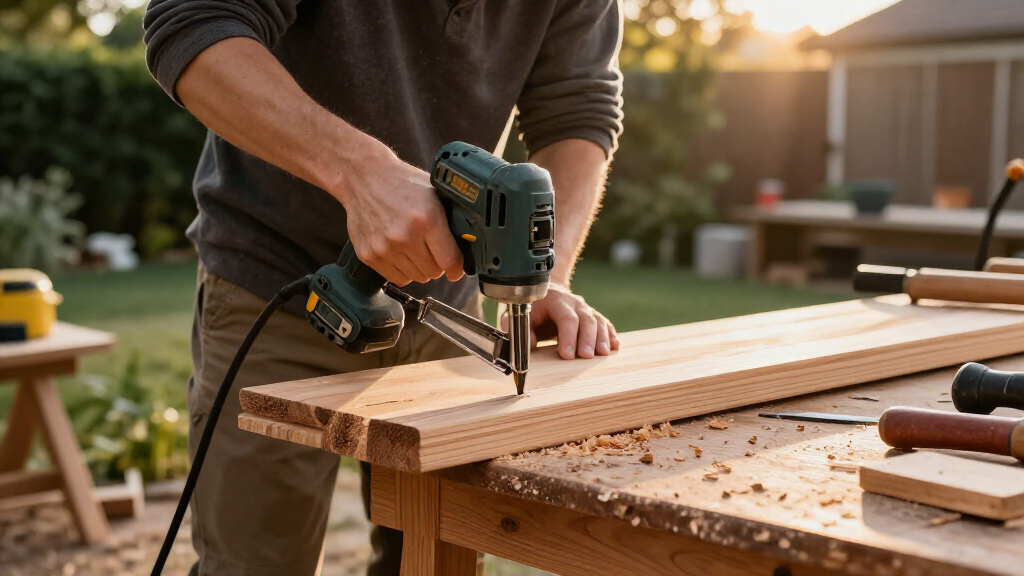
I ranked these tools around the decisions a finish-nailer buyer actually faces: gauge and nail format, battery-platform fit, useful controls, and the tradeoffs that follow from the listed specifications. A nailer that matches a buyer’s existing battery system may make more sense than one with an appealing feature list but an unfamiliar platform. I also distinguish 15-gauge from 16-gauge models rather than treating them as interchangeable: gauge affects the fastener and the kind of trim work a buyer may be planning.
For each pick, I weighed the stated nail range, firing modes, depth and jam adjustments, handling details, and any disclosed capacity information. I gave the Milwaukee credit for its listed up-to-700-nail figure only with the stated M18 CP2.0 battery, and the CRAFTSMAN for its up-to-375 figure, without assuming those numbers predict every job. Since all four are listed without a battery and charger, I treat platform ownership as a practical part of the decision. The ordering reflects fit and versatility for finish work, not a claim that one tool wins every application.
I did not infer missing details or treat inconsistent-looking specifications as verified performance. For example, the DEWALT DCN660B’s supplied weight and fastener-count entries are not enough to draw a reliable handling or capacity comparison, so I focus its assessment on the clearly stated 16-gauge angled format, nail length, platform, and controls. I also consider who should skip each option, because a useful roundup should show where a tool’s format or weight can become a mismatch.
| cordless finish nailer | Battery platform | Included | Nails per charge |
|---|---|---|---|
| DEWALT 20V MAX XR Cordless 15- | DEWALT 20V MAX Lithium-Ion | Tool only; battery not included | — |
| Milwaukee M18 FUEL 18V Brushle | Milwaukee M18 | — | Up to 700 with M18 CP2.0 battery |
| DEWALT 20V MAX 16-Gauge Angled | DEWALT 20V MAX | Tool only; battery and charger not included | — |
| CRAFTSMAN V20 16-Gauge Cordles | CRAFTSMAN V20 | Bare tool; battery and charger sold separately | Up to 375 |
Factors to Consider When Choosing Cordless Finish Nailers
Before picking a model, I would match the nailer to the actual trim, fasteners, and battery platform in the work plan. Cordless convenience is shared across all four; gauge, magazine angle, and platform are the differences that change the decision.
Choose gauge and nail format for the job
The DEWALT DCN650B is the only 15-gauge option here; the other three drive 16-gauge nails. Those are different fastener formats, so I would check the trim plan and required nails before choosing a tool. The supplied descriptions do not establish that one gauge replaces the other for every task. The DCN650B and DCN660B both use angled nails, while Milwaukee and CRAFTSMAN use straight nails. An angled format may suit particular working positions and access needs, but it also means buying the matching angled fasteners. Pick based on the nail type your work requires, not just a general preference for one magazine shape.
Check the nail-length range
The stated length ranges differ in a way that can rule a tool in or out. The DCN650B and DCN660B cover 1-1/4 to 2-1/2 inches; the Milwaukee covers 1 to 2-1/2 inches. The supplied CRAFTSMAN details do not provide a nail-length range, so I would confirm compatible fasteners before purchase. If a project calls for shorter nails than the DEWALT models list, Milwaukee has the broadest explicitly stated range here. For jobs involving longer nails, all three specified ranges reach 2-1/2 inches. I would still verify the nail collation and manufacturer compatibility requirements for the chosen tool.
Factor in battery-platform ownership
Every option is listed without a battery-and-charger set: DEWALT uses 20V MAX, Milwaukee uses M18, and CRAFTSMAN uses V20. If you already own compatible batteries, staying with that platform may make the tool-only package more practical. If you do not, compare the full setup you need, including battery and charger, rather than treating the bare tool as a complete working kit. Battery compatibility is brand- and platform-specific; the descriptions do not suggest that these systems interchange. This is a strong reason to choose the DCN650B or DCN660B together for a DEWALT owner, or to favor Milwaukee or CRAFTSMAN for an existing M18 or V20 setup.
Treat nails-per-charge figures as estimates
The Milwaukee listing states up to 700 nails per charge with an M18 CP2.0 battery, while CRAFTSMAN lists up to 375. These figures are useful for comparing the stated claims, but they should not be read as guaranteed job totals. Battery condition, nail size, material, and how the tool is used can affect output. The supplied descriptions do not give comparable capacity figures for the DEWALT nailers, so I would not assume they match either number. If minimizing battery changes matters, the Milwaukee has the strongest disclosed figure, provided the specified battery is part of the setup.
Weigh tool weight against overhead use
Weight matters most when a finish nailer is held overhead or repeatedly repositioned. The supplied figures are 6.6 pounds for the DCN650B, 7.48 pounds for the CRAFTSMAN, and 8.1 pounds for the Milwaukee. These values should be compared with care because the product descriptions do not establish that they were recorded under identical conditions. The DCN660B’s supplied 16-ounce entry is not a reliable basis for a direct handling comparison. I would focus on the clearest figures and, where possible, check how a compatible battery affects the complete tool’s weight. The lightest listed number is not the only comfort factor: grip shape, balance, and working position also matter.
Match controls to your pace and experience
The DEWALT models and Milwaukee disclose both sequential and contact actuation, letting buyers select a more deliberate trigger sequence or a faster repeated firing style. Tool-free depth adjustment appears across the supplied descriptions, and each model listing includes a way to deal with jams. The CRAFTSMAN description mentions tool-free depth and jam adjustments but does not specify firing modes, so I would not assume they are included. Buyers new to finish nailers may prefer deliberate placement while learning the tool and material; experienced users may value having a choice. Follow the tool’s instructions and use an appropriate firing mode for the work.
Decide which convenience features you will use
Small details can affect workflow. The DCN650B’s LED lights and diagnostics, the Milwaukee’s LED, reversible belt hook, and tip storage, and the CRAFTSMAN’s contoured handle and belt hook all serve different priorities. The DCN660B includes an adjustable belt hook and stall release. These features do not replace the basic format and platform decision, but they can help break a tie between tools that already suit the fasteners. For example, a buyer who often changes work positions may value belt-hook flexibility, while someone working in dim areas may give more weight to a work light.
Account for the whole job-site setup
All four models remove the need for a compressor, hose, and gas cartridge according to their supplied descriptions. That makes them convenient for moving between rooms and working without managing a pneumatic line. The tradeoff is that they still depend on compatible charged batteries, and the listed packages do not include a battery and charger. For a long installation, I would plan battery availability and a charging routine along with nail supply. Also note that the DCN650B is specifically listed as not water resistant; I would not assume any of these tools can be left in wet conditions without checking the maker’s care guidance.
Frequently Asked Questions
Which cordless finish nailer is the best overall pick here?
I rank the DEWALT DCN650B first for buyers who want 15-gauge angled nails, a 1-1/4-to-2-1/2-inch range, and both sequential and contact actuation. It has the broadest role in this particular comparison, but it is not a universal choice: buyers who need 16-gauge nails, straight nails, or a different battery platform should look at the other models.
What is the difference between the 15-gauge and 16-gauge options?
The DCN650B is the lineup’s 15-gauge nailer; the DCN660B, Milwaukee, and CRAFTSMAN are 16-gauge. They use different fastener formats, so I would choose according to the nails and finish work the job specifies. The listings do not establish that one gauge is suitable as a substitute for the other across all trim applications.
Are batteries and chargers included with these nailers?
No listed package includes a battery-and-charger set. The DEWALT models are tool-only, the Milwaukee listing is tool-only, and the CRAFTSMAN is a bare tool with battery and charger sold separately. I would check what compatible batteries I already own before choosing, since each model belongs to a different platform: DEWALT 20V MAX, Milwaukee M18, or CRAFTSMAN V20.
Which model has the highest stated nails-per-charge figure?
The Milwaukee 3020-20 is listed at up to 700 nails per charge when paired with an M18 CP2.0 battery. CRAFTSMAN lists up to 375 nails per charge. These are stated maximum figures, not guaranteed results for every job, and the supplied descriptions do not provide comparable figures for the two DEWALT models.
Should I choose an angled or straight finish nailer?
I would choose the format that matches the fasteners your job calls for and suits your access needs. The DEWALT DCN650B and DCN660B use angled nails; the Milwaukee and CRAFTSMAN use straight nails. Neither format is automatically the right choice for every buyer, and nail compatibility is not interchangeable just because the tools share a finish-nailer purpose.
Conclusion
For a buyer who wants the strongest all-around match among these four, I recommend the DEWALT DCN650B when 15-gauge angled nails and the DEWALT 20V MAX platform fit the job. If I were already using M18 batteries and wanted a straight 16-gauge tool with the highest listed nails-per-charge figure, I would choose the Milwaukee 3020-20, while keeping its 8.1-pound stated weight in mind. For an existing DEWALT owner who specifically wants angled 16-gauge nails, the DCN660B is the better fit than the DCN650B. A V20 owner who values a contoured grip and straightforward adjustments can favor the CRAFTSMAN CMCN616B, after confirming compatible nails and accepting its less detailed specifications. In every case, I would match the fastener format and battery platform first, then weigh handling and convenience features.